

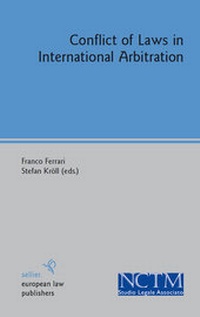
Conflict of Laws in International Arbitration
n.a.
1. Auflage
Erschienen am 11. November 2010
XIII, 466 Seiten
978-3-86653-929-7 (ISBN)
Beschreibung

Irrespective of the increasing harmonization of law at the transnational level, every arbitration raises a number of confl ict of laws problems relating to procedural questions as well as to issues concerning the merits of the case. Unlike a state court judge, the arbitrator has no "lex fori" in the proper sense providing the relevant confl ict rules to determine the applicable law. This raises the question of what confl ict of laws rules to apply and, consequently, of the extent of the freedom the arbitrator enjoys in dealing with this and related issues. The best example of the importance of confl ict of laws questions in arbitration is the Vivendi-Elektrim saga where the outcome of the various proceedings depended on the question of characterization.
This very beneficial book is dealing with
- the arbitration agreement,
- the jurisdiction of the arbitral tribunal,
- the law applicable to the merits and
- the arbitration procedure.
Weitere Details
Weitere Ausgaben
Andere Ausgaben
Franco Ferrari | Stefan Kröll
Conflict of Laws in International Arbitration
Buch
11/2010
1. Auflage
Sellier European Law Publishers
79,00 €
Keine Lieferinformation verfügbar
Inhalt
1 - Preface [Seite 6]
2 - List of Contributors [Seite 8]
3 - Contents [Seite 10]
4 - Abbreviations [Seite 12]
5 - I. Introduction [Seite 16]
5.1 - Conficts of law in international arbitration - an overview [Seite 18]
6 - II. Confict of Laws questions concerning the arbitration agreement and the jurisdiction of the tribunal [Seite 32]
6.1 - The law applicable to the validity of the arbitration agreement: A practitioner's view [Seite 34]
6.2 - Applicable laws under the New York Convention [Seite 78]
6.3 - Jurisdiction and applicable law in the case of so-called pathological arbitration clauses in view of the proposed reform of the Brussels I-Regulation [Seite 96]
6.4 - Arbitrability and confict of jurisdictions: The (diminishing) relevance of lex fori and lex loci arbitri [Seite 132]
6.5 - Extension of arbitration agreements to third parties: A never ending legal quest through the spatial-temporal continuum [Seite 152]
6.6 - The effect of overriding mandatory rules on the arbitration agreement [Seite 202]
6.7 - Arbitration and Insolvency - Selected confict of laws problems [Seite 226]
7 - III. Confict of Laws questions concerning the law applicable to the merits [Seite 270]
7.1 - Getting to the law applicable to the merits in international arbitration and the consequences of getting it wrong [Seite 272]
7.2 - Mandatory rules of law in international arbitration [Seite 340]
7.3 - Confict of overriding mandatory rules in arbitration [Seite 356]
7.4 - The law applicable to the assignment of claims subject to an arbitration agreement [Seite 394]
8 - IV. Confict of Laws questions concerning the arbitration procedure [Seite 422]
8.1 - The laws governing interim measures in international arbitration [Seite 424]
9 - Index [Seite 474]
2 - List of Contributors [Seite 8]
3 - Contents [Seite 10]
4 - Abbreviations [Seite 12]
5 - I. Introduction [Seite 16]
5.1 - Conficts of law in international arbitration - an overview [Seite 18]
6 - II. Confict of Laws questions concerning the arbitration agreement and the jurisdiction of the tribunal [Seite 32]
6.1 - The law applicable to the validity of the arbitration agreement: A practitioner's view [Seite 34]
6.2 - Applicable laws under the New York Convention [Seite 78]
6.3 - Jurisdiction and applicable law in the case of so-called pathological arbitration clauses in view of the proposed reform of the Brussels I-Regulation [Seite 96]
6.4 - Arbitrability and confict of jurisdictions: The (diminishing) relevance of lex fori and lex loci arbitri [Seite 132]
6.5 - Extension of arbitration agreements to third parties: A never ending legal quest through the spatial-temporal continuum [Seite 152]
6.6 - The effect of overriding mandatory rules on the arbitration agreement [Seite 202]
6.7 - Arbitration and Insolvency - Selected confict of laws problems [Seite 226]
7 - III. Confict of Laws questions concerning the law applicable to the merits [Seite 270]
7.1 - Getting to the law applicable to the merits in international arbitration and the consequences of getting it wrong [Seite 272]
7.2 - Mandatory rules of law in international arbitration [Seite 340]
7.3 - Confict of overriding mandatory rules in arbitration [Seite 356]
7.4 - The law applicable to the assignment of claims subject to an arbitration agreement [Seite 394]
8 - IV. Confict of Laws questions concerning the arbitration procedure [Seite 422]
8.1 - The laws governing interim measures in international arbitration [Seite 424]
9 - Index [Seite 474]
