

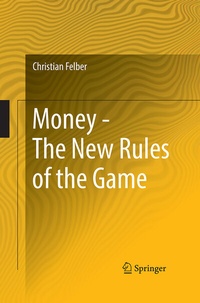
Money - The New Rules of the Game
Beschreibung

This book advocates a holistic reform of the current monetary and financial system dealing with the issues of money creation, central banks, loans, stock markets, tax justice, pension security and the international monetary system - "Bretton Woods II". Its innovative approach presents several alternatives for each cornerstone, in addition to introducing a participatory democratic process whereby sovereign citizens can themselves determine the rules governing the new financial and monetary system. With "democratic money conventions" in each municipality, where the elements of this new money system are discussed and decided on in a participatory manner, and a federal money covenant which then elaborates a template for a referendum about the future "money constitution", a true "sovereign" could progressively convert money from a financial weapon into a democratic tool.
The envisaged democratic monetary system, by providing equal opportunities for every member of society toparticipate in the development of the "new rules of the game", turns money progressively into a public good which increases the freedom for all.
The new system furthermore drives the enhancement of constitutional and relational values such as human dignity, solidarity, justice, sustainability, or democracy. Money should serve life and should serve the common good. The "Bank for the Common Good" Project, which was initiated in Austria by the author Christian Felber, represents a practical example of his proposals.
Weitere Details
Weitere Ausgaben
Andere Ausgaben
Personen
Christian Felber is an internationally renowned speaker, lecturer at the Vienna University of Economics and Business and a contemporary dancer. Christian has authored several bestsellers: "50 Suggestions for a fairer World", "New Values for the Economy", "Let's save the Euro!", "Change everything. Creating an Economy for the Common Good", and "Money. The new rules of the game", which was awarded the getAbstract International Book Award 2014. Christian is a regular collaborator of the Huffington Post. He is the initiator of the "Economy for the Common Good" and the project "B
ank for the Common Good". Felber was born in 1972, studied Spanish, Psychology, Sociology and Political Sciences in Madrid and Vienna, where he lives and works as an independent writer.Inhalt
Preface: Money and Democracy- an Overdue Wedding.- Introduction: A Coercitive and Intransparent Financial System.- Part I: The Process towards a New Monetary Order.- 1. Tamer Wanted: Who will Restrain the Global Monetary and Finance System?.- 2. Rewriting the Rules of the Game: The Democratic Monetary Convention.- 3. The Basis: Money as a Public Good.- Part II: The Content - Cornerstones of a Democratic Monetary System.- 1. Who Creates Money?.- 2. Sovereign Money Reform.- 3. Democratic Central Bank.- 4. Solving the Problem of Sovereign Debt.- 5. Bank Lending Regulations.- 6. Common Good Oriented Banks.- 7. EU and Global Financial Supervision.- 8. Derivatives - Close the Casino.- 9. Secure Pensions.- 10. Global Tax Cooperation.- 11. Income and Ownership Caps - "Negative Feedback".- 12. Currencies - Time for a Bretton Woods II.- Epilog I: Planned Economy in Peking und Zürich.- Epilog II: End of the Dollar Hegemony?.- Epilog III: Local and regional complementary currencies.- Part III:Kick Off.- 1. The Path to the First Convention.- 2. Questionnaire for the Convention.- Acknowledgements.- Index.
