

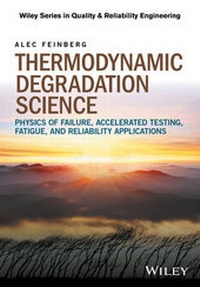
Thermodynamic Degradation Science
Beschreibung

Weitere Details
Weitere Ausgaben
Andere Ausgaben

Person
Inhalt
List of Figures xiii
List of Tables xvi
About the Author xvii
Preface xviii
1 Equilibrium Thermodynamic Degradation Science 1
1.1 Introduction to a New Science 1
1.2 Categorizing Physics of Failure Mechanisms 2
1.3 Entropy Damage Concept 3
1.3.1 The System (Device) and its Environment 4
1.3.2 Irreversible Thermodynamic Processes Cause Damage 5
1.4 Thermodynamic Work 6
1.5 Thermodynamic State Variables and their Characteristics 7
1.6 Thermodynamic Second Law in Terms of System Entropy Damage 9
1.6.1 Thermodynamic Entropy Damage Axiom 11
1.6.2 Entropy and Free Energy 13
1.7 Work, Resistance, Generated Entropy, and the Second Law 14
1.8 Thermodynamic Catastrophic and Parametric Failure 16
1.8.1 Equilibrium and Non-Equilibrium Aging States in Terms of the Free Energy or Entropy Change 16
1.9 Repair Entropy 17
1.9.1 Example 1.1: Repair Entropy: Relating Non-Damage Entropy Flow to Entropy Damage 17
Summary 18
References 22
2 Applications of Equilibrium Thermodynamic Degradation to Complex and Simple Systems: Entropy Damage, Vibration, Temperature, Noise Analysis, and Thermodynamic Potentials 23
2.1 Cumulative Entropy Damage Approach in Physics of Failure 23
2.1.1 Example 2.1: Miner's Rule Derivation 25
2.1.2 Example 2.2: Miner's Rule Example 26
2.1.3 Non-Cyclic Applications of Cumulative Damage 27
2.2 Measuring Entropy Damage Processes 27
2.3 Intermediate Thermodynamic Aging States and Sampling 29
2.4 Measures for System-Level Entropy Damage 29
2.4.1 Measuring System Entropy Damage with Temperature 29
2.4.2 Example 2.3: Resistor Aging 30
2.4.3 Example 2.4: Complex Resistor Bank 31
2.4.4 System Entropy Damage with Temperature Observations 32
2.4.5 Example 2.5: Temperature Aging of an Operating System 32
2.4.6 Comment on High-Temperature Aging for Operating and Non-Operating Systems 32
2.5 Measuring Randomness due to System Entropy Damage with Mesoscopic Noise Analysis in an Operating System 33
2.5.1 Example 2.6: Gaussian Noise Vibration Damage 35
2.5.2 Example 2.7: System Vibration Damage Observed with Noise Analysis 36
2.6 How System Entropy Damage Leads to Random Processes 37
2.6.1 Stationary versus Non-Stationary Entropy Process 40
2.7 Example 2.8: Human Heart Rate Noise Degradation 41
2.8 Entropy Damage Noise Assessment Using Autocorrelation and the Power Spectral Density 42
2.8.1 Noise Measurements Rules of Thumb for the PSD and R 43
2.8.2 Literature Review of Traditional Noise Measurement 44
2.8.3 Literature Review for Resistor Noise 48
2.9 Noise Detection Measurement System 48
2.9.1 System Noise Temperature 49
2.9.2 Environmental Noise Due to Pollution 50
2.9.3 Measuring System Entropy Damage using Failure Rate 50
2.10 Entropy Maximize Principle: Combined First and Second Law 51
2.10.1 Example 2.9: Thermal Equilibrium 52
2.10.2 Example 2.10: Equilibrium with Charge Exchange 53
2.10.3 Example 2.11: Diffusion Equilibrium 55
2.10.4 Example 2.12: Available Work 55
2.11 Thermodynamic Potentials and Energy States 57
2.11.1 The Helmholtz Free Energy 58
2.11.2 The Enthalpy Energy State 60
2.11.3 The Gibbs Free Energy 60
2.11.4 Summary of Common Thermodynamic State Energies 62
2.11.5 Example 2.13: Work, Entropy Damage, and Free Energy Change 62
2.11.6 Example 2.14: System in Contact with a Reservoir 65
Summary 68
References 76
3 NE Thermodynamic Degradation Science Assessment Using the Work Concept 77
3.1 Equilibrium versus Non-Equilibrium Aging Approach 77
3.1.1 Conjugate Work and Free Energy Approach to Understanding Non-Equilibrium Thermodynamic Degradation 78
3.2 Application to Cyclic Work and Cumulative Damage 79
3.3 Cyclic Work Process, Heat Engines, and the Carnot Cycle 81
3.4 Example 3.1: Cyclic Engine Damage Quantified Using Efficiency 84
3.5 The Thermodynamic Damage Ratio Method for Tracking Degradation 86
3.6 Acceleration Factors from the Damage Ratio Principle 87
Summary 89
References 92
4 Applications of NE Thermodynamic Degradation Science to Mechanical Systems: Accelerated Test and CAST Equations, Miner's Rule, and FDS 93
4.1 Thermodynamic Work Approach to Physics of Failure Problems 93
4.2 Example 4.1: Miner's Rule 93
4.2.1 Acceleration Factor Modification of Miner's Damage Rule 95
4.3 Assessing Thermodynamic Damage in Mechanical Systems 96
4.3.1 Example 4.2: Creep Cumulative Damage and Acceleration Factors 96
4.3.2 Example 4.3: Wear Cumulative Damage and Acceleration Factors 99
4.3.3 Example 4.4: Thermal Cycle Fatigue and Acceleration Factors 101
4.3.4 Example 4.5: Mechanical Cycle Vibration Fatigue and Acceleration Factors 102
4.3.5 Example 4.6: Cycles to Failure under a Resonance Condition: Q Effect 105
4.4 Cumulative Damage Accelerated Stress Test Goal: Environmental Profiling and Cumulative Accelerated Stress Test (CAST) Equations 107
4.5 Fatigue Damage Spectrum Analysis for Vibration Accelerated Testing 108
4.5.1 Fatigue Damage Spectrum for Sine Vibration Accelerated Testing 109
4.5.2 Fatigue Damage Spectrum for Random Vibration Accelerated Testing 110
Summary 111
References 117
5 Corrosion Applications in NE Thermodynamic Degradation 118
5.1 Corrosion Damage in Electrochemistry 118
5.1.1 Example 5.1: Miner's Rule for Secondary Batteries 119
5.2 Example 5.2: Chemical Corrosion Processes 121
5.2.1 Example 5.3: Numerical Example of Linear Corrosion 123
5.2.2 Example 5.4: Corrosion Rate Comparison of Different Metals 124
5.2.3 Thermal Arrhenius Activation and Peukert's Law 124
5.3 Corrosion Current in Primary Batteries 126
5.3.1 Equilibrium Thermodynamic Condition: Nernst Equation 127
5.4 Corrosion Rate in Microelectronics 128
5.4.1 Corrosion and Chemical Rate Processes Due to Temperature 129
Summary 130
References 133
6 Thermal Activation Free Energy Approach 134
6.1 Free Energy Roller Coaster 134
6.2 Thermally Activated Time-Dependent (TAT) Degradation Model 135
6.2.1 Arrhenius Aging Due to Small Parametric Change 136
6.3 Free Energy Use in Parametric Degradation and the Partition Function 138
6.4 Parametric Aging at End of Life Due to the Arrhenius Mechanism: Large Parametric Change 140
Summary 141
References 143
7 TAT Model Applications: Wear, Creep, and Transistor Aging 144
7.1 Solving Physics of Failure Problems with the TAT Model 144
7.2 Example 7.1: Activation Wear 144
7.3 Example 7.2: Activation Creep Model 146
7.4 Transistor Aging 148
7.4.1 Bipolar Transistor Beta Aging Mechanism 148
7.4.2 Capacitor Leakage Model for Base Leakage Current 149
7.4.3 Thermally Activated Time-Dependent Model for Transistors and Dielectric Leakage 150
7.4.4 Field-Effect Transistor Parameter Degradation 152
Summary 154
References 156
8 Diffusion 157
8.1 The Diffusion Process 157
8.2 Example 8.1: Describing Diffusion Using Equilibrium Thermodynamics 157
8.3 Describing Diffusion Using Probability 159
8.4 Diffusion Acceleration Factor with and without Temperature Dependence 161
8.5 Diffusion Entropy Damage 161
8.5.1 Example 8.2: Package Moisture Diffusion 162
8.6 General Form of the Diffusion Equation 163
Summary 164
Reference 166
9 How Aging Laws Influence Parametric and Catastrophic Reliability Distributions 167
9.1 Physics of Failure Influence on Reliability Distributions 167
9.2 Log Time Aging (or Power Aging Laws) and the Lognormal Distribution 168
9.3 Aging Power Laws and the Weibull Distribution: Influence on Beta 171
9.4 Stress and Life Distributions 175
9.4.1 Example 9.1: Cumulative Distribution Function as a Function of Stress 176
9.5 Time- (or Stress-) Dependent Standard Deviation 177
Summary 178
References 180
10 The Theory of Organization: Final Thoughts 181
Special Topics A: Key Reliability Statistics 183
A.1 Introduction 183
A.1.1 Reliability and Accelerated Testing Software to Aid the Reader 183
A.2 The Key Reliability Functions 184
A.3 More Information on the Failure Rate 186
A.4 The Bathtub Curve and Reliability Distributions 187
A.4.1 Exponential Distribution 188
A.4.2 Weibull Distribution 190
A.4.3 Normal (Gaussian) Distribution 191
A.4.4 The Lognormal Reliability Function 194
A.5 Confidence Interval for Normal Parametric Analysis 195
A.5.1 Example A.4: Power Amplifier Confidence Interval 196
A.6 Central Limit Theorem and Cpk Analysis 197
A.6.1 Cpk Analysis 197
A.6.2 Example A.5: Cpk and Yield for the Power Amplifiers 197
A.7 Catastrophic Analysis 199
A.7.1 Censored Data 199
A.7.2 Example A.6: Weibull and Lognormal Analysis of Semiconductors 199
A.7.3 Example A.7: Mixed Modal Analysis Inflection Point Method 201
A.8 Reliability Objectives and Confidence Testing 203
A.8.1 Chi-Squared Confidence Test Planning for Few Failures: The Exponential Case 204
A.8.2 Example A.8: Chi-Squared Accelerated Test Plan 205
A.9 Comprehensive Accelerated Test Planning 205
References 206
Special Topics B: Applications to Accelerated Testing 207
B.1 Introduction 207
B.1.1 Reliability and Accelerated Testing Software to Aid the Reader 208
B.1.2 Using the Arrhenius Acceleration Model for Temperature 209
B.1.3 Example B.2: Estimating the Activation Energy 211
B.1.4 Example B.3: Estimating Mean Time to Failure from Life Test 212
B.2 Power Law Acceleration Factors 212
B.2.1 Example B.4: Generalized Power Law Acceleration Factors 214
B.3 Temperature-Humidity Life Test Model 214
B.3.1 Temperature-Humidity Bias and Local Relative Humidity 215
B.4 Temperature Cycle Testing 216
B.4.1 Example B.6: Using the Temperature Cycle Model 217
B.5 Vibration Acceleration 217
B.5.1 Example B.7: Accelerated Testing Using Sine and Random Vibration 220
B.6 Multiple-Stress Accelerated Test Plans for Demonstrating Reliability 220
B.6.1 Example B.8: Designing Multi-Accelerated Tests Plans: Failure-Free 221
B.7 Cumulative Accelerated Stress Test (CAST) Goals and Equations Usage in Environmental Profiling 222
B.7.1 Example B.9: Cumulative Accelerated Stress Test (CAST) Goals and Equation in Environmental Profiling 222
References 223
Special Topics C: Negative Entropy and the Perfect Human Engine 224
C.1 Spontaneous Negative Entropy: Growth and Repair 224
C.2 The Perfect Human Engine: How to Live Longer 225
C.2.1 Differences and Similarities of the Human Engine to Other Systems 226
C.2.2 Knowledge of Cyclic Work to Improve Our Chances of a Longer Life 226
C.2.3 Example C.1: Exercise and the Human Heart Life Cycle 228
C.3 Growth and Self-Repair Part of the Human Engine 229
C.3.1 Example C.2: Work for Human Repair 230
C.4 Act of Spontaneous Negative Entropy 231
C.4.1 Repair Aging Rate: An RC Electrical Model 232
References 233
Overview of New Terms, Equations, and Concepts 234
Index 236
List of Figures
Figure 1.1 Conceptualized aging rates for physics-of-failure mechanisms Figure 1.2 First law energy flow to system: (a) heat-in, work-out; and (b) heat-in and work-in Figure 1.3 Fatigue S-N curve of cycles to failure versus stress, illustrating a fatigue limit in steel and no apparent limit in aluminum Figure 1.4 Elastic stress limit and yielding point 1 Figure 2.1 The entropy change of an isolated system is the sum of the entropy changes of its components, and is never less than zero Figure 2.2 Cell fatigue dislocations and cumulating entropy Figure 2.3 Gaussian white noise Figure 2.4 Noise limit heart rate variability measurements of young, elderly, and CHF patients [10] Figure 2.5 Noise limit heart rate variability chaos measurements of young and CHF patients [10] Figure 2.6 Graphical representation of the autocorrelation function Figure 2.7 (a) Sine waves at 10 and 15 Hz with some randomness in frequency; and (b) Fourier transform spectrum. In (b) we cannot transform back without knowledge of which sine tone occurred first Figure 2.8 (a) White noise time series; (b) normalized autocorrelation function of white noise; and (c) PSD spectrum of white noise Figure 2.9 (a) Flicker (pink) 1/f noise; (b) normalized autocorrelation function of 1/f noise; and (c) PSD spectrum of 1/f noise Figure 2.10 (a) Brown 1/f 2 noise; (b) normalized autocorrelation function of 1/f 2 noise; and (c) PSD spectrum of 1/f 2 noise Figure 2.11 Some key types of white, pink, and brown noise that might be observed from a system Figure 2.12 1/f noise simulations for resistor noise. Note the lower noise for larger resistors (power of 2) and higher noise for smaller resistors (power of 1.5) Figure 2.13 Autocorrelation noise measurement detection system Figure 2.14 Insulating cylinder divided into two sections by a frictionless piston Figure 2.15 System (capacitor) and environment (battery) circuit Figure 2.16 The system expands against the atmosphere Figure 2.17 Mechanical work done on a system Figure 2.18 Loss of available work due to increase in entropy damage Figure 2.19 A simple system in contact with a heat reservoir Figure 2.20 A system's free energy decrease over time and the corresponding total entropy increase Figure 3.1 Conceptual view of cyclic cumulative damage Figure 3.2 Cyclic work plane Figure 3.3 Carnot cycle in P, V plane Figure 3.4 Cyclic engine damage Area 1 > Area 2 Figure 4.1 Creep strain over time for different stresses where s4 > s3 > s2 > s1 Figure 4.2 Example of creep of a wire due to a stress weight Figure 4.3 Wear occurring to a sliding block having weight PW Figure 4.4 Graphical example of a sine test resonance Figure 5.1 Lead acid and alkaline MnO2 batteries fitted data Figure 5.2 A simple corrosion cell with iron corrosion Figure 5.3 Uniform electrochemical corrosion depicted on the surface of a metal Figure 6.1 Arrhenius activation free energy path having a relative minimum as a function of generalized parameter a Figure 6.2 Examples of ln(1 + B time) aging law, with upper graph similar to primary and secondary creep stages and the lower graph similar to primary battery voltage loss Figure 6.3 Log time compared to power law aging models Figure 6.4 (a) Continuous function with numerous energy states. (b) Relative minimum energy states having different degradation mechanisms Figure 6.5 Aging with critical values tc prior to catastrophic failure Figure 7.1 Types of wear dependence on sliding distance (time) Figure 7.2 Capacitor leakage model Figure 7.3 Beta degradation on life test data Figure 7.4 Life test data of gate-source MESFET leakage current over time fitted to the ln(1 + Bt) aging model. Junction rise was about 30°C Figure 8.1 System with n particles and nenv environment particles Figure 8.2 Diffusion concept Figure 9.1 Reliability bathtub curve model Figure 9.2 Power law fit to the wear-out portion of the bathtub curve Figure 9.3 Log time aging with parametric threshold tf Figure 9.4 PDF failure portion that drifted past the parametric threshold Figure 9.5 Creep curve with all three stages Figure 9.6 Creep rate power law model for each creep stage, similar to the bathtub curve in Figure 9.1 Figure 9.7 Creep strain over time for different stresses where s4 > s3 > s2 > s1 Figure 9.8 Crystal frequency drift showing time-dependent standard deviation Figure A.1 Reliability bathtub curve model Figure A.2 Demonstrating the power law on the wear-out shape Figure A.3 Modeling the bathtub curve with the Weibull power law Figure A.4 Weibull hazard (failure) rate for different values of ß [1] Figure A.5 Weibull shapes of PDF and CDF with ß = 2 [1] Figure A.6 Weibull shapes of PDF and CDF with ß = 0.5 [1] Figure A.7 Normal distribution shapes of PDF and CDF; µ = 5, s = 1 [1] Figure A.8 Lognormal hazard (failure) rate for different s values [1] Figure A.9 Lognormal CDF and PDF for different s values [1] Figure A.10 Cpk analysis Figure A.11 Life test: (a) Weibull analysis compared to (b) lognormal analysis test at 200°C [1] Figure A.12 Field data (Table A.4) displaying inflection point as sub and main populations [1] Figure A.13 Separating out the lower and upper distributions by the inflection point method [1] Figure B.1 Main accelerated stresses and associated common failure issues Figure B.2 Common accelerated qualification test plan used in industry [1] Figure B.3 Arrhenius plot of data given in Table B.1 Figure B.4 MTTF stress plot of data given in Table B.2 Figure B.5 Sine vibration amplitude over time example Figure B.6 Random vibration amplitude time series example Figure B.7 PSD of the random vibration time series in Figure B.6 Figure C.1 S-N curve for human heart compared to metal N fatigue cycle life versus...
