

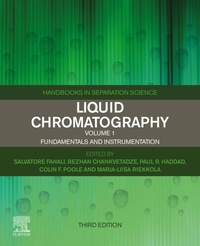
Liquid Chromatography
Fundamentals and Instrumentation
3. Auflage
Erschienen am 20. April 2023
884 Seiten
978-0-323-99999-1 (ISBN)
Beschreibung

Liquid Chromatography: Fundamentals and Instrumentation, Third Edition offers a single source of authoritative information on all aspects of the practice of modern liquid chromatography. The book gives those working in academia and industry the opportunity to learn, refresh, and deepen their understanding of the field by covering basic and advanced theoretical concepts, recognition mechanisms, conventional and advanced instrumentation, method development, data analysis, and more. This third edition addresses new developments in the field with updated chapters from expert researchers. The book is a valuable reference for research scientists, teachers, university students, industry professionals in research and development, and quality control managers.
- Emphasizes the integration of chromatographic methods and sample preparation
- Provides important data related to complex matrices, sample preparation, and data handling
- Gives background information to facilitate the choice of LC sub-technique and experimental conditions, mobile and stationary phases, detectors, data processing, and more
- Offers comprehensive updates to all chapters
- Includes new chapters on chiral recognition, co-solvents and mobile phase additives, physicochemical measurements, and identification and quantitation in mass spectrometry
Weitere Details
Weitere Ausgaben
Andere Ausgaben
Salvatore Fanali | Bezhan Chankvetadze | Paul R. Haddad
Liquid Chromatography
Fundamentals and Instrumentation
Buch
04/2023
3. Auflage
Elsevier
193,50 €
Versand in 15-20 Tagen
Vorauflage
Salvatore Fanali | Paul R. Haddad | Colin Poole
Liquid Chromatography
Fundamentals and Instrumentation
E-Book
06/2017
2. Auflage
Elsevier
180,00 €
Als Download verfügbar
Inhalt
1. Milestones in the development of liquid chromatography2. Kinetic theories of liquid chromatography3. Column technology in liquid chromatography4. General instrumentation in HPLC5. Liquid-solid chromatography6. Reversed-phase liquid chromatography7. Secondary chemical equilibria in reversed-phase liquid chromatography8. Ultra-high performance and Ultrafast liquid chromatography9. Nano-liquid chromatography10. Hydrophilic interaction liquid chromatography11. Mobile phase selection in liquid chromatography12. Co-solvents and mobile phase additives (new chapter)13. Method development in liquid chromatography 14. Physicochemical measurements15. Theory and practice of gradient elution liquid chromatography16. Fundamentals of Enantioselective LC (Chiral recognition mechanisms)17. Hydrophobic interaction chromatography18. Ion chromatography19. Size-exclusion chromatography20. Interaction polymer chromatography21. Affinity chromatography22. Multidimensional Liquid Chromatography23. Process concepts in preparative chromatography24. Modeling of preparative liquid chromatography25. Capillary electrochromatography26. Liquid Chromatography on microchip27. Mass spectrometric detection, instrumentation and ionization methods28. Identification and quantitation in Mass Spectrometry29. Advanced IR and Raman detectors for identification and quantification30. Advanced spectroscopic detectors for identification and quantification: Nuclear magnetic resonance31. Prediction of retention in Liquid Chromatography32. Validation of liquid chromatographic methods - chemometrics and calibration
