

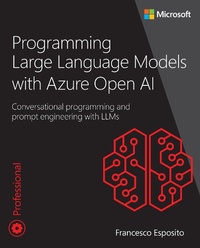
Programming Large Language Models with Azure Open AI
Conversational programming and prompt engineering with LLMs
Erschienen am 11. Juni 2024
256 Seiten
978-0-13-828045-1 (ISBN)
Beschreibung
Use LLMs to build better business software applications
Autonomously communicate with users and optimize business tasks with applications built to make the interaction between humans and computers smooth and natural. Artificial Intelligence expert Francesco Esposito illustrates several scenarios for which a LLM is effective: crafting sophisticated business solutions, shortening the gap between humans and software-equipped machines, and building powerful reasoning engines. Insight into prompting and conversational programming-with specific techniques for patterns and frameworks-unlock how natural language can also lead to a new, advanced approach to coding. Concrete end-to-end demonstrations (featuring Python and ASP.NET Core) showcase versatile patterns of interaction between existing processes, APIs, data, and human input.
Artificial Intelligence expert Francesco Esposito helps you:
Understand the history of large language models and conversational programming
Apply prompting as a new way of coding
Learn core prompting techniques and fundamental use-cases
Engineer advanced prompts, including connecting LLMs to data and function calling to build reasoning engines
Use natural language in code to define workflows and orchestrate existing APIs
Master external LLM frameworks
Evaluate responsible AI security, privacy, and accuracy concerns
Explore the AI regulatory landscape
Build and implement a personal assistant
Apply a retrieval augmented generation (RAG) pattern to formulate responses based on a knowledge base
Construct a conversational user interface
For IT Professionals and Consultants
For software professionals, architects, lead developers, programmers, and Machine Learning enthusiasts
For anyone else interested in natural language processing or real-world
applications of human-like language in software
Autonomously communicate with users and optimize business tasks with applications built to make the interaction between humans and computers smooth and natural. Artificial Intelligence expert Francesco Esposito illustrates several scenarios for which a LLM is effective: crafting sophisticated business solutions, shortening the gap between humans and software-equipped machines, and building powerful reasoning engines. Insight into prompting and conversational programming-with specific techniques for patterns and frameworks-unlock how natural language can also lead to a new, advanced approach to coding. Concrete end-to-end demonstrations (featuring Python and ASP.NET Core) showcase versatile patterns of interaction between existing processes, APIs, data, and human input.
Artificial Intelligence expert Francesco Esposito helps you:
Understand the history of large language models and conversational programming
Apply prompting as a new way of coding
Learn core prompting techniques and fundamental use-cases
Engineer advanced prompts, including connecting LLMs to data and function calling to build reasoning engines
Use natural language in code to define workflows and orchestrate existing APIs
Master external LLM frameworks
Evaluate responsible AI security, privacy, and accuracy concerns
Explore the AI regulatory landscape
Build and implement a personal assistant
Apply a retrieval augmented generation (RAG) pattern to formulate responses based on a knowledge base
Construct a conversational user interface
For IT Professionals and Consultants
For software professionals, architects, lead developers, programmers, and Machine Learning enthusiasts
For anyone else interested in natural language processing or real-world
applications of human-like language in software
Weitere Details
Reihe
Sprache
Englisch
Verlagsort
Boston
USA
Verlagsgruppe
Pearson Education (US)
Zielgruppe
Für Beruf und Forschung
Dateigröße
27,00 MB
ISBN-13
978-0-13-828045-1 (9780138280451)
Copyright in bibliographic data and cover images is held by Nielsen Book Services Limited or by the publishers or by their respective licensors: all rights reserved.
Schweitzer Klassifikation
Weitere Ausgaben
Person
Francesco Esposito, armed with a strong mathematical background, is the author of two Microsoft Press books on Machine Learning. He is currently the Head of Engineering & Data at Crionet, a company that provides innovative solutions for Sports and Media industries. He also founded Youbiquitous, a data analysis and software factory that works on LLMs, and KBMS Data Force, a startup focused on Digital Therapy and intelligent healthcare.
Inhalt
CHAPTER 1 The genesis and an analysis of large language models
CHAPTER 2 Core prompt learning techniques
CHAPTER 3 Engineering advanced learning prompts
CHAPTER 4 Mastering language frameworks
CHAPTER 5 Security, privacy, and accuracy concerns
CHAPTER 6 Building a personal assistant
CHAPTER 7 Chat with your data
CHAPTER 8 Conversational UI
Appendix: Inner functioning of LLMs
CHAPTER 2 Core prompt learning techniques
CHAPTER 3 Engineering advanced learning prompts
CHAPTER 4 Mastering language frameworks
CHAPTER 5 Security, privacy, and accuracy concerns
CHAPTER 6 Building a personal assistant
CHAPTER 7 Chat with your data
CHAPTER 8 Conversational UI
Appendix: Inner functioning of LLMs
