
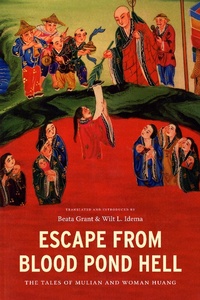
Escape from Blood Pond Hell
Beschreibung
These translations of The Precious Scroll of the Three Lives of Mulian and Woman Huang Recites the Diamond Sutra are late-nineteenth-century examples of baojuan (literally, "precious scrolls"), a Chinese folk genre featuring alternating verse and prose that was used by monks to illustrate religious precepts for lay listeners. They represent only two of numerous versions, composed in a variety of genres, of these legends, which were once popular all over China. While the seeds of the Mulian legend, in which a man rescues his mother from hell, can be found in Indian Buddhist texts, the story of Woman Huang, who seeks her own salvation, appears to be indigenous to China.
With their graphic portrayals of the underworld; dramatization of Buddhist beliefs about death, salvation, and rebirth; and frank discussion of women's responsibility for sin, these texts provide detailed and powerful descriptions of popular religious beliefs and practices in late imperial China, especially as they relate to women.
Alle Preise
Weitere Details
Weitere Ausgaben
Personen
Beata Grant is professor of Chinese language and literature at Washington University, and author of Eminent Nuns: Woman Chan Masters of Seventeenth-Century China and coauthor of The Red Brush: Writing Women of Imperial China. Wilt L. Idema is professor of Chinese literature at Harvard University. His recent publications include Meng Jiangnü Brings Down the Great Wall: Ten Versions of a Chinese Legend and Heroines of Jiangyong: Chinese Narrative Ballads in Women's Script.
Inhalt
Acknowledgments
Note on the Translations
Introduction
The Precious Scroll of the Three Lives of Mulian
Woman Huang Recites the Diamond Sutra
Notes
Glossary of Chinese Characters
Selected Bibliography

Systemvoraussetzungen
Dateiformat: PDF
Kopierschutz: Adobe-DRM (Digital Rights Management)
Systemvoraussetzungen:
- Computer (Windows; MacOS X; Linux): Installieren Sie bereits vor dem Download die kostenlose Software Adobe Digital Editions (siehe E-Book Hilfe).
- Tablet/Smartphone (Android; iOS): Installieren Sie bereits vor dem Download die kostenlose App Adobe Digital Editions oder die App PocketBook (siehe E-Book Hilfe).
- E-Book-Reader: Bookeen, Kobo, Pocketbook, Sony, Tolino u.v.a.m. (nicht Kindle)
Das Dateiformat PDF zeigt auf jeder Hardware eine Buchseite stets identisch an. Daher ist eine PDF auch für ein komplexes Layout geeignet, wie es bei Lehr- und Fachbüchern verwendet wird (Bilder, Tabellen, Spalten, Fußnoten). Bei kleinen Displays von E-Readern oder Smartphones sind PDF leider eher nervig, weil zu viel Scrollen notwendig ist.
Mit Adobe-DRM wird hier ein „harter” Kopierschutz verwendet. Wenn die notwendigen Voraussetzungen nicht vorliegen, können Sie das E-Book leider nicht öffnen. Daher müssen Sie bereits vor dem Download Ihre Lese-Hardware vorbereiten.
Bitte beachten Sie: Wir empfehlen Ihnen unbedingt nach Installation der Lese-Software diese mit Ihrer persönlichen Adobe-ID zu autorisieren!
Weitere Informationen finden Sie in unserer E-Book Hilfe.
Dateiformat: PDF
Kopierschutz: ohne DRM (Digital Rights Management)
Systemvoraussetzungen:
- Computer (Windows; MacOS X; Linux): Verwenden Sie zum Lesen die kostenlose Software Adobe Reader, Adobe Digital Editions oder einen anderen PDF-Viewer Ihrer Wahl (siehe E-Book Hilfe).
- Tablet/Smartphone (Android; iOS): Installieren Sie bereits vor dem Download die kostenlose App Adobe Digital Editions oder die App PocketBook (siehe E-Book Hilfe).
- E-Book-Reader: Bookeen, Kobo, Pocketbook, Sony, Tolino u.v.a.m.
Das Dateiformat PDF zeigt auf jeder Hardware eine Buchseite stets identisch an. Daher ist eine PDF auch für ein komplexes Layout geeignet, wie es bei Lehr- und Fachbüchern verwendet wird (Bilder, Tabellen, Spalten, Fußnoten). Bei kleinen Displays von E-Readern oder Smartphones sind PDF leider eher nervig, weil zu viel Scrollen notwendig ist.
Ein Kopierschutz bzw. Digital Rights Management wird bei diesem E-Book nicht eingesetzt.
Weitere Informationen finden Sie in unserer E-Book Hilfe.