

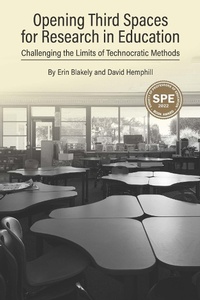
Opening Third Spaces for Research in Education
Challenging the Limits of Technocratic Methods
Erschienen am 9. Juni 2021
175 Seiten
978-1-9755-0476-2 (ISBN)
Beschreibung

A 2022 SPE Outstanding Book Award WinnerOpening Third Spaces for Research in Education challenges dominant educational research methods. It rejects the reductive binaries normalized in social science research-theory/practice, objective/subjective, quantitative/qualitative. Drawing from multiple fields and eras, the book opens third spaces between these artificial poles to help researchers expand interpretations and possibilities for research. Critiquing the current focus on the measurement of "e;student learning outcomes"e; and high-stakes assessment, the book offers conceptual tools and case examples to support educators in reconceptualizing research. The book critiques the modernist notion that learning is an individual mental process of acquiring knowledge or skills. It argues instead that learning is inextricably entangled with social relations and cannot be isolated or controlled no matter how scientifically rigorous researchers try to be in their study designs. This challenges the current goal of educational research instruction to design "e;valid and reliable"e; studies that provide evidence for "e;best practices,"e; and reimagines it as opening third spaces to expand opportunities and approaches for inquiry.Perfect for courses such as: Foundations of Social and Cultural Analysis of Education | Agency, Resistance, and Identity in Education | Critical and Postmodern Pedagogies | Culture, Cognition, and Power Issues in Education | Modernity and Postmodernity in Social Thought and Education | Integrating Research and Practice in Social Justice Education | Cultural Studies in Education | Science, Technology, and Social Research after Eurocentrism | Critical Pedagogy | Language, Performance, and Power | Sociology of Education | Ideology, Racial Politics, and Public Policy: Sociology of Knowledge | Seminar in Cross National Studies of Educational Problems | Participatory Action Research and Programming
Weitere Details
Weitere Ausgaben
Andere Ausgaben
Erin Blakely | David Hemphill
Opening Third Spaces for Research in Education
Challenging the Limits of Technocratic Methods
Buch
04/2021
Myers Education Press
147,50 €
Artikel z.Zt. nicht lieferbar
Inhalt
- Cover
- Half-Title
- Title
- Copyright
- Contents
- Dedication
- Introduction
- Chapter One: Examining Scientism in Educational Research
- 1.1 Technocratic research and the commodification of knowledge
- 1.2 The dominance of positivism and behaviorism
- 1.3 Scientific paradigm shifts as social consensus
- 1.4 Phenomenology of the social world
- Chapter Two: Challenging Binary Logic
- 2.1 Postmodern perspectives
- 2.2 Histories of dialectical thinking
- 2.3 Pragmatism
- 2.4 Agential realism
- Chapter Three: Critiquing Standard Research Methods
- 3.1 The false binary of quantitative/qualitative research
- 3.2 Rethinking "researchable" questions and variables
- 3.3 Instrumentation and problems with validity and reliability
- 3.4 Institutional review boards and the cursory administrative determination of ethical practices
- 3.5 Research reporting conventions and constraints on research possibilities
- Chapter Four: Reconceptualizing Learning in Educational Research
- 4.1 Problems with specifying learning outcomes and the myth of transfer
- 4.2 Learning as legitimate peripheral participation
- 4.3 Learning as identity formation
- 4.4 Learning as episodic, discontinuous, and nonlinear
- Chapter Five: Expanding Third Spaces for Research
- 5.1 Cycles of inquiry, lesson study, and archaeologies of knowledge
- 5.2 Multivocal narratives as third spaces
- 5.3 Crossing contexts and moving into borderlands
- 5.4 Supporting democracy and imagination in research forums
- 5.5 Research as an entangled material-discursive practice
- Conclusions
- Author Biographies
- Index
