

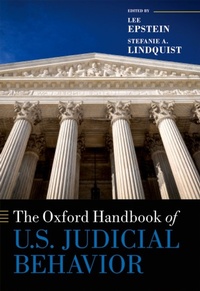
The Oxford Handbook of U.S. Judicial Behavior
1. Auflage
Erschienen am 8. Juni 2017
592 Seiten
978-0-19-150535-5 (ISBN)
Beschreibung
The Oxford Handbook of U.S. Judicial Behavior offers readers a comprehensive introduction and analysis of research regarding decision making by judges serving on federal and state courts in the U.S. Featuring contributions from leading scholars in the field, the Handbook describes and explains how the courts' political and social context, formal institutional structures, and informal norms affect judicial decision making. The Handbook also explores the impact of judges' personal attributes and preferences, as well as prevailing legal doctrine, influence, and shape case outcomes in state and federal courts. The volume also proposes avenues for future research in the various topics addressed throughout the book.
Consultant Editor for The Oxford Handbooks of American Politics: George C. Edwards III.
Weitere Details
Weitere Ausgaben
Personen
Lee Epstein is the Ethan A.H. Shepley Distinguished University Professor at Washington University in St. Louis. She is also a Fellow of the American Academy of Arts and Sciences and of the American Academy of Political and Social Science. Professor Epstein's research and teaching centres on law and legal institutions, especially the behaviour of judges. She has received 12 grants from the National Science Foundation and is the author or co-author of over 100 articles and essays and 17 books, most recently, The Behavior of Federal Judges (with William M. Landes and Richard A. Posner) and An Introduction to Empirical Legal Research (with Andrew D. Martin). The New York Times and other news media frequently cite her work on the U.S. Supreme Court.
Stefanie A. Lindquist serves as Deputy Provost and Vice President of Academic Affairs, and Foundation Professor of Law and Political Science, at Arizona State University. Her research and teaching falls at the intersection of law and politics. Her previous publications include Measuring Judicial Activism (with Frank Cross, 2009).
Inhalt
- Part I: Staffing the Court
- 1: Nancy Scherer: Appointing Federal Judges
- 2: Christine L. Nemacheck: Appointing Supreme Court Justices
- 3: James L. Gibson and Michael J. Nelson: Judicial Elections: Judges and Their 'New-Style' Constituencies
- 4: Albert Yoon: Federal Judicial Tenure
- 5: Artemus Ward: Law Clerks
- Part II: The Litigation Process and Appellate Review
- 6: Christina L. Boyd: Gatekeeping and Filtering in Trial Courts
- 7: Donald R. Songer and Susan B. Haire: Access to Intermediate Appellate Courts
- 8: Ryan J. Owens and James Sieja: Agenda-Setting on the United States Supreme Court
- 9: Timothy R. Johnson: Courtroom Proceedings in U.S. Federal Courts
- Part III: Judicial Decision-Making and Opinion Content
- 10: Pamela C. Corley: Opinion Writing
- 11: Thomas G. Hansford: Vertical Stare Decisis
- 12: David Klein: Law in Judicial Decision Making
- 13: Chad L. Westerland: The Strategic Analysis of Judicial Behavior and the Separation of Powers
- 14: Tom Clark: Judicial Review
- 15: Tracey E. George and Taylor Grace Weaver: The Role of Personal Attributes and Social Backgrounds on Judging
- 16: Justine D'Elia-Kueper and Jeffrey A. Segal: Ideology and Partisanship
- 17: Lee Epstein and Jack Knight: The Economic Analysis of Judicial Behavior
- Part IV: Judges and their Publics
- 18: Lawrence Baum: Judges and Their Audiences
- 19: Jared Perkins and Paul M. Collins, Jr.: Interest Groups and the Judiciary
- 20: Thomas M. Keck: The Relationship between Courts and Legislatures
- 21: Jeffrey L. Yates and Scott Boddery: Courts and Executives
- 22: Rorie Solberg: Covering the Courts
- 23: Joseph Daniel Ura and Alison Higgins: The Supreme Court and Public Opinion
- 24: Matthew E.K. Hall: Judicial Impact
- Part V: Methods and Approaches to Studying the Courts
- 25: Eileen Braman: Cognition in the Courts: Analyzing the Use of Experiments to Study Legal Decision-Making
- 26: Daniel E. Ho and Michael Morse: New Measurement Technologies: A Review and Application to Nuremberg and Justice Jackson
- 27: Sara C. Benesh: The Use of Observational Data to Study Law and the Judiciary
