

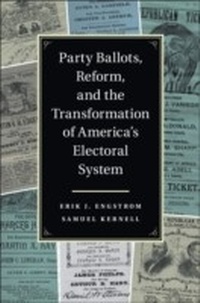
Party Ballots, Reform, and the Transformation of America's Electoral System
1. Auflage
Erschienen am 14. Oktober 2014
978-1-316-16442-6 (ISBN)
Beschreibung

This book explores the fascinating and puzzling world of nineteenth- and early twentieth-century American elections. It examines the strategic behavior of nineteenth-century party politicians and shows how their search for electoral victory led them to invent a number of remarkable campaign practices. Why were parties dedicated to massive voter mobilization? Why did presidential nominees wage front-porch campaigns? Why did officeholders across the country tie their electoral fortunes to the popularity of presidential candidates at the top of the ticket? Erik J. Engstrom and Samuel Kernell demonstrate that the defining features of nineteenth-century electoral politics were the product of institutions in the states that prescribed how votes were cast and how those votes were converted into political offices. Relying on a century's worth of original data, this book uncovers the forces propelling the nineteenth-century electoral system, its transformation at the end of the nineteenth century, and the implications of that transformation for modern American politics.
Rezensionen / Stimmen
'For many years to come, I expect this will be an important source of information on election law, the impact of ballot design on the 'coordination' of party control of offices, and hypotheses concerning structural manipulation of voter behavior. The analysis is carefully and skilfully executed, the findings are convincing, and the implications are well drawn.' Richard Bensel, Cornell University, New York 'In this book, Engstrom and Kernell give us a cogently theorized account, based on the most comprehensive data, of the dramatic transformations of American electoral politics over the nineteenth and early twentieth centuries. This is both a landmark study and an invaluable reference source.' Gary W. Cox, Stanford University, California 'This is a landmark book. Engstrom and Kernell draw on a rich dataset of elections to offer a bracing account of the origins of divided government. The nineteenth century, they show, was characterized by party-centered voting, with the fortunes of officeholders in every town and hamlet connected to the popularity of the president or governor. That party system ended unexpectedly with Progressive-era reforms, as ballots changed and districts grew less competitive.' Gerald Gamm, University of Rochester, New York 'An instant classic in the field of American electoral history. A must-read.' Jerrold G. Rusk, Rice University, Houston 'Engstrom and Kernell offer an important new interpretation of American electoral history. By collecting and analyzing a trove of new data on election rules and outcomes, they demonstrate how and why the American electoral system was transformed at the turn of the last century. It sets a new standard for the historical study of American elections.' Eric Schickler, University of California, Berkeley 'Erik Engstrom and Samuel Kernell have written a study that is remarkable in its scope, comprehensiveness, and depth of research. Very few works on the history of American elections examine the topic with such authority and detail. With this book, Professors Engstrom and Kernell join such luminaries as Walter Dean Burnham and Richard Bensel in breaking new ground in the study of American elections, providing fresh insights into a multitude of electoral practices - some long-gone, others that we take for granted even today.' Matthew N. Green, Congress and the Presidency 'Party Ballots, Reform, and the Transformation of America's Electoral System is an impressive piece of research that will have long-lasting significance for the study of parties and elections in the United States.' Perspectives in PoliticsWeitere Details
Sprache
Englisch
Verlagsort
Cambridge
Großbritannien
Verlagsgruppe
Cambridge University Press
Zielgruppe
Für Beruf und Forschung
Illustrationen
31 Tables, unspecified; 11 Halftones, black and white; 51 Line drawings, black and white
Dateigröße
6047,88 MB
ISBN-13
978-1-316-16442-6 (9781316164426)
Copyright in bibliographic data and cover images is held by Nielsen Book Services Limited or by the publishers or by their respective licensors: all rights reserved.
Schweitzer Klassifikation
Weitere Ausgaben
Andere Ausgaben
Erik J. Engstrom | Samuel Kernell
Party Ballots, Reform, and the Transformation of America's Electoral System
Buch
10/2014
Cambridge University Press
116,60 €
Versand in 15-20 Tagen
Personen
Erik J. Engstrom is a professor of political science at the University of California, Davis. He previously taught at the University of North Carolina, Chapel Hill. He received his PhD from the University of California, San Diego, in 2003. Engstrom is the author of Partisan Gerrymandering and the Construction of American Democracy. His research articles have appeared in numerous journals, including the American Political Science Review and the American Journal of Political Science. Samuel Kernell is a distinguished professor of political science at the University of California, San Diego. He has also taught at the University of Mississippi and the University of Minnesota and has served as a Senior Fellow at the Brookings Institution. Kernell received his PhD from the University of California, Berkeley. He has written numerous articles and books, including Strategy and Choice in Congressional Elections, 2nd edition (1983, with Gary C. Jacobson), James Madison: The Theory and Practice of Republican Governance (2005), Going Public: New Strategies of Presidential Leadership, 4th edition (2006), and The Logic of American Politics, 6th edition (2014, with Gary C. Jacobson, Thad Kousser, and Lynn Vavreck).
Inhalt
1. An era in need of explanation; 2. The puzzle of responsive elections; 3. National forces in presidential elections; 4. House of Representatives elections; 5. Senate indirect and direct elections; 6. State legislative elections; 7. Gubernatorial elections; 8. Dismantling the party-ticket system; Appendix: states as bundles of electoral laws, 1840-1940.
