

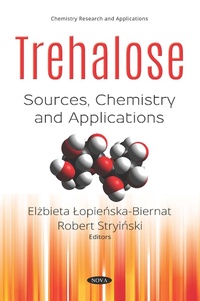
Trehalose: Sources, Chemistry and Applications
Erschienen am 10. Januar 2019
204 Seiten
978-1-5361-4945-6 (ISBN)
Beschreibung

Trehalose as a natural disaccharide presents in plants, invertebrates, fungi and prokaryotes, but not in mammals. A white, odorless, crystalline powder with a sweet taste, it is best known as a source of energy and protectant to survive harsh environmental conditions in many organisms, but its applications cover a wide array of disciplines. Research engagement is stimulated by interest in biotechnology; the use of trehalose in processes related to industry, agriculture, pharmacy and medicine. Considering both the advantages and disadvantages of this sugar for humans, Trehalose: Sources, Chemistry and Applications emphasizes the importance of trehalose in both basic and applied research and presents an overview of its biological significance. We have collected innovative research on the properties of trehalose and its application in industry or medicine; among others, the impact on the quality of fruit products, higher thermal resistance of wood, as well as innovative pharmaceuticals is also included.
Weitere Details
Weitere Ausgaben
Andere Ausgaben
Buch
02/2019
Nova Science Publishers Inc
105,50 €
Versand in 15-20 Tagen
Inhalt
- Intro
- Contents
- Preface
- Chapter 1
- Trehalose: Metabolism and Role in Stress Response in Various Organisms
- Abstract
- Introduction
- Trehalose Metabolism Pathways in Nature
- Trehalose Role in Environmental Stresses
- Other Applications of Trehalose
- References
- Chapter 2
- Trehalose Based Extremophiles in Harsh Environments
- Abstract
- 1. Extreme Environments and Extremophiles
- 1.1. Extreme arid Environment: Atacama Desert
- 1.2. Extremely Warm Environment: Death Valley
- 1.3. Extreme Cold Environment: Antarctica
- 1.4. Extreme Salty Environment: Pink Lake
- 1.5. Extreme Acid Environment: Yellowstone Park
- 2. Use of Disaccharides in the Agricultural Field
- 3. Protection of Plants and Seeds
- Conclusion
- References
- Chapter 3
- Study of Trehalose Effects on BSA Solutions
- Abstract
- Introduction
- Experimental Setup and Sample Preparation
- Experimental Data and Discussion
- Conclusion
- References
- Chapter 4
- Surface Tension in Trehalose and Maltose Aqueous Mixtures by Means of Acoustic Levitation
- Abstract
- Introduction
- Surface Tension Basis
- Measurement Methods
- Stalagmometric Method
- Capillary Rise Method
- Flat Plate Method and Contact Angle
- Tilted Plane Method and Dynamic Contact Angle
- Acoustic Levitation and IR Spectroscopy
- Results and Discussions
- Conclusion
- References
- Chapter 5
- X-Ray and IR Spectroscopy Investigations on Trehalose Morphological Modification Effects Induced by Mild Milling Treatments
- Abstract
- Introduction
- Methods of Amorphization
- Subcooled Liquid after Dissolving Trehalose
- Dehydration of Crystalline Hydrates
- Microwave Treatment
- Milling
- Characterization of the Amorphous State
- Infrared Spectroscopy
- X-Ray Powder Diffraction
- Results and Discussion
- Conclusion
- References
- Chapter 6
- Trehalose in Biomedicine and Biotechnology
- Abstract
- Introduction
- Trehalose in Cosmetics
- Trehalose in Agri-Food Sector
- Trehalose in Pharmaceuticals
- Trehalose in Medicine
- Conclusion
- References
- Chapter 7
- Trehalose Application in Fruit Products
- Abstract
- Introduction
- Flavor
- Color and Phenolics
- Texture
- Conclusion
- Acknowledgments
- References
- Chapter 8
- Trehalose Treatment for Wood Preservation
- Abstract
- Introduction
- Materials and Methods
- Results and Discussion
- Conclusion
- References
- About the Editors
- Index
- Blank Page
- Blank Page
