

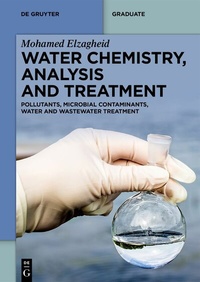
Water Chemistry, Analysis and Treatment
Beschreibung

Weitere Details
Weitere Ausgaben
Andere Ausgaben
Person
Professor Mohamed Elzagheid
Professor Elzagheid is a distinguished chemist with extensive expertise in research, development, and industrial applications. Throughout his career, he has made significant contributions to organic, macromolecular, water, polymer and nucleic acids chemistry. He has held key positions in academia, industry, and research institutions across multiple countries, shaping advancements in these fields.
In his current tenure at the Royal Commission for Jubail and Yanbu, he has held several key leadership roles, including Department Chairman and Deputy of Education and Training Affairs. He played a vital role in advancing institutional objectives by leading the JIC Research, Publications, Projects, and Academic Promotion Team for several years. He also chaired the JIC-CTAB Committee, overseeing the successful accreditation of the Industrial Chemistry Technology (INCT) program by the Canadian Council of Technicians and Technologists (CCTT). Alongside his administrative responsibilities, he remained deeply engaged in teaching a variety of courses to both regular students and professional trainees, sustaining a strong commitment to academic instruction and curriculum development. His ongoing research efforts have resulted in the publication of numerous high-quality scientific papers.
Dr. Elzagheid served as the Director of Research & Development at LPS Inc. in Canada, where he spearheaded innovative projects in chemical process optimization. His expertise in organic chemistry was further honed through his work as a post-doctoral fellow and research associate at McGill University, where he contributed to groundbreaking research in nucleic acids chemistry.
In the industrial sector, Dr. Elzagheid worked as the Laboratory Director at SynPrep Inc. (Canada), ensuring high standards in analytical research and product development. Additionally, he held the position of Senior Research Chemist at Perkin Elmer (Finland), where he played a crucial role in advancing analytical methodologies.
Beyond North America and Europe, Dr. Elzagheid has significantly contributed to scientific advancements in the Middle East and North Africa. As Head of the Training Department at the North Benghazi Desalination Plant (Libya), he led workforce training and process optimization in water treatment technologies. His academic research spans prestigious institutions, including Warsaw University (Poland), Turku University (Finland), McGill University (Canada), and Royal Commission for Jubail and Yanbu (Saudi Arabia), reinforcing his expertise in organic, nucleic acids, and macromolecular chemistry. His extensive research portfolio and numerous publications underscore his standing as a leading expert in the field.
Dr. Elzagheid's scholarly contributions include peer-reviewed research papers, conference presentations, and collaborative projects with international research teams. His work has had a profound impact on various chemical and pharmaceutical applications, particularly in the synthesis of biologically active molecules.
With a wealth of experience spanning academia, industry, and applied research, Dr. Elzagheid continues to be a driving force in the advancement of chemical sciences, fostering innovation and excellence in every role he undertakes.
Inhalt
- Intro
- Preface
- Acknowledgments
- The Author
- Contents
- Chapter 1 Introduction
- Chapter 2 Water Chemistry
- Chapter 3 Water Sources
- Chapter 4 Water Pollution and Pollutants
- Chapter 5 Microbial Contaminants in Water
- Chapter 6 Water Analysis
- Chapter 7 Water Quality
- Chapter 8 Water Treatment
- Chapter 9 Water and Wastewater Treatment Techniques
- Chapter 10 Stormwater Management and Green Infrastructure
- Chapter 11 Water as a Renewable Energy Source
- Essential Terms
- Abbreviations
- Resources and Further Readings
- Index
