

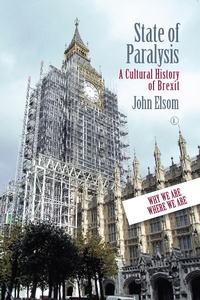
State of Paralysis
A Cultural History of Brexit
Erschienen am 25. April 2019
264 Seiten
978-0-7188-4730-2 (ISBN)
Beschreibung

We have not been driven into Brexit at the point of a gun or out of economic necessity, but purely for cultural reasons. State of Paralysis explores the climate of opinion in Britain that has led to more than seventy years of indecision about our relationship with our continental neighbours and our role on the world's stage. The post-war years saw many dramatic changes: the arrival of weapons of mass destruction, the nuclear industries, space travel, civil rights, global warming, the Internet, the digitalisation of behaviour and the loss of Empire. The aim of the European Union was to keep the peace on the continent and to face these global problems. But has it done so? Have we in Britain been able to adjust to the demands of the new world or are we clinging on to a past that can never be recovered?
John Elsom describes the political impasse in parliament and the country over the terms of Brexit to analyse what these motives were, how they were obtained and where their consequences may lead. He approaches these issues from the view of a political and cultural commentator, who has seen at first hand many of the changes that have affected all our lives.
John Elsom describes the political impasse in parliament and the country over the terms of Brexit to analyse what these motives were, how they were obtained and where their consequences may lead. He approaches these issues from the view of a political and cultural commentator, who has seen at first hand many of the changes that have affected all our lives.
Rezensionen / Stimmen
"... by far the most readable, comprehensive and authoritative account I have ever seen of the last 80 years in the UK."Professor Emeritus John Pick, Gresham College
"as one of the first serious attempts to provide understanding and insight from a specifically cultural perspective on Britain's decision to leave the European Union -- Brexit -- this study is, by definition, important.. Elsom himself, in the end, is a continuingly amusing guide, one who consistently provides verbal food for thought on such Brexit-related subjects as Equality and Democracy. "
Don Rubin, critical-stages.org
'[State of Paralysis is] a dazzling, constantly provoking account which ploughs its own furrow through the whole business, and which throws up questions about the nature of politics (and the slippage from principled politics to retail politics) to keep us arguing for years. I found myself wanting to argue with almost every sentence BUT equally found myself agreeing with the general drift(s). It is the voice of sanity and analytical intelligence in a deluded world.' - Prof. John Pick (1937-2020), formerly a leading arts economist and Gresham Professor of Rhetoric.
'State of Paralysis is a must for anyone who wants to understand Brexit. It is well-researched and very well written. It is a difficult book to put down.' - Dr. Farshid Sadr-Hashemi, formerly merchant banker and hedge fund manager
'An Austrian writer said that he wrote to be 'in possession of his life'. It's not enough just to live. First do the living, then write it up and you'll know where you stand. I feel much the same about State of Paralysis. I have lived through the events it describes, but most of them have washed over me without leaving a lasting mark. Reading this book... has been an education in my own experience. All these half-understood or entirely misunderstood terms ... Butskellism, stagflation, Maastricht, it's a long list ... have now acquired some kind of substance, and historical continuity for me, and I begin to see the story of the times I've coincided with as the outline of a coherent narrative ... I find it hard to engage with political writing, and have never persevered with it, but if there is any other book that tackles post-war history in the way you tackle it, I have not come across it. Stylistic grace aside, what makes it accessible for me is [John Elsom's] success in opening the story out to the world outside politics ... so we get biography, personal memory and the arts as well. [He] make[s] it seem artificial to adopt any more limited approach ... and it makes the argument so much more resonant and compelling when, say, a discussion of the Council of Europe gets an echo from the Ealing Studios. The book exactly lives up to its sub-title. The other thing I really appreciated was [the] distinction between British and Continental thinking ... and [the] success in avoiding the traps of both, so that (autobiography aside) if [the] book should fall into the hands of a Martian, he would be unable to work out whether [Elsom's] homeland was the UK or Romania. I cannot think of another piece of writing that has done more to open my eyes.'- Irving Wardle, formerly theatre critic and arts columnist for The Times
'I like the title. It defines the current 'state of paralysis' in a well-conceived contemporary observation that the 2016 Referendum result was 'not so much that the British agreed to leave the EU, but that they could not make up their minds.' ... This is a very well-written and meticulously researched book, and eminently readable, though for me, the most compelling part is the political narrative - which, in my view very properly dominates large sections of the book ... an outstanding narrative on how political developments and public policy changes have influenced public opinion on Britain's relationship with Europe over the last 70 years...' - Sir David Fell, LLD, former head of Northern Ireland's civil service (1991-1997)
'John [Elsom] has a deep understanding of why wheels turn and clocks tick in society and politics, and his clarity of thought makes for an enjoyable involvement in the narrative. Fifteen easy-to-access and engaging chapters navigates a safe course through what has been a tortuous journey for the country. Highly recommended.' David Warwick, actor, theatre director and chair of the Philosophy Club.
'John Elsom maps out a very interesting timeline of how Britain has constantly clung to the idea of national sovereignty whilst globalisation has rapidly changed the world around it, making that concept close to obsolete.' Ed Burrell, website and blog editor, Finesse Foreva
'For interested non-Europeans like me, who look in amazement at Britain's current political and cultural 'state of paralysis' and wonder how long such navel gazing can last, having this historical background is certainly useful. Such a cultural focus does provide an unusual intellectual arc through this impossibly large sub
Weitere Details
Sprache
Englisch
Verlagsort
Cambridge
Großbritannien
Verlagsgruppe
James Clarke & Co Ltd
Dateigröße
6,07 MB
ISBN-13
978-0-7188-4730-2 (9780718847302)
Copyright in bibliographic data and cover images is held by Nielsen Book Services Limited or by the publishers or by their respective licensors: all rights reserved.
Schweitzer Klassifikation
Weitere Ausgaben
Andere Ausgaben
Buch
04/2019
Lutterworth Press
29,25 €
Versand in 10-20 Tagen
Person
John Elsom has been a writer since leaving university. His works include many books, plays and extensive journalism. He was the theatre critic for the BBC's magazine, The Listener, broadcast extensively and was a talent scout for Paramount Pictures. He was the world president of the International Association of Theatre Critics, a UNESCO NGO, and received a knighthood from the Romanian government for his services to European culture after the Cold War. He was awarded a PhD from City University in London and has taught as a visiting professor to universities in many parts of the world. With The Lutterworth Press, he published Missing the Point: The rise of High Modernity and the decline of Everything Else in 2007.
Inhalt
(i) Never Again
(ii) The Dream of M. Monnet
(iii) The Floating Island
(iv) The Wind of Change
(v) Acid Rain
(vi) Untune That String
(vii) The Smack of Firm Government
(viii) Perspectives
(ix) Maastricht and the Bastards
(x) Breaking the Mold
(xi) The Third Way
(xii) Trial by Coalition
(xiii) Raw Brexit
(xiv) A Bloody Difficult Woman
(xv) Square One
Appendix: World War Movies and Documentaries from Radio Times Listings, 17-30 November 2018
Endnotes
Index
(ii) The Dream of M. Monnet
(iii) The Floating Island
(iv) The Wind of Change
(v) Acid Rain
(vi) Untune That String
(vii) The Smack of Firm Government
(viii) Perspectives
(ix) Maastricht and the Bastards
(x) Breaking the Mold
(xi) The Third Way
(xii) Trial by Coalition
(xiii) Raw Brexit
(xiv) A Bloody Difficult Woman
(xv) Square One
Appendix: World War Movies and Documentaries from Radio Times Listings, 17-30 November 2018
Endnotes
Index
