

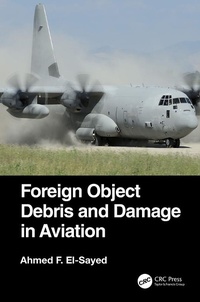
Foreign Object Debris and Damage in Aviation
1. Auflage
Erschienen am 27. April 2022
544 Seiten
978-1-000-54624-8 (ISBN)
Beschreibung

Foreign Object Debris and Damage in Aviation discusses both biological and non-biological Foreign Object Debris (FOD) and associated Foreign Object Damage (FOD) in aviation. The book provides a comprehensive treatment of the wide spectrum of FOD with numerous cost, management, and wildlife considerations.
Management control for the debris begins at the aircraft design phase, and the book includes numerical analyses for estimating damage caused by strikes. The book explores aircraft operation in adverse weather conditions and inanimate FOD management programs for airports, airlines, airframe, and engine manufacturers. It focuses on the sources of FOD, the categories of damage caused by FOD, and both the direct and indirect costs caused by FOD. In addition, the book provides management plans for wildlife, including positive and passive methods.
The book will interest aviation industry personnel, aircraft transport and ground operators, aircraft pilots, and aerospace or aviation engineers. Readers will learn to manage FOD to guarantee air traffic safety with minimum costs to airlines and airports.
Management control for the debris begins at the aircraft design phase, and the book includes numerical analyses for estimating damage caused by strikes. The book explores aircraft operation in adverse weather conditions and inanimate FOD management programs for airports, airlines, airframe, and engine manufacturers. It focuses on the sources of FOD, the categories of damage caused by FOD, and both the direct and indirect costs caused by FOD. In addition, the book provides management plans for wildlife, including positive and passive methods.
The book will interest aviation industry personnel, aircraft transport and ground operators, aircraft pilots, and aerospace or aviation engineers. Readers will learn to manage FOD to guarantee air traffic safety with minimum costs to airlines and airports.
Rezensionen / Stimmen
"The entire manuscript presents in detail the impact of FOD in aviation. Specifically, in the first two chapters, an analytical impact of various types of FOD (debris and damage) is integrated with a massive number of real word accidents and incidents. This novel approach should be in the library of any Aerospace Engineering institution, as well as any aircraft maintenance and design engineer. I would definitely recommend this novel handbook to all related readers." - Bill Xezonakis, University of East London"Chapter 1 gives a good introduction about the different types of FOD, while Chapter 2 focuses on the accidents/incidents caused by the FOD with the cost implications supported/backed by strong data. Chapter 7 expands on how to prevent and eliminate FOD with detailed images and data, which is very useful for professionals in the field of aviation, as well as operations. I think it is a suitable reference and should be considered for any reader interested in aviation, operation/maintenance, and whole aircraft design." - Mohamed Aly, Rolls-Royce
"The book is rich with data and provides a solid reference foundation for further research. The extensive bibliography will help researchers to delve more deeply into specific topics; this is valuable because published research on aviation FOD is pretty thin. It breaks up the concept of FOD into industry-standard components, such as inanimate vs wildlife FOD. I recommend this reference book for anyone who needs a broad, data-driven primer on FOD in aviation, such as airfield maintenance supervisors, operations and safety managers, airport directors and FOD program developers." - David Arv Bragi, The FOD Control Corporation
"This book is very well organized, comprehensive, and well-written with a thorough coverage of the subject matter including extensive bibliography in each chapter. In addition to being a very valuable reference for those in the aviation industry, it is also a quite interesting read for laymen with a general interest in the field." - S. Can Guelen, Bechtel "The entire manuscript presents in detail the impact of FOD in aviation. Specifically, in the first two chapters, an analytical impact of various types of FOD (debris and damage) is integrated with a massive number of real word accidents and incidents. This novel approach should be in the library of any Aerospace Engineering institution, as well as any aircraft maintenance and design engineer. I would definitely recommend this novel handbook to all related readers." - Bill Xezonakis, University of East London
"Chapter 1 gives a good introduction about the different types of FOD, while Chapter 2 focuses on the accidents/incidents caused by the FOD with the cost implications supported/backed by strong data. Chapter 7 expands on how to prevent and eliminate FOD with detailed images and data, which is very useful for professionals in the field of aviation, as well as operations. I think it is a suitable reference and should be considered for any reader interested in aviation, operation/maintenance, and whole aircraft design." - Mohamed Aly, Rolls-Royce
"The book is rich with data and provides a solid reference foundation for further research. The extensive bibliography will help researchers to delve more deeply into specific topics; this is valuable because published research on aviation FOD is pretty thin. It breaks up the concept of FOD into industry-standard components, such as inanimate vs wildlife FOD. I recommend this reference book for anyone who needs a broad, data-driven primer on FOD in aviation, such as airfield maintenance supervisors, operations and safety managers, airport directors and FOD program developers." - David Arv Bragi, The FOD Control Corporation
"This book is very well organized, comprehensive, and well-written with a thorough coverage of the subject matter including extensive bibliography in each chapter. In addition to being a very valuable reference for those in the aviation industry, it is also a quite interesting read for laymen with a general interest in the field." - S. Can Guelen, Bechtel
"The book is an excellent introduction to the subject of Foreign Object Debris and Damage in Aviation (FOD). Most of the descriptions are illustrated with real-world cases with detailed explanations, for example, the Concorde crash in Paris, the US Airways Flight 1549 in the Hudson River, and the Space Shuttle Columbia case, etc. The last chapter of the book is dedicated to numerical studies for the interaction of solid and liquid debris with aircraft modules. The approach of theory, well-selected and explained real-world examples, and references to the literature is very well balanced and helps the reader to thoroughly understand the subject. This chapter is a true treasure trove for those interested in solving real-world FOD problems numerically." - Philipp Epple, Coburg University of Applied Sciences
Weitere Details
Auflage
1. Auflage
Sprache
Englisch
Verlagsort
London
Großbritannien
Verlagsgruppe
Taylor & Francis Ltd
Zielgruppe
Für höhere Schule und Studium
Für Beruf und Forschung
Produkt-Hinweis
Reflowable
Illustrationen
58 Tables, black and white; 107 Line drawings, black and white; 133 Halftones, black and white; 240 Illustrations, black and white
ISBN-13
978-1-000-54624-8 (9781000546248)
Copyright in bibliographic data and cover images is held by Nielsen Book Services Limited or by the publishers or by their respective licensors: all rights reserved.
Schweitzer Klassifikation
Weitere Ausgaben
Andere Ausgaben
Ahmed F. El-Sayed
Foreign Object Debris and Damage in Aviation
Buch
10/2024
1. Auflage
CRC Press
85,70 €
Versand in 15-20 Tagen
Ahmed F. El-Sayed
Foreign Object Debris and Damage in Aviation
Buch
05/2022
1. Auflage
CRC Press
233,80 €
Versand in 15-20 Tagen
Person
Dr. Ahmed F. El-Sayed is a Professor of Aerospace and Mechanical Power Engineering at Zagazig University, Egypt, since 1983. He was a Senior Engineer with the Egyptian Airline EGYPTAIR for ten years, working in maintenance, technical inspection, and R&D departments, as well as the engine overhaul shop. He has worked as a researcher in corporate projects with Westinghouse, USA, Rolls Royce, UK, and Wind Energy Projects; VUB, Belgium. He taught propulsion and turbomachinery courses in several universities in Egypt, the USA, and Libya. He has lectured in the field of design and performance of aircraft engines and particulate flows in several universities in the USA, Russia, Belgium, UK, Austria, China, Syria, and Japan, including UNLV, NASA Glenn, MIT, UCF, the USAFA and Moscow Institute for Physics and Technology, von Karman Institute, Royal Military College for Science (RMCS), Graz Technical University, Tsinghua and Beijing Universities, Homos University, and Tokyo Metropolitan University and Japanese Environmental Agency. He is a member of 10 International societies and institutions and listed in Marquis Who's Who in America, Who's Who in Science and Engineering, Who's Who in Education. He is author of 12 International textbooks including Aircraft and Rocket Propulsion and Gas Turbine Engines, Taylor & Francis; 2nd ed. (2017) and 1st ed. (2008), Fundamentals of Aircraft and Rocket Propulsion, Springer, UK (2016), and Bird Strike in Aviation, Wiley, 2019. Moreover, he published more than 100 technical papers and reports published in international journals and conferences. He worked as a Chairman, Aeronautical and Spacecrafts department, Zagazig University (2015-2017, and Chairman, Mechanical Power Engineering Department, Zagazig University (1999-2005). He was awarded Distinguished Professor, Zagazig University, 2009. Moscow Institute for Physics and Technology, Russia awarded him the 50 Year Aerospace Medal, 2015. Also, he was awarded the medal of long-life engineering distinction; Egyptian Engineering Syndicate, 2017.
Inhalt
Chapter 1. Introductions
Chapter 2. Accidents and Incidents
Chapter 3. Inanimate Debris Generated from Ground Operation
Chapter 4. Inanimate Debris Generated by Adverse Weather Conditions
Chapter 5. Drones, UAVs, and Space Debris
Chapter 6. Animate (Biological) Debris
Chapter 7. FOD Prevention and Elimination (FOE) in Manufacturing Processes
Chapter 8. Management of Inanimate (Non-biological FOD)
Chapter 9. Management of Animate (Biological) FOD
Chapter 10. Numerical Studies for the Interaction of Solid and Liquid Debris with Aircraft Modules
Chapter 2. Accidents and Incidents
Chapter 3. Inanimate Debris Generated from Ground Operation
Chapter 4. Inanimate Debris Generated by Adverse Weather Conditions
Chapter 5. Drones, UAVs, and Space Debris
Chapter 6. Animate (Biological) Debris
Chapter 7. FOD Prevention and Elimination (FOE) in Manufacturing Processes
Chapter 8. Management of Inanimate (Non-biological FOD)
Chapter 9. Management of Animate (Biological) FOD
Chapter 10. Numerical Studies for the Interaction of Solid and Liquid Debris with Aircraft Modules
