

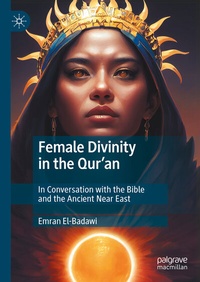
Female Divinity in the Qur'an
Beschreibung

This is the first book to examine how pre-Islamic/Late Antique goddesses shaped the Qur'an, including its basic theology and cosmology. Exploring the traces found in the text of cultic veneration to goddesses of Arabia and the Ancient Near East, this book analyses what these traces tell us about female power in late antique Arabia, and how this power changed on the advent of Islam. While recent studies on the Qur'anic God have typically considered the question of divinity separately from gender, this book bridges the gap between these two questions, and is therefore an essential constructive mission. This mission adduces literary and documentary evidence-including recent scholarly revolutions in Syriac literature and Arabian epigraphy-and builds upon the critical insights of preceding studies in conversation with post-biblical and Near Eastern traditions.
Rezensionen / Stimmen
"This is a marvelous and original piece of scholarship. El-Badawi's fresh and controversial ideas will make waves among his peers in the academy, and I mean that in a good way. The author shows remarkable awareness of the history, literature, and epigraphy of the region, very wide and deep. He pulls together a variety of sources and moves easily between them. This is a mature work that shows El-Badawi a first-rate scholar at the top of his field." (David Penchansky, University of St. Thomas, St. Paul, Minnesota, USA)
Weitere Details
Weitere Ausgaben
Andere Ausgaben
Person
Emran El-Badawi is Dean of the College of Liberal and Fine Arts at Tarleton State University, where he is also Full Professor of History, Geography and GIS. He was formerly Chair of the Department of Modern and Classical Languages at the University of Houston, where he also served as Associate Professor and Program Director of Middle Eastern Studies. He is author of Queens and Prophets (2022); The Qur'an and the Aramaic Gospel Traditions (2013), and co-editor of Communities of the Qur'an (2019). His current research projects include a book on female power in late antique Arabia, and another on hate speech as a global crisis. He has contributed to Forbes , The Houston Chronicle , and The Christian Science Monitor .
Inhalt
Chapter 1: Introduction.- Chapter 2: The Ancient Tree.- Chapter 3: The Divine Couple.- Chapter 4: Divine Birth.- Chapter 5: Daughters of God?.- Chapter 6: The Rise of Allah.- Chapter 7: Conclusion.
