

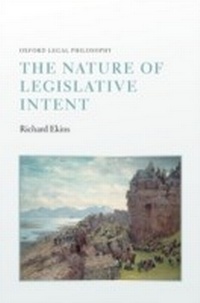
Nature of Legislative Intent
1. Auflage
Erschienen am 11. Oktober 2012
318 Seiten
978-0-19-164593-8 (ISBN)
Beschreibung

Are legislatures able to form and act on intentions? The question matters because the interpretation of statutes is often thought to centre on the intention of the legislature and because the way in which the legislature acts is relevant to the authority it does or should enjoy. Many scholars argue that legislative intent is a fiction: the legislative assembly is a large, diverse group rather than a single person and it seems a mystery how the intentions of the individuallegislators might somehow add up to a coherent group intention. This book argues that in enacting a statute the well-formed legislature forms and acts on a detailed intention, which is the legislative intent. The foundation of the argument is an analysis of how the members of purposive groups act together by way of common plans, sometimes forming complex group agents. The book extends this analysis to the legislature, considering what it is to legislate and how members of the assembly cooperate to legislate. The book argues that to legislate is to chooseto change the law for some reason: the well-formed legislature has the capacity to consider what should be done and to act to that end. This argument is supported by reflection on the centrality of intention to the nature of language use. The book then explains in detail how members of theassembly form and act on joint intentions, which do not reduce to the intentions of each member, before outlining some implications of this account for the practice of statutory interpretation. Developing a robust account of the nature and importance of legislative intention, the book represents a significant contribution to the literature on deliberative democracy that will be of interest to all those thinking about legal interpretation and constitutional theory. Oxford Legal Philosophy publishes the best new work in philosophically-oriented legal theory. It commissions and solicits monographs in all branches of the subject, including works on philosophical issues in all areas of public and private law, and in the national, transnational, and international realms, studies of the nature of law, legal institutions, and legal reasoning, treatments of problems in political morality as they bear on law, and explorations in the nature and developmentof legal philosophy itself. The series represents diverse traditions of thought but always with an emphasis on rigour and originality. It sets the standard in contemporary jurisprudence.
Weitere Details
Weitere Ausgaben
Andere Ausgaben
Richard Ekins
The Nature of Legislative Intent
Buch
10/2012
1. Auflage
Oxford University Press
135,20 €
Versand in 15-20 Tagen
Inhalt
- Cover
- Contents
- List of Abbreviations
- 1. Introduction
- 2. Sceptical Arguments
- I. Stipulating Legislative Intent
- II. Hermes and 'the Catalogue of Mysteries'
- III. The Unitary Model and Its Discontents
- IV. An Alternative: the Voting Machine Model
- V. Arrow's Theorem and the Legislative Process
- 3. Joint Intention and Group Agency
- I. The Futility of Summing Intentions
- II. Joint Intention and Group Action
- III. Complex Group Action
- IV. Discursive Dilemmas and Collective Irrationality
- V. The Idea of Group Agency
- 4. Legislating Without Reasoning
- I. The Forum of Policy
- II. Technical Problems With Preference Aggregation
- III. Reasons and Preferences
- IV. The Authority of Unintentional Legislation
- V. Rationality and the Voting Machine
- VI. The Minimal Intention Argument
- VII. Intelligible Legislating
- 5. What It Is to Legislate
- I. Legislative Capacity
- II. How One Reasons to Legislate
- III. The Act of Legislating
- IV. Legislative Integrity
- 6. The Legislative Assembly
- I. The Problem of the Sole Legislator
- II. Representation and Deliberation
- III. The Advantage of an Assembly
- IV. The Internal Hierarchy of the Legislature
- V. Washington and Westminster
- VI. Prospects for Reasoned Action
- 7. Language Use and Intention
- I. The Language Code
- II. Language Use Is Rational Action
- III. The Underdetermination Thesis
- IV. Pragmatics
- V. Legislative Language Use
- 8. The Nature of Legislative Intent
- I. The Standing Intention of the Legislature
- II. Parliamentary Procedure
- III. Legislative Intent in Particular Acts
- IV. Agency and Compromise
- 9. Intentions in Interpretation
- I. The Object of Interpretation
- II. Intentions, Purposes, and Applications
- III. Legislative Context
- IV. The Use and Misuse of Context: Some Examples
- V. The Relevance of Legislative History
- VI. Equitable Interpretation
- Bibliography
- Index
- A
- B
- C
- D
- E
- F
- G
- H
- I
- J
- K
- L
- M
- N
- O
- P
- Q
- R
- S
- T
- U
- V
- W
- Y
