

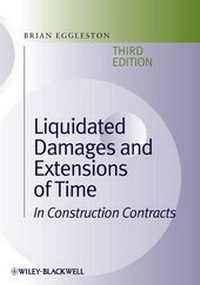
Liquidated Damages and Extensions of Time
Beschreibung

Rezensionen / Stimmen
"Practitioners of construction contracts owe a debt to BrianEggleston for this updated publication and the sooner they add thisto their library the better." (The Expert and DisputeResolver, Spring 2009) "Eggleston has once again hit the nail on the head with thishigh-quality, easy to understand legal textbook written for lawyersand the industry." (Building Magazine, February 2009)Weitere Details
Weitere Ausgaben
Andere Ausgaben
Person
Inhalt
References.
Acknowledgements.
1 Introduction.
1.1 General overview.
1.2 Legal developments.
1.3 Contractual developments.
2 Time in contracts.
2.1 Problems with terminology.
2.2 Conditions and warranties.
2.3 Termination.
2.4 Time for performance.
2.5 Time of the essence.
2.6 Notice making time of the essence.
2.7 Time at large.
2.8 Reasonable time.
2.9 Fixing time by reference to correspondence.
2.10 The effect of time at large on the contract price.
3 Damages for late completion.
3.1 Liquidated and general damages distinguished.
3.2 Principles of general damages.
3.3 Alternative remedies.
3.4 Can general damages exceed liquidated damages?
3.5 Under-liquidation of damages.
3.6 Double damages.
3.7 Liability for damages in tort.
3.8 The Panatown problem.
4 Liquidated damages and penalties.
4.1 Penalties - general introduction.
4.2 Liquidated damages.
4.3 Liquidated damages and penalties distinguished.
4.4 Pre-estimates of damage.
4.5 Particular aspects of penalty clauses.
4.6 Evidential matters.
4.7 Bonus clauses.
4.8 Site occupation charges.
5 Prevention.
5.1 Principle of prevention.
5.2 Need for extension of time provisions.
5.3 Defining an act of prevention.
5.4 Prevention after the completion date.
5.5 Effect of late variations on unliquidated damages.
5.6 Prevention and time at large.
5.7 Conditions precedent and time-bars.
5.8 Steria v. Sigma (2007).
6 Legal construction of liquidated damages clauses.
6.1 Rules of construction.
6.2 Contra proferentem rule.
6.3 Restrictions on implied terms.
6.4 'Catch all' phrases.
6.5 Inconsistencies in drafting.
7 Effects of determination.
7.1 The question of continuing responsibility.
7.2 British Glanzstoff.
7.3 Contractual provisions.
7.4 Novations.
7.5 Summary on liquidated damages.
7.6 Determination and limitation on liability.
8 Problems with sectional completion.
8.1 Discovering the parties' intentions.
8.2 Proportioning down clauses.
8.3 Provisions for sectional completion.
8.4 Requirements not fully specified.
9 Application to sub-contractors.
9.1 Effect of 'stepping-down' provisions.
9.2 Can there be a genuine pre-estimate of loss?
9.3 Commercial considerations.
9.4 Nominated sub-contracts.
10 Recovery of liquidated damages.
10.1 When do liquidated damages become payable?
10.2 Meaning of completion.
10.3 Certificates and conditions precedent.
10.4 Methods of recovery.
10.5 Time limits on recovery.
10.6 Interest on repayment.
10.7 Withholding notices.
10.8 Decisions of adjudicators.
11 Defences/challenges to liquidated damages.
11.1 Benefits of precedents.
11.2 Extension of time due.
11.3 Completion achieved earlier than certified.
11.4 Certificates not valid.
11.5 Conditions precedent not observed.
11.6 No date for commencement.
11.7 Prevention.
11.8 Penalties.
11.9 Provisions void for uncertainty.
11.10 Waiver/estoppel.
11.11 Unfair Contract Terms Act 1977.
12 Extensions of time.
12.1 Purposes of extension provisions.
12.2 Notices, applications and assessments.
12.3 Time for granting extensions.
12.4 Application to claims.
12.5 Proof of entitlement.
12.6 Global claims.
13 Relevant events.
13.1 Force majeure.
13.2 Adverse weather.
13.3 Civil commotion, strikes etc.
13.4 Damage to the works.
13.5 Sub-contractors.
13.6 Non-availability of resources.
13.7 Statutory undertakers' works.
13.8 Other special circumstances.
13.9 Statutory powers.
13.10 Possession and access.
13.11 Late issue of drawings and instructions.
13.12 Variations and extra works.
13.13 Compliance with instructions.
13.14 Unforeseen physical conditions.
14 Causation and concurrency.
14.1 Introduction.
14.2 Causation generally.
14.3 Concurrency generally.
14.4 Dominant cause approach.
14.5 Apportionment.
14.6 Rules for extension of time.
14.7 Discussion on various approaches.
14.8 Extensions when in culpable delay.
15 Programmes, method statements and best endeavours.
15.1 Status of contractor's programmes and method statements.
15.2 Programmes.
15.3 Shortened programmes.
15.4 Method statements.
15.5 Best endeavours and the like.
16 Delay analysis.
16.1 Introduction.
16.2 Critical paths.
16.3 Float.
16.4 Methods of delay analysis.
16.5 Judicial comments on delay analysis.
17 Building forms.
17.1 Introduction.
17.2 JCT 2005 contracts.
17.3 Commencement and completion.
17.4 Notification of delay.
17.5 Extension of time.
17.6 Relevant events.
17.7 Non-completion certificates.
17.8 Payment of liquidated damages.
17.9 Proportioning down liquidated damages.
18 Civil engineering forms.
18.1 NEC 3 - Engineering and Conditions of Contract, 2005.
18.2 ICE Conditions of Contract - 7th edition, 1999.
18.3 ICE Conditions of Contract for Minor Works - 3rd edition, 2001.
18.4 CECA Form of Sub-Contract, 2008.
19 Process and plant forms.
19.1 I.Chem.E. Red Book - 4th edition, 2001.
19.2 MF/1 (Rev. 4) - 2000 edition.
20 FIDIC Conditions of Contract 1999.
20.1 FIDIC contracts.
20.2 Commencement and completion.
20.3 Extension of time.
20.4 Delay damages.
Table of Cases.
Index.
