

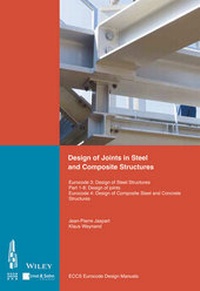
Design of Joints in Steel and Composite Structures
Eurocode 3: Design of Steel Structures. Part 1-8 Design of Joints. Eurocode 4: Design of Composite Steel and Concrete Structures
1. Auflage
Erschienen am 22. Juni 2016
388 Seiten
978-3-433-60479-3 (ISBN)
Beschreibung

This book details the basic concepts and the design rules included in Eurocode 3 ?Design of steel structures? Part 1-8 ?Design of joints?. Joints in composite construction are also addressed through references to Eurocode 4 ?Design of composite steel and concrete structures? Part 1-1 ?General rules and rules for buildings?.
Attention has to be duly paid to the joints when designing a steel or composite structure, in terms of the global safety of the construction, and also in terms of the overall cost, including fabrication, transportation and erection. Therefore, in this book, the design of the joints themselves is widely detailed, and aspects of selection of joint configuration and integration of the joints into the analysis and the design process of the whole construction are also fully covered.
Connections using mechanical fasteners, welded connections, simple joints, moment-resisting joints and lattice girder joints are considered. Various joint configurations are treated, including beam-to-column, beam-to-beam, column bases, and beam and column splice configurations, under different loading situations (axial forces, shear forces, bending moments and their combinations).
The book also briefly summarises the available knowledge relating to the application of the Eurocode rules to joints under fire, fatigue, earthquake, etc., and also to joints in a structure subjected to exceptional loadings, where the risk of progressive collapse has to be mitigated.
Finally, there are some worked examples, plus references to already published examples and to design tools, which will provide practical help to practitioners.
Attention has to be duly paid to the joints when designing a steel or composite structure, in terms of the global safety of the construction, and also in terms of the overall cost, including fabrication, transportation and erection. Therefore, in this book, the design of the joints themselves is widely detailed, and aspects of selection of joint configuration and integration of the joints into the analysis and the design process of the whole construction are also fully covered.
Connections using mechanical fasteners, welded connections, simple joints, moment-resisting joints and lattice girder joints are considered. Various joint configurations are treated, including beam-to-column, beam-to-beam, column bases, and beam and column splice configurations, under different loading situations (axial forces, shear forces, bending moments and their combinations).
The book also briefly summarises the available knowledge relating to the application of the Eurocode rules to joints under fire, fatigue, earthquake, etc., and also to joints in a structure subjected to exceptional loadings, where the risk of progressive collapse has to be mitigated.
Finally, there are some worked examples, plus references to already published examples and to design tools, which will provide practical help to practitioners.
Weitere Details
Weitere Ausgaben
Andere Ausgaben

ECCS - European Convention for Constructional Steelwork
Design of Joints in Steel and Composite Structures
Eurocode 3: Design of Steel Structures. Part 1-8 Design of Joints. Eurocode 4: Design of Composite Steel and Concrete Structures. Part 1-8 Design of Joints
Software
08/2016
Ernst & Sohn
102,25 €
Keine Lieferinformation verfügbar
ECCS - European Convention for Constructional Steelwork | Associacao Portuguesa de Construcao Metalica e Mista
Design of Joints in Steel and Composite Structures
Eurocode 3: Design of Steel Structures. Part 1-8 Design of Joints. Eurocode 4: D esign of Composite Steel and Concrete Structures.
Buch
04/2016
1. Auflage
Ernst & Sohn
70,00 €
Versand in 5-7 Tagen
Personen
Jean-Pierre Jaspart is professor of steel and composite constructions at Liège University, in Belgium. He is also involved in other teaching activities throughout Europe, and in particular in an Erasmus Mundus project, SUSCOS, together with five other top-level European universities in the field of steel construction. He carries out research in the following topics: stability and resistance of steel and composite structures, connection design in steel and composite constructions, and robustness of structural systems. In 1992, he won the Magnel Award. He is a member of the Technical Committee ?Connections? (TC10) of the ECCS and was chairman for several years of its sub-committee TWG10.2 ?Joints?. Together with the second author and the late Martin Steenhuis, he drafted large parts of the initial version of Eurocode 3 Part 1-8 (the so-called Annex JJ) and is currently a member of Working Group CEN/TC 250/SC 3/WG 8 for the evolution of Eurocode 3 Part 1-8. He has authored over 260 publications, including 50 papers in international journals and 20 contributions to books.
Klaus Weynand worked for ten years at the Institute of Steel Construction at the Technical University of Aachen, Germany, as a researcher and teacher. He has been involved in many international research projects, his research mainly focusing on joints in steel structures. In 1999, he founded, together with Markus Feldmann in Aachen, his own design office Feldmann+Weynand, where he is still a partner and the managing director. Since 1992, Klaus Weynand has been a member of the Technical Committee ECCS TC 10 and, since 1997, a technical expert in the Technical Commission of CIDECT. He was involved in drafting the pre-version of Eurocode 3 Part 1-8, together with Jean-Pierre Jaspart, co-author of this book, and the late Martin Steenhuis from Delft. He has prepared papers for various international conferences and journals and has published books for practitioners (e.g. design tables for standardised joints). He is currently also a member of the German Mirror Group for Eurocode 3 and a member of the Working Group CEN/TC 250/SC 3/WG 8 for the evolution of Eurocode 3 Part 1-8.
Klaus Weynand worked for ten years at the Institute of Steel Construction at the Technical University of Aachen, Germany, as a researcher and teacher. He has been involved in many international research projects, his research mainly focusing on joints in steel structures. In 1999, he founded, together with Markus Feldmann in Aachen, his own design office Feldmann+Weynand, where he is still a partner and the managing director. Since 1992, Klaus Weynand has been a member of the Technical Committee ECCS TC 10 and, since 1997, a technical expert in the Technical Commission of CIDECT. He was involved in drafting the pre-version of Eurocode 3 Part 1-8, together with Jean-Pierre Jaspart, co-author of this book, and the late Martin Steenhuis from Delft. He has prepared papers for various international conferences and journals and has published books for practitioners (e.g. design tables for standardised joints). He is currently also a member of the German Mirror Group for Eurocode 3 and a member of the Working Group CEN/TC 250/SC 3/WG 8 for the evolution of Eurocode 3 Part 1-8.
Inhalt
1 Introduction
2 Structural analysis and design
3 Connections with mechanical fasteners
4 Welded connections
5 Simple joints
6 Moment-resisting joints
7 Lattice girder joints
8 Joints under various loading situations
9 Design strategies
2 Structural analysis and design
3 Connections with mechanical fasteners
4 Welded connections
5 Simple joints
6 Moment-resisting joints
7 Lattice girder joints
8 Joints under various loading situations
9 Design strategies
