

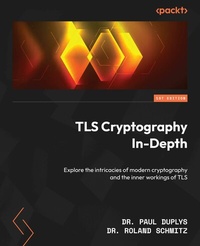
TLS Cryptography In-Depth
Explore the intricacies of modern cryptography and the inner workings of TLS
1. Auflage
Erschienen am 23. September 2024
712 Seiten
978-1-80461-596-6 (ISBN)
Beschreibung

A practical introduction to modern cryptography using the Transport Layer Security protocol as the primary referenceKey Features - Learn about real-world cryptographic pitfalls and how to avoid them
- Understand past attacks on TLS, how these attacks worked, and how they were fixed
- Discover the inner workings of modern cryptography and its application within TLS
- Purchase of the print or Kindle book includes a free PDF eBook
Book DescriptionTLS is the most widely used cryptographic protocol today, enabling e-commerce, online banking, and secure online communication. Written by Dr. Paul Duplys, Security, Privacy & Safety Research Lead at Bosch, and Dr. Roland Schmitz, Internet Security Professor at Stuttgart Media University, this book will help you gain a deep understanding of how and why TLS works, how past attacks on TLS were possible, and how vulnerabilities that enabled them were addressed in the latest TLS version 1.3. By exploring the inner workings of TLS, you'll be able to configure it and use it more securely. Starting with the basic concepts, you'll be led step by step through the world of modern cryptography, guided by the TLS protocol. As you advance, you'll be learning about the necessary mathematical concepts from scratch. Topics such as public-key cryptography based on elliptic curves will be explained with a view on real-world applications in TLS. With easy-to-understand concepts, you'll find out how secret keys are generated and exchanged in TLS, and how they are used to creating a secure channel between a client and a server. By the end of this book, you'll have the knowledge to configure TLS servers securely. Moreover, you'll have gained a deep knowledge of the cryptographic primitives that make up TLS.What you will learn - Understand TLS principles and protocols for secure internet communication
- Find out how cryptographic primitives are used within TLS V1.3
- Discover best practices for secure configuration and implementation of TLS
- Evaluate and select appropriate cipher suites for optimal security
- Get an in-depth understanding of common cryptographic vulnerabilities and ways to mitigate them
- Explore forward secrecy and its importance in maintaining confidentiality
- Understand TLS extensions and their significance in enhancing TLS functionality
Who this book is forThis book is for IT professionals, cybersecurity professionals, security engineers, cryptographers, software developers, and administrators looking to gain a solid understanding of TLS specifics and their relationship with cryptography. This book can also be used by computer science and computer engineering students to learn about key cryptographic concepts in a clear, yet rigorous way with its applications in TLS. There are no specific prerequisites, but a basic familiarity with programming and mathematics will be helpful.
- Understand past attacks on TLS, how these attacks worked, and how they were fixed
- Discover the inner workings of modern cryptography and its application within TLS
- Purchase of the print or Kindle book includes a free PDF eBook
Book DescriptionTLS is the most widely used cryptographic protocol today, enabling e-commerce, online banking, and secure online communication. Written by Dr. Paul Duplys, Security, Privacy & Safety Research Lead at Bosch, and Dr. Roland Schmitz, Internet Security Professor at Stuttgart Media University, this book will help you gain a deep understanding of how and why TLS works, how past attacks on TLS were possible, and how vulnerabilities that enabled them were addressed in the latest TLS version 1.3. By exploring the inner workings of TLS, you'll be able to configure it and use it more securely. Starting with the basic concepts, you'll be led step by step through the world of modern cryptography, guided by the TLS protocol. As you advance, you'll be learning about the necessary mathematical concepts from scratch. Topics such as public-key cryptography based on elliptic curves will be explained with a view on real-world applications in TLS. With easy-to-understand concepts, you'll find out how secret keys are generated and exchanged in TLS, and how they are used to creating a secure channel between a client and a server. By the end of this book, you'll have the knowledge to configure TLS servers securely. Moreover, you'll have gained a deep knowledge of the cryptographic primitives that make up TLS.What you will learn - Understand TLS principles and protocols for secure internet communication
- Find out how cryptographic primitives are used within TLS V1.3
- Discover best practices for secure configuration and implementation of TLS
- Evaluate and select appropriate cipher suites for optimal security
- Get an in-depth understanding of common cryptographic vulnerabilities and ways to mitigate them
- Explore forward secrecy and its importance in maintaining confidentiality
- Understand TLS extensions and their significance in enhancing TLS functionality
Who this book is forThis book is for IT professionals, cybersecurity professionals, security engineers, cryptographers, software developers, and administrators looking to gain a solid understanding of TLS specifics and their relationship with cryptography. This book can also be used by computer science and computer engineering students to learn about key cryptographic concepts in a clear, yet rigorous way with its applications in TLS. There are no specific prerequisites, but a basic familiarity with programming and mathematics will be helpful.
Weitere Details
Weitere Ausgaben
Andere Ausgaben
Dr. Paul Duplys | Dr. Roland Schmitz
TLS Cryptography In-Depth
Explore the intricacies of modern cryptography and the inner workings of TLS
Buch
01/2024
Packt Publishing
60,30 €
Versand in 3-4 Wochen
Personen
Duplys Dr. Paul :
Dr. Paul Duplys is chief expert for cybersecurity at the department for technical strategies and enabling within the Mobility sector of Robert Bosch GmbH, a Tier-1 automotive supplier and manufacturer of industrial, residential, and consumer goods. Previous to this position, he spent over 12 years with Bosch Corporate Research, where he led the security and privacy research program and conducted applied research in various fields of information security. Paul's research interests include security automation, software security, security economics, software engineering, and AI. Paul holds a PhD degree in computer science from the University of Tuebingen, Germany.Schmitz Dr. Roland :
Dr. Roland Schmitz has been a professor of internet security at the Stuttgart Media University (HdM) since 2001. Prior to joining HdM, from 1995 to 2001, he worked as a research engineer at Deutsche Telekom, with a focus on mobile security and digital signature standardization. At HdM, Roland teaches courses on internet security, system security, security engineering, digital rights management, theoretical computer science, discrete mathematics, and game physics. He has published numerous scientific papers in the fields of internet and multimedia security. Moreover, he has authored and co-authored several books. Roland holds a PhD degree in mathematics from Technical University Braunschweig, Germany.
Dr. Paul Duplys is chief expert for cybersecurity at the department for technical strategies and enabling within the Mobility sector of Robert Bosch GmbH, a Tier-1 automotive supplier and manufacturer of industrial, residential, and consumer goods. Previous to this position, he spent over 12 years with Bosch Corporate Research, where he led the security and privacy research program and conducted applied research in various fields of information security. Paul's research interests include security automation, software security, security economics, software engineering, and AI. Paul holds a PhD degree in computer science from the University of Tuebingen, Germany.Schmitz Dr. Roland :
Dr. Roland Schmitz has been a professor of internet security at the Stuttgart Media University (HdM) since 2001. Prior to joining HdM, from 1995 to 2001, he worked as a research engineer at Deutsche Telekom, with a focus on mobile security and digital signature standardization. At HdM, Roland teaches courses on internet security, system security, security engineering, digital rights management, theoretical computer science, discrete mathematics, and game physics. He has published numerous scientific papers in the fields of internet and multimedia security. Moreover, he has authored and co-authored several books. Roland holds a PhD degree in mathematics from Technical University Braunschweig, Germany.
Inhalt
Table of Contents - The Role of Cryptography in the Connected World
- Secure Channel and the CIA Triad
- A Secret to Share
- Encryption and Decryption
- Entity Authentication
- Transport Layer Security at a Glance
- Public-Key Cryptography
- Elliptic Curves
- Digital Signatures
- Digital Certificates and Certification Authorities
- Hash Functions and Message Authentication Codes
- Secrets and Keys in TLS 1.3
- TLS Handshake Protocol Revisited
- Block Ciphers and Their Modes of Operation
- Authenticated Encryption
- The Galois Counter Mode
- TLS Record Protocol Revisited
- TLS Cipher Suites
- Attacks on Cryptography
- Attacks on the TLS Handshake Protocol
- Attacks on the TLS Record Protocol
- Attacks on TLS Implementations
- Secure Channel and the CIA Triad
- A Secret to Share
- Encryption and Decryption
- Entity Authentication
- Transport Layer Security at a Glance
- Public-Key Cryptography
- Elliptic Curves
- Digital Signatures
- Digital Certificates and Certification Authorities
- Hash Functions and Message Authentication Codes
- Secrets and Keys in TLS 1.3
- TLS Handshake Protocol Revisited
- Block Ciphers and Their Modes of Operation
- Authenticated Encryption
- The Galois Counter Mode
- TLS Record Protocol Revisited
- TLS Cipher Suites
- Attacks on Cryptography
- Attacks on the TLS Handshake Protocol
- Attacks on the TLS Record Protocol
- Attacks on TLS Implementations
