


Secular Mysteries: Stanley Cavell and English Romanticism
1. Auflage
Erschienen am 14. März 2013
304 Seiten
978-1-4411-8647-8 (ISBN)
Beschreibung

Stanley Cavell and English Romanticism serves as both introduction to Cavell for Romanticists, and to the larger question of what philosophy means for the reading of literature, as well as to the importance and relevance of Romantic literature to Cavell's thought.
Illustrated through close readings of Wordsworth and Shelley, and extended discussions of Emerson and Thoreau as well as Cavell, Duffy proposes a Romanticism of persisting cultural relevance and truly trans-Atlantic scope. The turn to romanticism of America's most distinguished "ordinary-language" philosopher is shown to be tied to the neo-Romantic claim that far from being merely an illustrator of the truths discovered by philosophy, poetry is its equal partner in the instituting of knowledge. This book will be vital reading for anyone interested in Romanticism, Stanley Cavell and the ever-deepening connections between literature and philosophy.
Illustrated through close readings of Wordsworth and Shelley, and extended discussions of Emerson and Thoreau as well as Cavell, Duffy proposes a Romanticism of persisting cultural relevance and truly trans-Atlantic scope. The turn to romanticism of America's most distinguished "ordinary-language" philosopher is shown to be tied to the neo-Romantic claim that far from being merely an illustrator of the truths discovered by philosophy, poetry is its equal partner in the instituting of knowledge. This book will be vital reading for anyone interested in Romanticism, Stanley Cavell and the ever-deepening connections between literature and philosophy.
Rezensionen / Stimmen
Duffy's understanding of Cavell is clearly profound, and he has an impressively detailed and broad knowledge of a swathe of Romantic poetry. * The Year's Work in English Studies * By reading some central texts of Wordsworth and Shelley, along with those of Cavell, as efforts at the reconstruction or resettlement of the everyday, Edward Duffy recalls to us powerfully why both English Romantic poetry and Cavellian philosophy matter for us as at once 'records of losses' and 'texts of recovery.' Duffy's care, subtlety, power, and insight in this recalling will be of enormous help to anyone trying to make sense of the strange powers of these variously wonderful works that show the philosophical and the literary in engagement with each other. Edward Duffy's approaches to Cavell's work significantly extend and consolidate Cavell's forays into Romanticism. Just as significant are his companion efforts to understand Cavell's enterprises as in themselves Romantic projects. For Cavell, in Duffy's reading, the skeptic seeks to confront and isolate the ground of knowledge in each individual knower. But skepticism yields a sense of the isolation in human knowledge that is self-imposed and inauthentic. Duffy demonstrates that the skeptic avoids the knowledge that 'we knowers' exist at a point 'where all stand single.' For Cavell's Romanticism, our separateness is not the consequence of a failure of our knowledge but a condition of being an individual. The redemption of solitude from the corrosiveness of a skeptical self-consciousness makes possible an openness to companionship. Through this book's painstaking attention to the details of a poem, we learn of the specific possibilities of poetry as embodying and acknowledging the human voice. Through his careful attention to the steps of Cavell's reflections, Duffy brings us to the territory where philosophy and poetry meet. The effect is stunning. Brilliantly appropriating Stanley Cavell's rich and complex approach to literary expression as an investigation into our common linguistic inheritance, Edward Duffy explores Wordsworth and Shelley's poetry as a way into the 'secular mysteries' of the ordinary. Treating romanticism as a transatlantic phenomenon-instantiated on the American side in Emerson and Thoreau-Duffy finds our efforts to locate routes of significance in the everyday in what he persuasively shows to be something of a lacuna in Cavell's thought: a sustained reflection of English romanticism. The prose is throughout perceptive and crisp, and the readings are shrewd and original.Weitere Details
Auflage
1. Auflage
Sprache
Englisch
Verlagsort
New York
USA
Verlagsgruppe
Bloomsbury Publishing PLC (Digital)
ISBN-13
978-1-4411-8647-8 (9781441186478)
Copyright in bibliographic data and cover images is held by Nielsen Book Services Limited or by the publishers or by their respective licensors: all rights reserved.
Schweitzer Klassifikation
Weitere Ausgaben
Andere Ausgaben

Edward T. Duffy
Secular Mysteries: Stanley Cavell and English Romanticism
Buch
05/2013
Bloomsbury Academic USA
55,79 €
Artikel ist vergriffen; siehe andere Ausgabe
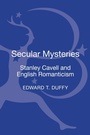
Edward T. Duffy
Secular Mysteries: Stanley Cavell and English Romanticism
Stanley Cavell and English Romanticism
Buch
05/2013
Bloomsbury Academic USA
150,50 €
Versand in 15-20 Tagen
Person
Edward T. Duffy is Associate Professor of English (Emeritus) at Marquette University, USA. He is the author of Rousseau in England: The Context for Shelley's Critique of the Enlightenment and The Constitution of Shelley's Poetry.
Inhalt
1. Stanley Cavell's Redemptive Reading: A Philosophical Labor in Progress
2. Reading Romanticism
3. A Wordsworthian Calling of Thinking
4. Bursting from a Congregated Might of Vapors: Desire, Expression and Motive in Shelley
5. "The Breath Whose Might I Have Invoked in Song": Epipsychidion and Adonais
6. Reviewing the Vision of The Triumph of Life
Bibliography
Index
2. Reading Romanticism
3. A Wordsworthian Calling of Thinking
4. Bursting from a Congregated Might of Vapors: Desire, Expression and Motive in Shelley
5. "The Breath Whose Might I Have Invoked in Song": Epipsychidion and Adonais
6. Reviewing the Vision of The Triumph of Life
Bibliography
Index
