

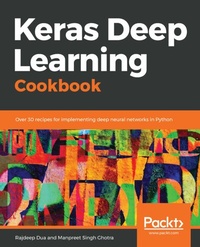
Keras Deep Learning Cookbook
Over 30 recipes for implementing deep neural networks in Python
1. Auflage
Erschienen am 23. September 2024
252 Seiten
978-1-78862-308-7 (ISBN)
Beschreibung
No detailed description available for "Keras Deep Learning Cookbook".
Weitere Details
Weitere Ausgaben
Personen
Dua Rajdeep :
Rajdeep Dua has over 18 years experience in the cloud and big data space. He has taught Spark and big data at some of the most prestigious tech schools in India: IIIT Hyderabad, ISB, IIIT Delhi, and Pune College of Engineering. He currently leads the developer relations team at Salesforce India. He has also presented BigQuery and Google App Engine at the W3C conference in Hyderabad. He led the developer relations teams at Google, VMware, and Microsoft, and has spoken at hundreds of other conferences on the cloud. Some of the other references to his work can be seen at Your Story and on ACM digital library. His contributions to the open source community relate to Docker, Kubernetes, Android, OpenStack, and Cloud Foundry.Pal Sujit :
Sujit Pal is a Technology Research Director at Elsevier Labs, an advanced technology group within the Reed-Elsevier Group of companies. His interests include semantic search, natural language processing, machine learning, and deep learning. At Elsevier, he has worked on several initiatives involving search quality measurement and improvement, image classification and duplicate detection, and annotation and ontology development for medical and scientific corpora.Ghotra Manpreet Singh :
Manpreet Singh Ghotra has more than 15 years experience in software development for both enterprise and big data software. He is currently working at Salesforce on developing a machine learning platform/APIs using open source libraries and frameworks such as Keras, Apache Spark, and TensorFlow. He has worked on various machine learning systems, including sentiment analysis, spam detection, and anomaly detection. He was part of the machine learning group at one of the largest online retailers in the world, working on transit time calculations using Apache Mahout, and the R recommendation system, again using Apache Mahout. With a master's and postgraduate degree in machine learning, he has contributed to, and worked for, the machine learning community.
Rajdeep Dua has over 18 years experience in the cloud and big data space. He has taught Spark and big data at some of the most prestigious tech schools in India: IIIT Hyderabad, ISB, IIIT Delhi, and Pune College of Engineering. He currently leads the developer relations team at Salesforce India. He has also presented BigQuery and Google App Engine at the W3C conference in Hyderabad. He led the developer relations teams at Google, VMware, and Microsoft, and has spoken at hundreds of other conferences on the cloud. Some of the other references to his work can be seen at Your Story and on ACM digital library. His contributions to the open source community relate to Docker, Kubernetes, Android, OpenStack, and Cloud Foundry.Pal Sujit :
Sujit Pal is a Technology Research Director at Elsevier Labs, an advanced technology group within the Reed-Elsevier Group of companies. His interests include semantic search, natural language processing, machine learning, and deep learning. At Elsevier, he has worked on several initiatives involving search quality measurement and improvement, image classification and duplicate detection, and annotation and ontology development for medical and scientific corpora.Ghotra Manpreet Singh :
Manpreet Singh Ghotra has more than 15 years experience in software development for both enterprise and big data software. He is currently working at Salesforce on developing a machine learning platform/APIs using open source libraries and frameworks such as Keras, Apache Spark, and TensorFlow. He has worked on various machine learning systems, including sentiment analysis, spam detection, and anomaly detection. He was part of the machine learning group at one of the largest online retailers in the world, working on transit time calculations using Apache Mahout, and the R recommendation system, again using Apache Mahout. With a master's and postgraduate degree in machine learning, he has contributed to, and worked for, the machine learning community.
Inhalt
Table of Contents - Installing and Setting up Keras
- Working with datasets and models
- Data Preprocessing, Optimization and Visualization
- Classifying text using different Keras layers
- Implementing Convolutional Neural Networks
- Generative Adversarial Networks
- Implementing Recurrent Neural Networks
- Natural Language Processing using Keras Models
- Text summarization using Keras Models
- Reinforcement learning using Keras Models
- Working with datasets and models
- Data Preprocessing, Optimization and Visualization
- Classifying text using different Keras layers
- Implementing Convolutional Neural Networks
- Generative Adversarial Networks
- Implementing Recurrent Neural Networks
- Natural Language Processing using Keras Models
- Text summarization using Keras Models
- Reinforcement learning using Keras Models
