

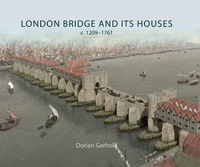
London Bridge and its Houses, c. 1209-1761
Erschienen am 31. Oktober 2021
224 Seiten
978-1-78925-754-0 (ISBN)
Beschreibung

London Bridge lined with houses from end to end was one of the most extraordinary structures ever seen in London. It was home to over 500 people, perched above the rushing waters of the Thames, and was one of the city's main shopping streets. It is among the most familiar images of London in the past, but little has previously been known about the houses and the people who lived and worked in them. This book uses plentiful newly-discovered evidence, including detailed descriptions of nearly every house, to tell the story of the bridge and its houses and inhabitants.
With the new information it is possible to reconstruct the plan of the bridge and houses in the seventeenth century, to trace the history of each house back through rentals and a survey to 1358, revealing the original layout, to date most of the houses which appear in later views, and to show how the houses and their occupants changed during five and half centuries. The book describes what stopped the houses falling into the river, how the houses were gradually enlarged, what their layout was inside, what goods were sold on the bridge and how these changed over time, the extensive rebuilding in 1477-1548 and 1683-96, and the removal of the houses around 1760.
There are many new discoveries - about the structure of the bridge, the width of the roadway, the original layout of the houses, how the houses were supported, the size and internal planning of the houses, the quality of their architecture, and the trades practised on the bridge. The book includes five newly-commissioned reconstruction drawings showing what we now know about the bridge and its houses.
With the new information it is possible to reconstruct the plan of the bridge and houses in the seventeenth century, to trace the history of each house back through rentals and a survey to 1358, revealing the original layout, to date most of the houses which appear in later views, and to show how the houses and their occupants changed during five and half centuries. The book describes what stopped the houses falling into the river, how the houses were gradually enlarged, what their layout was inside, what goods were sold on the bridge and how these changed over time, the extensive rebuilding in 1477-1548 and 1683-96, and the removal of the houses around 1760.
There are many new discoveries - about the structure of the bridge, the width of the roadway, the original layout of the houses, how the houses were supported, the size and internal planning of the houses, the quality of their architecture, and the trades practised on the bridge. The book includes five newly-commissioned reconstruction drawings showing what we now know about the bridge and its houses.
Weitere Details
Weitere Ausgaben
Andere Ausgaben

Dorian Gerhold
London Bridge and its Houses, c. 1209-1761
Buch
09/2021
Oxbow Books
57,03 €
Versand in 3-4 Wochen
Inhalt
- Cover
- Book Title
- Copyright
- Contents
- AUTHOR'S ACKNOWLEDGEMENTS
- ABBREVIATIONS
- CHAPTER 1 Introduction
- The bridge
- Plans and views
- CHAPTER 2 Reconstructing the bridge and its houses
- The roadway
- Widths and depths of the houses
- The cross buildings
- Reconstructing the plan of the bridge and its houses
- Piers and hammer beams
- CHAPTER 3 The houses from c. 1209 to 1358
- Origins
- The houses in 1358
- The 'hautpas' of 1358
- CHAPTER 4 The major buildings
- The chapel
- The stone gate
- The drawbridge tower
- Other structures
- CHAPTER 5 The houses from 1358 to 1633
- Houses on new sites
- Merging of plots
- Rebuilding of houses
- The house with many windows
- Nonsuch House
- Enlarging the houses
- Landlord and tenants: leases
- Landlord and tenants: repairs and rebuilding
- CHAPTER 6 Inside the houses in the seventeenth century
- Cellars and shops
- Upper rooms
- Services
- CHAPTER 7 Fires and rebuildings 1633-82
- The fire of 1633
- The new building of 1645-49
- The Great Fire of 1666 and the sheds
- CHAPTER 8 Trading on the bridge
- The fourteenth and fifteenth centuries
- The sixteenth and seventeenth centuries
- Bridge customers
- Booksellers
- From the 1680s to the 1750s
- CHAPTER 9 Families and community
- Bridge families
- The bridge population in the late seventeenth century
- Community
- CHAPTER 10 The great rebuilding of 1683-96
- The northern end
- Growing traffic and the keep-right rule
- The middle part and the drawbridge houses
- South of the stone gate
- The new houses
- CHAPTER 11 From the fire of 1725 to the removal of the houses
- The fire of 1725
- The falling in of leases in the 1740s
- The new houses of 1745
- Managing the existing houses
- Removing the houses
- Survey of the houses on London Bridge, 1604-83
- APPENDIX 1 Reconstructing the plan of London Bridge
- APPENDIX 2 The reliability of the views of the bridge
- APPENDIX 3 Tracing the bridge houses back to 1358
- APPENDIX 4 The hearth tax of 1664-66
- APPENDIX 5 Rents on the bridge
- APPENDIX 6 The northern end of the bridge
- Notes
- IMAGE CREDITS
- INDEX
- Back Cover
