

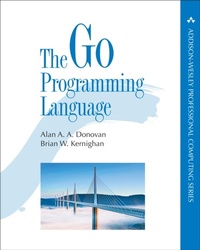
Go Programming Language, The
1. Auflage
Erschienen am 16. November 2015
400 Seiten
978-0-13-419056-3 (ISBN)
Beschreibung
The Go Programming Language is the authoritative resource for any programmer who wants to learn Go. It shows how to write clear and idiomatic Go to solve real-world problems. The book does not assume prior knowledge of Go nor experience with any specific language, so you'll find it accessible whether you're most comfortable with JavaScript, Ruby, Python, Java, or C++.
The first chapter is a tutorial on the basic concepts of Go, introduced through programs for file I/O and text processing, simple graphics, and web clients and servers.
Early chapters cover the structural elements of Go programs: syntax, control flow, data types, and the organization of a program into packages, files, and functions. The examples illustrate many packages from the standard library and show how to create new ones of your own. Later chapters explain the package mechanism in more detail, and how to build, test, and maintain projects using the go tool.
The chapters on methods and interfaces introduce Go's unconventional approach to object-oriented programming, in which methods can be declared on any type and interfaces are implicitly satisfied. They explain the key principles of encapsulation, composition, and substitutability using realistic examples.
Two chapters on concurrency present in-depth approaches to this increasingly important topic. The first, which covers the basic mechanisms of goroutines and channels, illustrates the style known as communicating sequential processes for which Go is renowned. The second covers more traditional aspects of concurrency with shared variables. These chapters provide a solid foundation for programmers encountering concurrency for the first time.
The final two chapters explore lower-level features of Go. One covers the art of metaprogramming using reflection. The other shows how to use the unsafe package to step outside the type system for special situations, and how to use the cgo tool to create Go bindings for C libraries.
The book features hundreds of interesting and practical examples of well-written Go code that cover the whole language, its most important packages, and a wide range of applications. Each chapter has exercises to test your understanding and explore extensions and alternatives. Source code is freely available for download from http://gopl.io/ and may be conveniently fetched, built, and installed using the go get command.
The first chapter is a tutorial on the basic concepts of Go, introduced through programs for file I/O and text processing, simple graphics, and web clients and servers.
Early chapters cover the structural elements of Go programs: syntax, control flow, data types, and the organization of a program into packages, files, and functions. The examples illustrate many packages from the standard library and show how to create new ones of your own. Later chapters explain the package mechanism in more detail, and how to build, test, and maintain projects using the go tool.
The chapters on methods and interfaces introduce Go's unconventional approach to object-oriented programming, in which methods can be declared on any type and interfaces are implicitly satisfied. They explain the key principles of encapsulation, composition, and substitutability using realistic examples.
Two chapters on concurrency present in-depth approaches to this increasingly important topic. The first, which covers the basic mechanisms of goroutines and channels, illustrates the style known as communicating sequential processes for which Go is renowned. The second covers more traditional aspects of concurrency with shared variables. These chapters provide a solid foundation for programmers encountering concurrency for the first time.
The final two chapters explore lower-level features of Go. One covers the art of metaprogramming using reflection. The other shows how to use the unsafe package to step outside the type system for special situations, and how to use the cgo tool to create Go bindings for C libraries.
The book features hundreds of interesting and practical examples of well-written Go code that cover the whole language, its most important packages, and a wide range of applications. Each chapter has exercises to test your understanding and explore extensions and alternatives. Source code is freely available for download from http://gopl.io/ and may be conveniently fetched, built, and installed using the go get command.
Alle Preise
Weitere Details
Reihe
Auflage
1. Auflage
Sprache
Englisch
Verlagsort
Boston
USA
Verlagsgruppe
Pearson Education (US)
Zielgruppe
Für höhere Schule und Studium
Dateigröße
33,52 MB
ISBN-13
978-0-13-419056-3 (9780134190563)
Copyright in bibliographic data and cover images is held by Nielsen Book Services Limited or by the publishers or by their respective licensors: all rights reserved.
Schweitzer Klassifikation
Weitere Ausgaben
Personen
Alan A. A. Donovan is a member of Google's Go team in New York. He holds computer science degrees from Cambridge and MIT and has been programming in industry since 1996. Since 2005, he has worked at Google on infrastructure projects and was the co-designer of its proprietary build system, Blaze. He has built many libraries and tools for static analysis of Go programs, including oracle, godoc -analysis, eg, and gorename.
Brian W. Kernighan is a professor in the Computer Science Department at Princeton University. He was a member of technical staff in the Computing Science Research Center at Bell Labs from 1969 until 2000, where he worked on languages and tools for Unix. He is the co-author of several books, including The C Programming Language, Second Edition (Prentice Hall, 1988), and The Practice of Programming (Addison-Wesley, 1999).
Brian W. Kernighan is a professor in the Computer Science Department at Princeton University. He was a member of technical staff in the Computing Science Research Center at Bell Labs from 1969 until 2000, where he worked on languages and tools for Unix. He is the co-author of several books, including The C Programming Language, Second Edition (Prentice Hall, 1988), and The Practice of Programming (Addison-Wesley, 1999).
Inhalt
Chapter 1: Tutorial
Chapter 2: Program Structure
Chapter 3: Basic Data Types
Chapter 4: Composite Types
Chapter 5: Functions
Chapter 6:. Methods
Chapter 7: Interfaces
Chapter 8: Goroutines and Channels
Chapter 9: Concurrency with Shared Variables
Chapter 10: Packages and the Go Tool
Chapter 11: Testing
Chapter 12: Reflection
Chapter 2: Program Structure
Chapter 3: Basic Data Types
Chapter 4: Composite Types
Chapter 5: Functions
Chapter 6:. Methods
Chapter 7: Interfaces
Chapter 8: Goroutines and Channels
Chapter 9: Concurrency with Shared Variables
Chapter 10: Packages and the Go Tool
Chapter 11: Testing
Chapter 12: Reflection
