

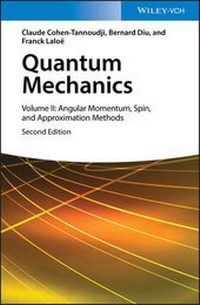
Quantum Mechanics
Volume II: Angular Momentum, Spin, and Approximation Methods
2. Auflage
Erschienen am 1. Juni 2020
688 Seiten
978-3-527-82272-0 (ISBN)
Beschreibung

This new edition of the unrivalled textbook introduces concepts such as the quantum theory of scattering by a potential, special and general cases of adding angular momenta, time-independent and time-dependent perturbation theory, and systems of identical particles. The entire book has been revised to take into account new developments in quantum mechanics curricula.
The textbook retains its typical style also in the new edition: it explains the fundamental concepts in chapters which are elaborated in accompanying complements that provide more detailed discussions, examples and applications.
* The quantum mechanics classic in a new edition: written by 1997 Nobel laureate Claude Cohen-Tannoudji and his colleagues Bernard Diu and Franck Laloë
* As easily comprehensible as possible: all steps of the physical background and its mathematical representation are spelled out explicitly
* Comprehensive: in addition to the fundamentals themselves, the book contains more than 170 worked examples plus exercises
Claude Cohen-Tannoudji was a researcher at the Kastler-Brossel laboratory of the Ecole Normale Supérieure in Paris where he also studied and received his PhD in 1962. In 1973 he became Professor of atomic and molecular physics at the Collège des France. His main research interests were optical pumping, quantum optics and atom-photon interactions. In 1997, Claude Cohen-Tannoudji, together with Steven Chu and William D. Phillips, was awarded the Nobel Prize in Physics for his research on laser cooling and trapping of neutral atoms.
Bernard Diu was Professor at the Denis Diderot University (Paris VII). He was engaged in research at the Laboratory of Theoretical Physics and High Energy where his focus was on strong interactions physics and statistical mechanics.
Franck Laloë was a researcher at the Kastler-Brossel laboratory of the Ecole Normale Supérieure in Paris. His first assignment was with the University of Paris VI before he was appointed to the CNRS, the French National Research Center. His research was focused on optical pumping, statistical mechanics of quantum gases, musical acoustics and the foundations of quantum mechanics.
The textbook retains its typical style also in the new edition: it explains the fundamental concepts in chapters which are elaborated in accompanying complements that provide more detailed discussions, examples and applications.
* The quantum mechanics classic in a new edition: written by 1997 Nobel laureate Claude Cohen-Tannoudji and his colleagues Bernard Diu and Franck Laloë
* As easily comprehensible as possible: all steps of the physical background and its mathematical representation are spelled out explicitly
* Comprehensive: in addition to the fundamentals themselves, the book contains more than 170 worked examples plus exercises
Claude Cohen-Tannoudji was a researcher at the Kastler-Brossel laboratory of the Ecole Normale Supérieure in Paris where he also studied and received his PhD in 1962. In 1973 he became Professor of atomic and molecular physics at the Collège des France. His main research interests were optical pumping, quantum optics and atom-photon interactions. In 1997, Claude Cohen-Tannoudji, together with Steven Chu and William D. Phillips, was awarded the Nobel Prize in Physics for his research on laser cooling and trapping of neutral atoms.
Bernard Diu was Professor at the Denis Diderot University (Paris VII). He was engaged in research at the Laboratory of Theoretical Physics and High Energy where his focus was on strong interactions physics and statistical mechanics.
Franck Laloë was a researcher at the Kastler-Brossel laboratory of the Ecole Normale Supérieure in Paris. His first assignment was with the University of Paris VI before he was appointed to the CNRS, the French National Research Center. His research was focused on optical pumping, statistical mechanics of quantum gases, musical acoustics and the foundations of quantum mechanics.
Weitere Details
Weitere Ausgaben
Andere Ausgaben
Bernard Diu | Franck Laloe
Quantum Mechanics
Volume II: Angular Momentum, Spin, and Approximation Methods
Buch
10/2019
2. Auflage
Wiley-VCH
139,00 €
Versand in 5-7 Tagen
Personen
Claude Cohen-Tannoudji was a researcher at the Kastler-Brossel laboratory of the Ecole Normale Supérieure in Paris where he also studied and received his PhD in 1962. In 1973 he became Professor of atomic and molecular physics at the Collège des France. His main research interests were optical pumping, quantum optics and atom-photon interactions. In 1997, Claude Cohen-Tannoudji, together with Steven Chu and William D. Phillips, was awarded the Nobel Prize in Physics for his research on laser cooling and trapping of neutral atoms.
Bernard Diu was Professor at the Denis Diderot University (Paris VII). He was engaged in research at the Laboratory of Theoretical Physics and High Energy where his focus was on strong interactions physics and statistical mechanics.
Franck Laloë was a researcher at the Kastler-Brossel laboratory of the Ecole Normale Supérieure in Paris. His first assignment was with the University of Paris VI before he was appointed to the CNRS, the French National Research Center. His research was focused on optical pumping, statistical mechanics of quantum gases, musical acoustics and the foundations of quantum mechanics.
Bernard Diu was Professor at the Denis Diderot University (Paris VII). He was engaged in research at the Laboratory of Theoretical Physics and High Energy where his focus was on strong interactions physics and statistical mechanics.
Franck Laloë was a researcher at the Kastler-Brossel laboratory of the Ecole Normale Supérieure in Paris. His first assignment was with the University of Paris VI before he was appointed to the CNRS, the French National Research Center. His research was focused on optical pumping, statistical mechanics of quantum gases, musical acoustics and the foundations of quantum mechanics.
Inhalt
AN ELEMENTARY APPROACH TO THE QUANTUM THEORY OF SCATTERING BY A POTENTIAL
Introduction
Stationary Scattering States. Calculation of the Cross Section
Scattering by a Central Potential. Method of Partial Waves
Complements
ELECTRON SPIN
Introduction
Special Properties of Angular Moment 1/2
Non-Relativistic Description of a Spin 1/2 Particle
Complements
ADDITION OF ANGULAR MOMENTA
Introduction
Addition of Two Spin 1/2's. Elementary Method
Addition of Two Arbitrary Angular Momenta. General Methods
Complements
STATIONARY PERTURBATION THEORY
Description of the Method
Perturbation of a Non-Degenerate Level
Perturbation of a Degenerate Level
Complements
AN APPLICATION OF PERTURBATION THEORY: THE FINE AND HYPERFINE STRUCTURE OF THE HYDROGEN ATOM
Introduction
Additional Terms in the Hamiltonian
The Fine Structure of the N=2 Level
The Hyperfine Structure of the N=1 Level
The Zeeman Effect of the Hyperfine Structure of the 1s Ground State
Complements
APPROXIMATION METHODS FOR TIME-DEPENDENT PROBLEMS
Statement of the Problem
Approximate Solution of the Schrödinger Equation
An Important Special Case: Sinusoidal or Constant Perturbation
Complements
SYSTEMS OF IDENTICAL PARTICLES
Statement of the Problem
Permutation Operators
The Symmetrization Postulate
Discussion
Complements
APPENDICES
Fourier Series and the Fourier Transform
The Dirac "Function"
The Lagrangian and Hamiltonian in Classical Mechanics
Introduction
Stationary Scattering States. Calculation of the Cross Section
Scattering by a Central Potential. Method of Partial Waves
Complements
ELECTRON SPIN
Introduction
Special Properties of Angular Moment 1/2
Non-Relativistic Description of a Spin 1/2 Particle
Complements
ADDITION OF ANGULAR MOMENTA
Introduction
Addition of Two Spin 1/2's. Elementary Method
Addition of Two Arbitrary Angular Momenta. General Methods
Complements
STATIONARY PERTURBATION THEORY
Description of the Method
Perturbation of a Non-Degenerate Level
Perturbation of a Degenerate Level
Complements
AN APPLICATION OF PERTURBATION THEORY: THE FINE AND HYPERFINE STRUCTURE OF THE HYDROGEN ATOM
Introduction
Additional Terms in the Hamiltonian
The Fine Structure of the N=2 Level
The Hyperfine Structure of the N=1 Level
The Zeeman Effect of the Hyperfine Structure of the 1s Ground State
Complements
APPROXIMATION METHODS FOR TIME-DEPENDENT PROBLEMS
Statement of the Problem
Approximate Solution of the Schrödinger Equation
An Important Special Case: Sinusoidal or Constant Perturbation
Complements
SYSTEMS OF IDENTICAL PARTICLES
Statement of the Problem
Permutation Operators
The Symmetrization Postulate
Discussion
Complements
APPENDICES
Fourier Series and the Fourier Transform
The Dirac "Function"
The Lagrangian and Hamiltonian in Classical Mechanics
