

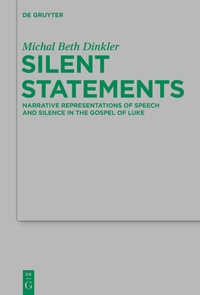
Silent Statements
Beschreibung

Even a brief comparison with its canonical counterparts demonstrates that the Gospel of Luke is preoccupied with the power of spoken words; still, words alone do not make a language. Just as music without silence collapses into cacophony, so speech without silence signifies nothing: silences are the invisible, inaudible cement that hold the entire edifice together. Though scholars across diverse disciplines have analyzed silence in terms of its contexts, sources, and functions, these insights have barely begun to make inroads in biblical studies. Utilizing conceptual tools from narratology and reader-response criticism, this study is an initial exploration of largely uncharted territory - the various ways that narrative intersections of speech and silences function together rhetorically in Luke's Gospel. Considering speech and silence to be mutually constituted in intricate and inextricable ways, Dinkler demonstrates that attention to both characters' silences and the narrator's silences helps to illuminate plot, characterization, theme, and readerly experience in Luke's Gospel. Focusing on both speech and silence reveals that the Lukan narrator seeks to shape readers into ideal witnesses who use speech and silence in particular ways; Luke can be read as an early Christian proclamation - not only of the gospel message - but also of the proper ways to use speech and silence in light of that message. Thus, we find that speech and silence are significant matters of concern within the Lukan story and that speech and silence are significant tools used in its telling.
Rezensionen / Stimmen
"I would not hesitate to recommend Silent Statements to anyone interested in Luke's narrative artistry, rhetoric, or story."Scott S. Elliott in: Biblical Interpretation 24/2016
Weitere Details
Weitere Ausgaben
Andere Ausgaben
Person
Inhalt
2 - Part I: The Multivalent Phenomenon of Silence [Seite 17]
2.1 - Previous Scholarship on Silence in General [Seite 18]
2.2 - Silence is Multivalent [Seite 20]
2.3 - Silence is Contextually Determined [Seite 22]
2.4 - Silence is Rhetorically Powerful [Seite 23]
2.5 - Previous Scholarship on Silence in Antiquity [Seite 25]
3 - Part II: A Narrative-Critical Approach and Definitions of Key Terms [Seite 31]
3.1 - Promises and Perils of A Narrative Approach [Seite 31]
3.2 - Key Concepts [Seite 34]
3.3 - The Story and its Narration [Seite 34]
3.4 - The Narrator as Character [Seite 36]
3.5 - The Narrator's Silences [Seite 37]
3.6 - Point of View [Seite 38]
3.7 - The Narrator's Silences, Readers, and the Reading Process [Seite 40]
3.8 - Luke's Readers [Seite 43]
3.9 - Plot, Characterization, and Theme [Seite 44]
3.10 - Plot [Seite 45]
3.11 - Characterization [Seite 49]
3.12 - Theological Themes [Seite 53]
4 - Part III: Silences in Luke's Gospel [Seite 55]
4.1 - Explicit References to Silence [Seite 56]
4.2 - The Lukan Narrator's Silences [Seite 57]
5 - Part IV: The Design of The Book [Seite 59]
6 - Chapter One: Prologue and Narrative Beginnings (Luke 1.1-4.13) [Seite 62]
6.1 - Introduction [Seite 62]
6.2 - Narrative Beginnings in Theory [Seite 62]
6.3 - Speech and Silence in the Lukan Prologue (1.1-4) and Narrative Beginnings (1.5-4.13) [Seite 65]
6.4 - Between the Narrator and the Reader [Seite 67]
6.5 - The Narrative Rhetoric of Characterization through Speech and Silence [Seite 74]
6.6 - Jesus [Seite 75]
6.7 - Jesus In Others' Words [Seite 76]
6.8 - Illustrative Pericope: Speech and Silence in the Silencing of Zechariah (1.5-23, 57-65) [Seite 79]
6.9 - The Silencing of Zechariah: Previous Proposals [Seite 80]
6.10 - The Silencing of Zechariah: Nuancing the Typical Interpretations [Seite 84]
6.11 - In Sum: Speech and Silence in Luke's Prologue and Introduction [Seite 95]
7 - Chapter Two: Jesus' Galilean Ministry (Luke 4.14-9.50) [Seite 97]
7.1 - Introduction [Seite 97]
7.2 - Speech and Silence in Jesus' Galilean Ministry [Seite 99]
7.3 - Between the Narrator and the Reader [Seite 100]
7.4 - The Narrative Rhetoric of Characterization through Speech and Silence [Seite 110]
7.5 - The Religious Leaders [Seite 111]
7.6 - The Disciples [Seite 115]
7.7 - Jesus [Seite 117]
7.8 - Jesus In Others' Words [Seite 117]
7.9 - Jesus' Words About Speech [Seite 118]
7.10 - Jesus' Miraculous Uses of Speech and Silence [Seite 123]
7.11 - Jesus' Control of Others' Speech [Seite 126]
7.12 - Illustrative Pericope: Speech, Silence, and Simon the Pharisee (Luke 7.36-50) [Seite 133]
7.13 - Excursus: The Literary Technique of Internal Monologue [Seite 135]
7.14 - In Sum: Speech and Silence in Jesus' Galilean Ministry [Seite 143]
8 - Chapter Three: Speech and Silence in The Central Section (Luke 9.51-19.44) [Seite 144]
8.1 - Introduction [Seite 144]
8.2 - Speech and Silence in the Central Section of Luke [Seite 146]
8.3 - Between the Narrator and the Reader [Seite 147]
8.4 - The Narrative Rhetoric of Characterization Through Speech and Silence [Seite 153]
8.5 - The Disciples [Seite 153]
8.6 - Jesus [Seite 158]
8.7 - Jesus' Words - and Silences - in Parables [Seite 158]
8.8 - Jesus' Words About Speech [Seite 166]
8.9 - The Religious Leaders [Seite 170]
8.10 - Illustrative Pericope: The Pharisees' Silence Before Jesus (Luke 14.1-6) [Seite 171]
8.11 - In Sum: Speech and Silence in the Central Section of Luke [Seite 175]
9 - Chapter Four: The Passion and Post-Resurrection Narratives (Luke 19.45-24.53) [Seite 177]
9.1 - Introduction [Seite 177]
9.2 - Speech and Silence in the Passion and Post-Resurrection Stories [Seite 178]
9.3 - Between the Narrator and the Reader [Seite 179]
9.4 - The Narrative Rhetoric of Characterization through Speech and Silence [Seite 186]
9.5 - The Disciples [Seite 186]
9.6 - The Religious Leaders [Seite 201]
9.7 - Jesus [Seite 204]
9.8 - Illustrative Pericope: Jesus' Trial Before Herod (Luke 23.6-12) [Seite 205]
9.9 - In Sum: Speech and Silence in the Passion and Post-Resurrection Narratives [Seite 215]
10 - Conclusion [Seite 217]
10.1 - Summary and Implications [Seite 218]
10.1.1 - Plot [Seite 218]
10.1.2 - Characterization [Seite 219]
10.1.3 - Theological Themes [Seite 222]
10.1.4 - Between the Narrator and the Reader [Seite 225]
10.1.5 - Looking Ahead: Speech and Silence in Future Research [Seite 228]
11 - Bibliography [Seite 230]
12 - Index of Ancient References [Seite 255]
13 - Index of Modern Authors [Seite 268]
