

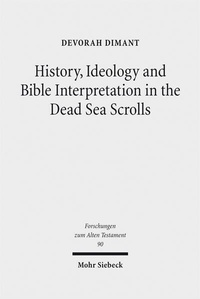
History, Ideology and Bible Interpretation in the Dead Sea Scrolls
Collected Studies
1. Auflage
Erschienen am 12. Februar 2014
610 Seiten
978-3-16-152851-4 (ISBN)
Beschreibung

Devorah Dimant versammelt in diesem Band siebenundzwanzig vollständig überarbeitete und teilweise neu geschriebene Aufsätze zu den verschiedenen Aspekten der Schriftrollen vom Toten Meer, die sie in den letzten drei Jahrzehnten veröffentlicht hat. Ein einleitender Aufsatz, der speziell für diesen Band verfasst wurde, gibt einen Überblick über den gegenwärtigen Stand der Forschung zu den Schriftrollen. Die Autorin behandelt zentrale Themen der Schriftrollen vom Toten Meer und reflektiert die rasche Ausbreitung und den Wandel der Forschungsperspektive auf die Sammlung in den Jahren nach ihrer vollständigen Veröffentlichung. Zu den behandelten Themen zählen auch Form und Inhalt der Sammlung als Ganzes, die spezielle Literatur der Gemeinde, der diese Sammlung gehörte, die aramäischen Texte und die apokryphen und pseudepigraphischen Werke, die darin entdeckt wurden. Der Band enthält auch Untersuchungen zu spezifischen Themen wie der Geschichte der Gemeinde, zu der die Schriftrollen gehörten, ihr Selbstbild sowie bestimmte Deutungen von biblischen Verheißungen und ihr Zeitverständnis.
Weitere Details
Weitere Ausgaben
Andere Ausgaben
Buch
02/2014
1. Auflage
Mohr Siebeck
214,00 €
Artikel ist vergriffen; siehe andere Ausgabe
Person
Inhalt
- Cover
- Preface
- Table of Contents
- Acknowledgments
- Abbreviations
- Introductory Essay: The Study of the Dead Sea Scrolls - Past and Present
- The First Phase of Qumran Research: 1950-1980
- Critique of the First Phase of Research
- Qumran Research from 1980 Onwards: New Texts and New Perspectives
- The Sectarian Literature as a Distinct Corpus
- The Nonsectarian Texts
- The Qumran Library
- The Qumran Manuscripts: Contents and Significance
- Principles of the Present Classification
- Results of the Present Revision
- The Character of the Qumran Library
- Configuration of the Qumran Collection
- Literary Genres
- The Aramaic Texts
- The Manuscripts and the Qumran Site
- The Collection in Historical Perspective
- Appendix
- Table I: List of Nonbiblical Qumranic Works and Mss
- Table II: Cave Distribution
- Table III: Types Of Works And Their Distribution
- The Vocabulary of the Qumran Sectarian Texts
- Introduction: A History of the Research
- Principles for the Selection of Criteria for Classifying the Qumran Texts
- Criteria for the Definition of Sectarian Writings
- 1. Terms Related to the Community and its Organizational Structure
- 1.1 Epithets for the community
- 1.2 Designations of the community members
- 1.3 Designations for the community's institutions
- 2. Terms Relating to the Community's History and Controversies
- 3. Terms Related to the Worldview of the Community
- 3.1 Terms and expressions associated with dualism
- 3.2 Expressions and terms that reflect the doctrine of predestination
- 3.3 Terms pertaining to the conduct and practices required of the sectaries
- Linguistic Terms Exclusive to Sectarian Writings
- Texts Whose Provenance is Disputed - Three Examples
- 1. Instruction
- 2. Daily Prayers (4Q503)
- 3. The Songs of the Sabbath Sacrifice
- Compositions that Exhibit Affinities with the Ideas of the Scrolls Community but Lack its Distinctive Terminology and Style
- Conclusion
- Sectarian and Nonsectarian Texts from Qumran: The Pertinence and Use of a Taxonomy
- Classification
- Covenant of the Fathers
- Between Sectarian and Nonsectarian: The Case of the Apocryphon of Joshua
- A. The Crossing of the Jordan
- Notes on Readings
- Translation
- Comments
- Discussion
- B. The Tent of Meeting in Canaan
- Translation
- C. The Curse of Joshua
- Notes on Readings
- Col i
- Translation
- Translation of the Combined Text
- Comments on the Combined Text
- Discussion
- Conclusion
- Between Qumran Sectarian and Qumran Nonsectarian Texts: The Case of Belial and Mastema
- Introduction
- Belial
- Mst?mh
- Conclusions
- Apocrypha and Pseudepigrapha at Qumran
- Copies of Previously Known Writings
- I. Apocrypha
- II. Pseudepigrapha
- Copies of Previously Unknown Writings
- Hebrew
- I. Texts Akin to the Traditional Apocrypha
- II. Pseudepigrapha
- III. Nonbiblical Compositions
- Aramaic
- I. Compositions Related to the Bible
- II. Nonbiblical Apocalypses and Visions
- III. Legendary Narratives
- Observations
- Distinctiveness
- Classification
- Rewritten Bible Texts
- Language
- Greek Texts
- The Composite Character of the Qumran Sectarian Literature as an Indication of Its Date and Provenance
- a. The Rule of the Community
- b. Hodayot (1QH?)
- c. The War Scroll (1QM)
- The Qumran Aramaic Texts and the Qumran Community
- Themes and Genres in the Aramaic Texts from Qumran
- The History of the Qumran Community
- The History of the Qumran Community in Light of New Developments in the Study of the Scrolls
- I. Initial Discoveries
- II. The Qumran Site and the Caves
- The Nature of the Qumran Site
- Specific Features of the Qumran Site
- The Qumran Site and the Scroll Caves
- The Qumran Site and the Scrolls in Light of New Findings
- III. The Community Depicted in the Scrolls and the Qumran Settlement are Essene
- IV. The Origins and History of the Qumran Community
- Themes in the Qumran Literature
- Resurrection, Restoration, and Time-Curtailing at Qumran, and in Early Judaism and Christianity
- Introduction
- Analysis of 4Q385 I-VI
- Early Jewish and Christian Exegesis Related to Resurrection
- Appendix
- Translation of the Main Fragments from Pseudo-Ezekiel as Reconstructed in 4Q385
- 4QFlorilegium and the Idea of the Community as a Temple
- 4QFlor (= 4Q174) 1 i 1-13
- Notes on Readings
- Translation
- Comments
- Discussion
- Exegetical Structure of the Pesher
- Translation
- First Unit: Pesher on 2 Sam 7:10-11a (Lines 1-7a) - The Three Temples
- Second Unit: Pesher on 2 Sam 7:11b (Lines 7b-9) - The Future of David'sLineage
- Third Unit: Pesher on 2 Sam 7:11c-14 (Lines 10-13)
- The Pesher on 2 Samuel 7 in the Context of the Sectarian Ideology
- The Volunteers in the Rule of the Community: A Biblical Notion in Sectarian Garb
- Time, Torah and Prophecy at Qumran
- Exegesis and Time in the Pesharim from Qumran
- a. The Pesher of the Sure House (CD III-IV)
- b. The Pesher on the Curse of Joshua (4Q379 22 ii//4Q175 21-30)
- c. The Prophecy of Jeremiah Interpreted by Daniel 9
- Texts from Qumran
- The Apocryphon of Joshua - 4Q522 9 ii: A Reappraisal
- 4Q522 Frag. 9, Col. ii
- Notes on Readings
- Translation
- Comments
- Discussion
- Two "Scientific" Fictions: The So-Called Book of Noah and the Alleged Quotation from Jubilees in the Damascus Document XVI, 3-4
- The So-Called Book of Noah
- 1 Enoch 6-11
- 1 Enoch 39:1-2
- 54:7-55:2
- 60
- 65-69:25
- 1 Enoch 106-107
- Jubilees 7:20-39
- 10:1-15
- The Alleged Citation of the Jubilees prologue in the Damascus Document XVI, 3-4
- What is the "Book of the Divisions of the Times"?
- "Division" and "Divisions"
- "Time" and "Times"
- The Expression "the Divisions of the Times" in the Qumran Scrolls
- 4Q228 1 i
- Translation
- Comments
- 4Q217 2
- Translation
- "The Divisions of the Times" in the Damascus Document
- "The Divisions of the Times" and Jubilees
- What is the "Book of the Divisions of Times"?
- The Pesher on the Periods (4Q180) and 4Q181
- 4Q180
- Frg. 1
- Notes on Readings
- Translation
- Comments
- Frgs. 2-4
- Notes on Readings
- Translation
- Comments
- Frgs. 5-6
- Translation
- Comments
- Frg. 7
- Discussion
- 4Q180 and 4Q181 are not Copies of the Same Work
- On Righteous and Sinners: 4Q181 Reconsidered
- 4Q181
- Frg. 2
- Notes on Readings
- Translation
- Comments
- Frg. 1
- Notes on Readings
- Translation
- Notes on the Translation
- Comments
- Discussion
- Relationship between 4Q181 and 4Q180
- Pseudo-Ezekiel and the Apocryphon of Jeremiah C in Perspective
- Not the Testament of Judah but the Words of Benjamin: The Character of 4Q538
- 4Q538
- Frg. 1
- Frg. 2
- Frg. 3
- Frg. 4
- Notes on Readings
- Translation
- Comments
- Frgs. 1 + 2 - The Combined Version
- Translation of the Combined Text
- Comments on the Combined Text
- Discussion
- Not Exile in the Desert but Exile in Spirit: The Pesher of Isa 40:3 in the Rule of the Community and the History of the Scrolls Community
- Men as Angels: The Self-Image of the Qumran Community
- David's Youth in the Qumran Context (11QPs? XXVIII, 3-12)
- Abraham the Astrologer at Qumran? Observations on Pseudo-Jubilees (4Q225 2 i 3-8)
- 4Q225 2 i
- Translation
- Melchizedek at Qumran and in Judaism
- DJD Volumes Cited in the Bibliography
- Bibliographic Abbreviations
- Index of Sources
- Apocrypha
- New Testament
- Pseudepigrapha
- Other Ancient Works
- Qumran
- Philo of Alexandria
- Josephus Flavius
- Christian Writings
- Rabbinic Writings
- Later Jewish Sources
- Index of Names and Subjects
