

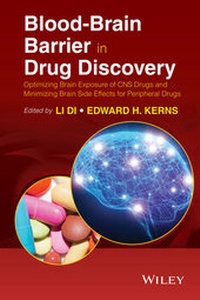
Blood-Brain Barrier in Drug Discovery
Beschreibung

Weitere Details
Weitere Ausgaben
Andere Ausgaben
Personen
Inhalt
1
Introduction and Overview
Li Di1 and Edward H. Kerns2
1 Pharmacokinetics, Dynamics and Metabolism, Pfizer Inc., Groton, CT, USA
2 Laytonsville, MD, USA
Brain exposure can affect drug development success for all diseases. For neuroscience therapeutics, a leading area of pharmaceutical research, development, and product portfolios in pharmaceutical companies and research institutions, insufficient brain exposure leaves many central nervous system (CNS) diseases untreated or without optimum drugs, despite the vast resources applied to the problem. Researchers working to treat CNS diseases were stymied by the blood-brain barrier (BBB), but, in recent years, experience led to improved drug exposure at brain targets. Conversely, researchers working on peripheral diseases encountered CNS side effects owing to brain exposure at unintended CNS targets, but they are increasingly successful at reducing brain exposure. These advances on brain exposure came as pharmaceutical science uncovered the intricacies of drug molecule interactions at the BBB and within brain tissue. Newly discovered interactions provide an opportunity to overcome previous project disappointments, understand previously unexplained observations, and enable new tools for successful drug development.
This book comprises the contributions of experts regarding the complex interactions encountered by drug molecules that affect brain exposure and their successful solution in drug discovery, development, and clinical studies, including the following:
- Complexities of brain physiology and anatomy
- Designing CNS drug candidates to reduce transporter BBB efflux or increase BBB uptake
- Designing peripheral drugs to increase BBB efflux
- Focus on brain free drug concentration for efficacy
- Constructing novel biologics to deliver therapeutic molecules to the CNS
- Building pharmacokinetic-pharmacodynamic (PK/PD) and physiologically-based pharmacokinetic (PBPK) models for CNS therapy
- Projecting in vivo CNS exposure
- Nanotechnology and nasal dosing for CNS delivery
- In silico, in vitro, and in vivo methods of predicting and measuring CNS barriers, exposure, and free drug concentration
- Imaging for CNS therapy
- Case studies of successful recent drug product advances in brain delivery enhancement or reduction
Restricted Brain Exposure Reduces CNS Drug Efficacy
A primary cause of the disappointment in developing CNS disease treatments is that the brain is a difficult organ for drug therapy. In past years, a high percentage of promising CNS drug candidates have failed. A major cause of this failure is the restricted access of many drug candidates circulating in the blood to penetrate into the brain owing to the BBB. Chapters 2 and 4 discuss the physiology of the BBB and differences among species and disease states. For most organs, drug molecules freely move between the blood and tissue via open junctions between capillary cells, but the BBB presents greater restrictions via tight junctions that reduce drug molecule access to brain tissue. Thus, molecules that do not have facile passive transcellular diffusion (e.g., acids, biologics) are restricted. In addition, efflux transporters (e.g., Pgp, BCRP), actively pump the molecules of some compounds out of the brain. These barriers to BBB permeation and the general characteristics of compounds that are efflux substrates are detailed in Chapters 5 and 6. These barriers effectively reduce the concentration, and therefore the efficacy, of some potentially therapeutic drug molecules to brain cells.
Another component of brain exposure restriction is binding of drug molecules to blood and brain tissue components. This restricts the free drug concentration that is available to bind to the therapeutic target protein molecules. In past years, the concentration of drug molecules that are available to bind to the brain target was assumed to be the total concentration measured in the brain tissue. However, in recent years, there has been a major shift in acceptance and application of the Free Drug Hypothesis, which states that only the unbound drug molecules are available to bind to the target to produce efficacy. Binding varies with the structure and physicochemical properties of each compound. This recognition has solved many previously unexplained failures in translation from in vitro activity to in vivo efficacy. The primary role of free drug concentration in determining in vivo efficacy is now being widely applied to CNS research and is reviewed in Chapter 3.
Permitted CNS Access Increases Side Effects of Peripheral Drugs
Many drug candidates for peripheral therapeutic targets have minimal restrictions in penetrating the BBB and affecting brain targets. For example, they may have high passive diffusion through the BBB endothelial cells and not be efflux substrates. These drugs penetrate into the brain and may interact with CNS targets to cause difficult side effects for patients. Such effects lead to research project cancelation, regulatory rejection, drug product use restrictions, reduction of patient administration compliance, and long-term toxicities. For these reasons, drug researchers and developers need to investigate whether a new drug candidate causes unfavorable CNS effects in vivo. Chapters 20 and 21 explain this issue for peripheral drugs and how it may be overcome.
A New Generation of CNS Exposure Tools
As the interactions affecting brain exposure are elucidated, in silico, in vitro, and in vivo methods for these interactions are developed. In addition, these interactions are included in methods for in vivo projection. Such methods allow drug researchers to screen for potential problems, measure specific interactions (e.g., Pgp efflux), and quantitate how they affect drug tissue concentrations in vivo. These tools provide reliable information for lead selection and optimization to benefit drug research projects throughout their progress. Chapter 9 discusses the development and state of the art of in silico BBB predictions. BBB permeability is often predicted using in vitro artificial and cell membrane assays (Chapters 10 and 11). Another component of brain exposure assessment is in vitro assays for brain binding, as discussed in Chapter 12. This information is typically used in combination with in vivo brain exposure studies (Chapter 13) to determine the free drug concentration in brain tissue. Direct measurement of free drug concentration using microdialysis is reviewed in Chapter 16. Another important advance in the field of brain exposure is the replacement of the Log BB and B/P parameters by the more valuable Kp,uu, the free drug distribution coefficient between brain and plasma, as discussed in Chapters 2, 3, 4, and 18. There is an increasing sophistication in PBPK modeling for the BBB (Chapter 14) and PK/PD model building (Chapter 15) for CNS drug candidates, which improve interpretations of biological efficacy, as well as projections for higher animals and human clinical studies. Recent advances in imaging techniques for CNS discovery research are discussed in Chapter 17.
Drug design advancements for brain exposure enhancement have taken advantage of the growing knowledge of drug interactions at the BBB. Small molecule design to optimize exposure (Chapter 18) and case study examples (Chapter 19) report successful strategies in CNS drug discovery. Concepts for the enhancement of brain exposure by designing drugs as substrates for BBB uptake transporters are advancing and are reviewed in Chapter 7. Biological drugs (antibodies, proteins) of higher-molecular weight generally do not pass the BBB. However, recent success in delivering biologics was achieved by making constructs that contain the biological drug and a group that binds to a BBB receptor that promotes transport across the BBB. Chapter 8 explains the exciting progress in this promising field.
Researchers working on peripheral drugs will benefit from insights into the design suggestions for minimizing brain exposure in Chapter 20 and the successful case studies on nonsedative antihistamines in Chapter 21 that have efficacy at peripheral targets but are restricted by the BBB from producing effects at the same or closely related receptors in the brain.
For more compounds that are very recalcitrant to CNS exposure, researchers are developing new concepts for CNS delivery. Technologies using nanotechnology have the possibility to enhance delivery across the BBB (Chapter 24). Concepts and evidence for CNS drug delivery using the nasal route is also reviewed in Chapter 25.
Case Studies of Drug Development Successes
We often find guidance from successful case study examples. Thus, colleagues have kindly provided successful CNS exposure case studies for fycompa, an AMPA receptor antagonist (Chapter 22) and for vortioxetine, a serotonin modulator and simulator (Chapter 23). The inspiration and enlightenment of these experienced examples provide encouragement and direction for our research projects.
Conclusion
This book was prepared with the purpose of benefiting drug researchers in the following areas:
- Fundamental knowledge about the BBB and drug binding
- Implications of these restrictions for brain pharmacokinetics (PK) and pharmacodynamics (PD)
- Drug...
