

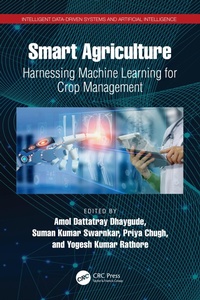
Smart Agriculture
Harnessing Machine Learning for Crop Management
1. Auflage
Erschienen am 18. Dezember 2024
182 Seiten
978-1-040-26905-3 (ISBN)
Beschreibung

This book, Smart Agriculture: Harnessing Machine Learning for Crop Management, is a comprehensive guide designed to explore the various facets of integrating machine learning into agricultural practices. It aims to provide readers with a solid foundation in machine learning concepts while demonstrating their practical applications in real-world farming scenarios. It also examines the role of remote monitoring and precision agriculture, highlighting how technologies such as remote sensing and recurrent neural networks can optimize farming practices.
This book:
Emphasizes sustainable agricultural practices and data-driven decision-making for eco-friendly farming.
Highlights the importance of using environmentally friendly practices, and how machine learning can play a pivotal role in achieving sustainability goals.
Discusses topics such as crop optimization, disease detection, pest control, resource management, precision agriculture, and sustainability.
Covers predictive analytics for weather forecasting, Internet of Things applications for precision agriculture, and the role of sensors in data collection.
Illustrates optimizing resource allocation, irrigation with artificial intelligence, and machine learning for soil health assessment.
Whether you are a researcher, a student, an agricultural professional, or a technology enthusiast, this book offers valuable insights into the transformative power of machine learning in agriculture. It invites readers to explore the potential of machine learning to transform farming practices, improve food security, and promote environmental sustainability.
This book:
Emphasizes sustainable agricultural practices and data-driven decision-making for eco-friendly farming.
Highlights the importance of using environmentally friendly practices, and how machine learning can play a pivotal role in achieving sustainability goals.
Discusses topics such as crop optimization, disease detection, pest control, resource management, precision agriculture, and sustainability.
Covers predictive analytics for weather forecasting, Internet of Things applications for precision agriculture, and the role of sensors in data collection.
Illustrates optimizing resource allocation, irrigation with artificial intelligence, and machine learning for soil health assessment.
Whether you are a researcher, a student, an agricultural professional, or a technology enthusiast, this book offers valuable insights into the transformative power of machine learning in agriculture. It invites readers to explore the potential of machine learning to transform farming practices, improve food security, and promote environmental sustainability.
Weitere Details
Reihe
Auflage
1. Auflage
Sprache
Englisch
Verlagsort
London
Großbritannien
Verlagsgruppe
Taylor & Francis Ltd
Zielgruppe
Für höhere Schule und Studium
Für Beruf und Forschung
Illustrationen
27 Tables, black and white; 35 Line drawings, black and white; 11 Halftones, black and white; 46 Illustrations, black and white
ISBN-13
978-1-040-26905-3 (9781040269053)
Copyright in bibliographic data and cover images is held by Nielsen Book Services Limited or by the publishers or by their respective licensors: all rights reserved.
Schweitzer Klassifikation
Weitere Ausgaben
Andere Ausgaben

Smart Agriculture
Harnessing Machine Learning for Crop Management
Buch
01/2025
CRC Press
Preis leider unbekannt
Lieferbar (Termin auf Anfrage)

Smart Agriculture
Harnessing Machine Learning for Crop Management
Buch
01/2025
1. Auflage
CRC Press
85,42 €
Versand in 10-20 Tagen
Amol Dattatray Dhaygude | Suman Kumar Swarnkar | Priya Chugh
Smart Agriculture
Harnessing Machine Learning for Crop Management
Buch
12/2024
1. Auflage
CRC Press
110,40 €
Versand in 10-20 Tagen
Personen
Amol Dattatray Dhaygude is a renowned professional in the field of machine learning, artificial intelligence, data science and computer science. He is an alumnus of University of Washington, Seattle, USA with a master of science degree in data science and specialization in machine learning. Amol has 16 years of software industry experience in top-tier organizations including IBM, Cognizant, and Microsoft Corporation. He has been employed at Microsoft Corporation for the last ten years in the role of Senior Data and Applied at Redmond, Washington. He is inspired to make use of cutting-edge technological advancements in the field of machine learning and artificial intelligence to solve real-world practical problems, making a difference in the world. He has strong techno business acumen to formulate and solve business problems with applications of data science, machine learning and artificial intelligence. He is well-versed in deep learning, natural language processing, and computer vision fields of artificial intelligence.
Suman Kumar Swarnkar is a highly accomplished professional with a Ph.D. and M.Tech qualifications. With over a decade of experience in educational institutions, Dr. Swarnkar has been serving as an Assistant Professor in the Computer Science & Engineering Department at Shri Shankaracharya Institute of Professional Management and Technology, Durg, Chhattisgarh, India. His expertise includes mentoring over ten MTech Scholars and securing more than ten granted patents in India, Australia, and the United Kingdom. Dr. Swarnkar has also made significant contributions to academia with over ten research papers published in international journals indexed in Scopus. Additionally, he has actively participated in 7+ IEEE international conferences and holds memberships in various professional organizations such as IEEE, Computer Society, IAENG, ASR, ICSES, and the Internet Society. Dr. Swarnkar's dedication to professional development is evident through his successful completion of numerous Faculty Development Programs (FDPs), training programs, webinars, and workshops, along with a comprehensive two-week online Patent Information Course. His proficiency extends to managing teaching, research, and administrative responsibilities with great expertise and diligence.
Priya Chugh obtained her Ph.D. from Punjab Agricultural University, Ludhiana, Pujab, India. She has more than three years experience in teaching and research. Her doctoral research emphasis on effect of crop species toward climate change. She has published more than eight research papers, seven book chapters and two review papers. She has a passion for writing interdisciplinary research that opens up new creative and informative ideas. She has also participated in various national and international interdisciplinary conferences. Presently, she is working as Assistant Professor at the School of Agriculture, Dehradun, Uttarakhand.
Yogesh Kumar Rathore received an M. Tech degree in computer science engineering from Chhattisgarh Swami Vivekanand Technical University, Bhilai, India in the year 2010, and a Ph.D. in information technology from the National Institute of Technology, Raipur. He has 16 years' experience of working, as a Asstistant Professor (Department of Computer Science Engineering) at Shri Shankaracharya Institute of Professional Management and Technology, Raipur, Chhattisgarh, India. He has published more than 40 research papers in various conferences and journals indexed in Scopus and the Science Citation Index. He has also contributed many book chapters in books published by international publishers and also published two patents on the topics of "RIFT based automatic parking system for vehicle" and "AI-based technique for plant disease identification". He has good hands-on C, MATLAB, IoT and Python programming language, which are the soul of much research in today's era. His interests include pattern recognition, image processing, video processing, deep learning, machine learning, and artificial intelligence.
Suman Kumar Swarnkar is a highly accomplished professional with a Ph.D. and M.Tech qualifications. With over a decade of experience in educational institutions, Dr. Swarnkar has been serving as an Assistant Professor in the Computer Science & Engineering Department at Shri Shankaracharya Institute of Professional Management and Technology, Durg, Chhattisgarh, India. His expertise includes mentoring over ten MTech Scholars and securing more than ten granted patents in India, Australia, and the United Kingdom. Dr. Swarnkar has also made significant contributions to academia with over ten research papers published in international journals indexed in Scopus. Additionally, he has actively participated in 7+ IEEE international conferences and holds memberships in various professional organizations such as IEEE, Computer Society, IAENG, ASR, ICSES, and the Internet Society. Dr. Swarnkar's dedication to professional development is evident through his successful completion of numerous Faculty Development Programs (FDPs), training programs, webinars, and workshops, along with a comprehensive two-week online Patent Information Course. His proficiency extends to managing teaching, research, and administrative responsibilities with great expertise and diligence.
Priya Chugh obtained her Ph.D. from Punjab Agricultural University, Ludhiana, Pujab, India. She has more than three years experience in teaching and research. Her doctoral research emphasis on effect of crop species toward climate change. She has published more than eight research papers, seven book chapters and two review papers. She has a passion for writing interdisciplinary research that opens up new creative and informative ideas. She has also participated in various national and international interdisciplinary conferences. Presently, she is working as Assistant Professor at the School of Agriculture, Dehradun, Uttarakhand.
Yogesh Kumar Rathore received an M. Tech degree in computer science engineering from Chhattisgarh Swami Vivekanand Technical University, Bhilai, India in the year 2010, and a Ph.D. in information technology from the National Institute of Technology, Raipur. He has 16 years' experience of working, as a Asstistant Professor (Department of Computer Science Engineering) at Shri Shankaracharya Institute of Professional Management and Technology, Raipur, Chhattisgarh, India. He has published more than 40 research papers in various conferences and journals indexed in Scopus and the Science Citation Index. He has also contributed many book chapters in books published by international publishers and also published two patents on the topics of "RIFT based automatic parking system for vehicle" and "AI-based technique for plant disease identification". He has good hands-on C, MATLAB, IoT and Python programming language, which are the soul of much research in today's era. His interests include pattern recognition, image processing, video processing, deep learning, machine learning, and artificial intelligence.
Inhalt
1. Reviewing Detection of Plant Disease by making use of Machine Learning Mechanism. 2. Future Prospects and Challenges of Digital Transformation in Agriculture and Dairy Industries Mechanisms. 3. Innovative IoT-Driven Solutions for Real-Time Crop Health Surveillance and Precision Agriculture. 4. Optimizing Resource Allocation in Precision Agriculture through the Application of K-Means Clustering. 5. Upholding Ethical Standards in Modern Agriculture: An Examination of Privacy-Preserving Machine Learning Techniques. 6. Exploring the Effectiveness of Decision Trees for Comprehensive Detection of Crop Diseases in Agricultural Environments. 7. Integrating Deep Learning and Image Recognition in Smart Farming. 8. Exploring the Effectiveness of Decision Trees for Comprehensive Detection of Crop Diseases in Agricultural Environments. 9. Enhancing Crop Yield Prediction Accuracy through the Application of Gradient Descent Optimization Algorithms. 10. Machine Learning Models for Early Detection of Pest Infestation in Crops: A Comparative Study.
