

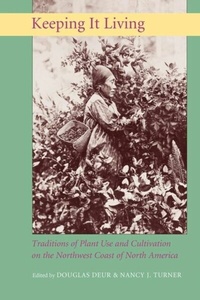
Keeping It Living
Beschreibung
The European explorers who first visited the Northwest Coast of North America assumed that the entire region was virtually untouched wilderness whose occupants used the land only minimally, hunting and gathering shoots, roots, and berries that were peripheral to a diet and culture focused on salmon. Colonizers who followed the explorers used these claims to justify the displacement of Native groups from their lands. Scholars now understand, however, that Northwest Coast peoples were actively cultivating plants well before their first contact with Europeans. This book is the first comprehensive overview of how Northwest Coast Native Americans managed the landscape and cared for the plant communities on which they depended.
Bringing together some of the world's most prominent specialists on Northwest Coast cultures, Keeping It Living tells the story of traditional plant cultivation practices found from the Oregon coast to Southeast Alaska. It explores tobacco gardens among the Haida and Tlingit, managed camas plots among the Coast Salish of Puget Sound and the Strait of Georgia, estuarine root gardens along the central coast of British Columbia, wapato maintenance on the Columbia and Fraser Rivers, and tended berry plots up and down the entire coast.
With contributions from ethnobotanists, archaeologists, anthropologists, geographers, ecologists, and Native American scholars and elders, Keeping It Living documents practices, many unknown to European peoples, that involve manipulating plants as well as their environments in ways that enhanced culturally preferred plants and plant communities. It describes how indigenous peoples of this region used and cared for over 300 different species of plants, from the lofty red cedar to diminutive plants of backwater bogs.
Alle Preise
Weitere Details
Weitere Ausgaben
Personen
Douglas Deur is research coordinator with the Pacific Northwest Cooperative Ecosystem Studies Unit at the University of Washington and adjunct professor of geography at the University of Nevada, Reno. Nancy J. Turner is distinguished professor in environmental studies and geography at the University of Victoria. The other contributors include Kenneth M. Ames, E. Richard Atleo (Umeek), Melissa Darby, Douglas Hallett, James T. Jones, Dana Lepofsky, Ken Lertzman, Rolf Mathewes, James McDonald, Albert (Sonny) McHalsie, Madonna L. Moss, Sandra Peacock, Bruce D. Smith, Robin Smith, Wayne Suttles, and Kevin Washbrook.
Inhalt
Preface / E. Richard Atleo, Umeek of Ahousat
1. Introduction: Reassessing Indigenous Resource Management, Reassessing the History of an Idea / Douglas Deur and Nancy J. Turner
Part I. Concepts
2. Low-Level Food Production and the Northwest Coast / Bruce D. Smith
3. Intensification of Food Production on the Northwest Coast and Elsewhere / Kenneth M. Ames
4. Solving the Perennial Pardox: Ethnobotanical Evidence for Plant Resource Management on the Northwest Coast / Nancy J. Turner and Sandra Peacock
5. "A Fine Line Between Two Nations": Ownership Patterns for Plant Resources among Northwest Coast Indigenous Peoples / Nancy J. Turner, Robin Smith, and James T. Jones
Part II. Case Studies
6. Coast Salish Resource Management: Incipient Agriculture? / Wayne Suttles
7. The Intensification of Wapato (Sagittaria latifolia) by the Chinookan People of the Lower Columbia River / Melissa Darby
8. Documenting Precontact Plant Management on the Northwest Coast: An Example of Prescribed Burning in the Central and Upper Fraser Valley, British Columbia / Dana Lepofsky, Douglas Hallett, Ken Lertzman, Rolf Mathewes, Albert (Sonny) McHalsie, and Kevin Washbrook
9. Cultivating in the Northwest: Early Accounts of Tsimshian Horticulture / James McDonald
10. Tlingit Horticulture: An Indigenous or Introduced Development? / Madonna L. Moss
11. Tending the Garden, Making the Soil: Northwest Coast Estuarine Gardens as Engineered Enrivonments / Douglas Deur
Part III. Conclusions
12. Conclusions / Douglas Deur and Nancy J. Turner
Bibliography
Contributors
Index
