

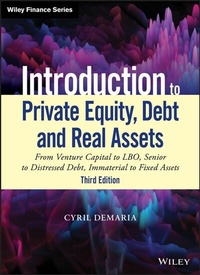
Introduction to Private Equity, Debt and Real Assets
Beschreibung

Building on and refining the content of previous editions, Introduction to Private Equity, Debt and Real Assets, Third Edition adopts the same logical, systematic, factual and long-term perspective on private markets (private equity, private debt and private real assets) combining academic rigour with extensive practical experience.
The content has been fully revised to reflect developments and innovations in private markets, exploring new strategies, changes in structuring and the drive of new regulations. New sections have been added, covering fund raising and fund analysis, portfolio construction and risk measurement, as well as liquidity and start-up analysis. In addition, private debt and private real assets are given greater focus, with two new chapters analysing the current state of these evolving sectors.
* Reflects the dramatic changes that have affected the private market industry, which is evolving rapidly, internationalizing and maturing fast
* Provides a clear, synthetic and critical perspective of the industry from a professional who has worked at many levels within the industry
* Approaches the private markets sector top-down, to provide a sense of its evolution and how the current situation has been built
* Details the interrelations between investors, funds, fund managers and entrepreneurs
This book provides a balanced perspective on the corporate governance challenges affecting the industry and draws perspectives on the evolution of the sector.
Weitere Details
Weitere Ausgaben
Andere Ausgaben
Person
CYRIL DEMARIA is a Partner and Head of private markets at Wellershoff & Partners, an independent CIO service provider for family offices and financial institutions. A private equity expert combining academic expertise and practical experience, his extensive knowledge of the asset class spans more than 20 years during which he has notably held positions at the Chief Investment Office of UBS, where he was in charge of private markets research (buy-side). He is the founder and managing partner of two venture capital funds. He is also an Affiliate Professor at EDHEC and lectures at top academic institutions such as HEC Paris, EADA, and ESCP-Europe. He is an expert and a trainer for leading private equity associations such as Invest Europe, France Invest and SECA, and has authored best-selling books, such as Introduction to Private Equity which has been translated in multiple languages, and Private Equity Fund Investments.
Inhalt
Acknowledgements ix
About the Author xi
Introduction 1
Part I What are Private Equity, Private Debt and Private Real Assets?
Chapter 1 Private Equity as an Economic Driver: An Historical Perspective 15
Chapter 2 Modern Private Equity - A French Invention? 39
Part II The Private Markets Ecosystem
Chapter 3 Private Markets: A Business System Perspective 85
Chapter 4 The Universe of Investment 145
Chapter 5 The Process of Investment: A Matter of Trust and Mutual Interest 245
Part III Private Markets in Teenage Time: Trend Setting, Fads and Responsibilities
Chapter 6 Private Markets Evolution: Trends or Buzzes? 267
Chapter 7 Private Equity and Ethics: A Culture Clash 287
Chapter 8 General Conclusion: Private Markets Today and Tomorrow 309
Template 1 (Fund): Architecture of the Private Placement Memorandum of a Private Equity Fund 329
Template 2 (Fund): Structure of a Limited Partnership Agreement 331
Template 3 (Fund): Due Diligence Checklist 335
Template 4 (Fund): Quarterly Report Template 339
Template 5 (Company): Non-Disclosure Agreement 343
Template 6 (Company): Business Plan 347
Template 7 (Company): Term Sheet 353
Business Case: Kroton Educacional SA - A Private Equity Operation Can Hide Another One 363
Exhibits 379
Glossary 389
Bibliography 425
Index 439
Introduction
The initial version of this book was born as an exercise of pedagogy in a sector which was largely uncharted: private equity. I wrote then that it was the direct result of 'my experience of reading the available literature and my recurring lack of satisfaction regarding their ability to combine so as to formulate an articulate theory'. I was obviously not the only one. The success of the abridged French version of this book (Demaria, 2006, 2008, 2010, 2012, 2016 and 2018), of which the first edition as well as the updated reprints were each sold out within less than a year, tends to confirm it. The second edition was also translated into Spanish, Portuguese and Mandarin, reaching an even wider public.
Things have changed. First, there are now multiple books on private equity, at times highly opiniated (Phalippou, 2017). This is a positive development, as we all collectively need multiple sources of information of high quality. Many academics from different disciplines, as well as finance practitioners, have also tried to contribute to public enlightenment, often with considerable success. Highly acclaimed academics, such as Josh Lerner, Antoinette Schoar and Paul Gompers in the USA, or Per Stromberg, Tim Jenkinson and Douglas Cumming in Europe, are a few of a growing academic community extending our knowledge of this difficult and largely misunderstood part of a broader category of finance called 'alternative assets'. Private equity has benefitted from their efforts tremendously. There have also been honourable attempts to paint a portrait of private equity by famous and reputable practitioners, such as The Institute of Chartered Accountants of England and Wales (ICAEW).
However, one of the recurring criticisms made notably to many academic works is that they often remain prisoners of ill-adapted theoretical frameworks. Using toolboxes designed for analysing quantitative data, these frameworks soon reveal their limitations. The discrepancies which can be observed between research by academic authors and empirical observations by practitioners are a testimony to their inadequacy. There are constant gaps between the findings of the former and the facts as reported by the latter. Multiple sources rehash outdated content (at times biased), trying to valiantly maintain an illusion of coherence - with some dogmas coming from the analysis of listed markets. Many concepts, such as efficient markets and the measure of risks through volatility, are inadapted. This should now be clear and acknowledged - notably as they are not even relevant for listed markets.
It is time to devise new instruments, a task long overdue. Private equity cannot be turned simply into equations as is done for hedge funds. It requires specific tools, for example to analyse its performance, risk and liquidity. Indeed, acknowledging that liquidity is not a risk but a variable of private equity investing and thus supporting specific analyses should now be straightforward. The consequences of this acceptation are that there are three dimensions to analyse systematically, instead of two. This notably changes the framework to analyse the source of value creation in private equity specifically, where there is no such thing as an 'illiquidity premium' (a concept only applicable in fixed income).
Second, the sector has grown very fast and morphed multiple times. To say that private equity is moving fast is an understatement. We try to keep up with these fast-paced changes, which is why this third edition goes beyond a simple update. Private equity has become part of a larger sector, often referred to as 'private markets', 'private capital' or 'private finance'. In previous editions, we presented what is now distinctly identified as 'private debt' and 'private assets' as part of the private equity universe. They are now autonomous, and we have amended this book to take this into account. This third edition will therefore include developments on private debt and private real assets. We will also describe in more detail how funds work and how to analyse them. To be more complete, we will also include the analysis of a start-up. We have chosen to look at each piece of the private markets puzzle and recognise that they somehow do not form a harmonious and clear picture.
0.1 A MOVING TARGET
A confusing terminology
Private equity is constantly being redefined. Establishing a typology of transactions is thus especially tricky, notably when there is semantic confusion. One of them is the confusion between 'private equity' and 'leveraged buy-out' (LBO) in the USA, where they are used interchangeably. LBO is dedicated, as we will see, to the transfer of ownership (a buy-out) of a company, with the additional twist that the buyer uses debt for the acquisition (hence the leverage). Though LBOs represent the great majority of investments made in private equity in developed markets, they are just one of the components of private equity. The American confusion comes from the fact that LBO has a bad reputation there and the expression was in substance blacklisted. Associated historically with asset stripping, this reputation is now contaminating the expression 'private equity'. Warren Buffett, himself described by Burton Malkiel1 as a 'quasi private equity investor'2 (Kaczor, 2009), classified LBO managers as being 'porn shop operators', and the semantic confusion between private equity and LBO as 'Orwellian'.
Because of its constantly changing nature, the expression 'private equity' often covers only part of its field of action. Indeed, the 'private', which refers to 'unlisted', element is no longer decisive; nor is that of 'equity'.
Not just 'equity'
Stating that 'private equity' is (just) 'equity' is a mistake. From this assumption, it might also be assumed that private equity may be analysed validly with the tools used for public equities. This has so far been proven wrong: the timeframe, the risks, the skills required and the returns associated with private equity investments differ substantially from those associated with public equities.
The defining feature is the value creation, which is the result of the implementation of a plan by the management on behalf of the owner(s) of the company, also referred to as 'investor(s)'. A focus on value creation also applies to the more recent segments of the private markets universe, such as private debt and private real assets. Investors analyse companies and assets to assess their plans for development (or restructuring in specific cases). In the case of specific private debt strategies such as direct lending, although the 'governance' is structured through debt contracts, investors monitor the implementation of the plan and act in case of significant deviation from it.
Not necessarily 'private'
To implement this plan efficiently, the company benefits from being private. Some companies, such as Dell in 2013, can be delisted to undertake significant changes. In this example, Silver Lake Partners and Michael Dell acquired the company for USD 24.4 billion to take it private and launch a stream of acquisitions, such as EMC for USD 67 billion in 2015.
Therefore, if it is not 'equity', then 'private' could appear as defining the sector. Once again, this has been proven wrong: although private, that is non-listed assets, companies and assets can implement plans more easily, some private equity investors also operate on the stock exchange. For example, in the case of a private investment in public entities (PIPE), investors inject significant capital in profitable and growing listed companies in what is usually described in private equity as 'growth capital'. Other investors execute their private equity investment with a listed structure, such as a Business Development Company (BDC) or Special Purpose Acquisition Company (SPAC).
The common and defining feature of these investments in private or public entities is their long holding period: the average 3 to 5 years during which the company is held by the investor in private equity. This is necessary to implement the plan referred to above to create value. This differentiates, for example, private equity investors from activist investors. The latter belong to the hedge fund world and borrow some of the tools from the private equity box to apply them to listed companies. Their holding periods are shorter than in private equity.
More than private equity: the emergence of new 'private market' segments
The criteria of value creation and long holding periods support the identification of additional segments in private markets. Private debt has long been in the shadow of private equity. After all, two of the oldest strategies in the book are focusing on convertible debt: mezzanine debt and distressed debt. They are 'quasi private equity', in a way. Mezzanine debt is often associated with the acquisition of a company through LBO, by providing some of the debt for that purpose. Distressed debt aims at acquiring the debt of an ailing company under bankruptcy procedures and taking control of it by converting this debt into equity. However, their risk-return profiles differ significantly from private equity strategies. The emergence of direct lending (also known as senior lending), consisting of financing...
