

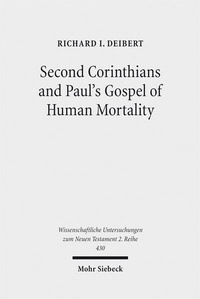
Second Corinthians and Paul's Gospel of Human Mortality
How Paul's Experience of Death Authorizes His Apostolic Authority in Corinth
1. Auflage
Erschienen am 31. Januar 2017
280 Seiten
978-3-16-153378-5 (ISBN)
Beschreibung

In diesem "close reading" des 2. Korintherbriefes und der Untersuchung der im griechisch-römischen Korinth vorherrschenden Haltungen dem Tod gegenüber schlägt Richard I. Deibert vor, dass Paulus' Sterblichkeit als Schlüssel dient, um sowohl das Rätsel des Einbruchs seiner Autorität in Korinth als auch die Essenz seines Evangeliums zu verstehen. Durch das Erlebnis seines eigenen physischen Todes erlebt Paulus die "Leblosigkeit" des wiederauferstandenen Jesus, welche ihm paradoxerweise Leben überträgt und durch ihn an seine Gemeinde. Paulus erkennt, dass der Tod in eine Quelle des Lebens verwandelt und somit die menschliche Sterblichkeit mit rettenden Kräften ausgestattet wurde. Diese Untersuchung der menschlichen Sterblichkeit macht deutlich, wie wichtig es sowohl zu Paulus' Zeiten als auch heutzutage war und ist, den Menschen als untrennbare Einheit von Körper und Geist zu begreifen und die Theologie auf die menschlicheErfahrung zu gründen. Richard I. Deiberts Arbeit ist nicht nur für Studierende der frühchristlichen und neutestamentlichen Geschichte interessant, sondern auch für Anthropologen, Philosophen und Theologen.
Weitere Details
Weitere Ausgaben
Andere Ausgaben
Richard I. Deibert
Second Corinthians and Paul's Gospel of Human Mortality
How Paul's Experience of Death Authorizes His Apostolic Authority in Corinth
Buch
01/2017
1. Auflage
Mohr Siebeck
94,00 €
Artikel ist vergriffen; siehe andere Ausgabe
Person
Autor*in
Born 1958; 1980 BA in Religion at Davidson College, Davidson, North Carolina; 1984 MD at University of Florida College of Medicine, Gainesville, Florida; 1985 Internship in Medicine and Pediatrics at Emory University School of Medicine, Atlanta, Georgia; 1989 MDiv at Columbia Theological Seminary, Atlanta, Georgia; 2005 PhD in New Testament, University of Cambridge; ordained minister in the Presbyterian Church (USA), with Eastern Orthodox leanings; served churches in Alabama, North Carolina, and Florida; currently practicing hospice and palliative care medicine for the dying with Tidewell Hospice in southwest Florida.
ISNI:
ISNI:
Inhalt
1 - Cover [Seite 1]
2 - Preface [Seite 6]
3 - Table of Contents [Seite 10]
4 - Chapter 1: Introduction, Issues, Method [Seite 16]
4.1 - 1.1 Introduction [Seite 16]
4.2 - 1.2 Literary & Historical Reconstruction of Second Corinthians [Seite 20]
4.3 - 1.3 Opponents [Seite 24]
4.4 - 1.4 Method [Seite 27]
4.5 - 1.5 Implications [Seite 30]
5 - Chapter 2: Death in Ancient Corinth: Attitudes that Contributed to the Fall of an Afflicted Apostle [Seite 33]
5.1 - 2.1 Introduction [Seite 33]
5.2 - 2.2 The History and Culture of the Corinthia [Seite 34]
5.3 - 2.3 Attitudes Toward Death in Graeco-Roman Corinth [Seite 45]
5.4 - 2.4 Attitudes Toward Death in Graeco-Roman Literature [Seite 51]
5.4.1 - 2.4.1 Plato: Phaedo [Seite 53]
5.4.1.1 - Plato's Body-Soul Dualism [Seite 54]
5.4.1.2 - Plato's Understanding of Physical Death [Seite 57]
5.4.1.3 - Plato's Understanding of the Soul's Immortality [Seite 58]
5.4.1.4 - Plato in Corinth [Seite 59]
5.4.2 - 2.4.2 Cicero: "Somnium Scipionis" in De Re Publica [Seite 61]
5.4.2.1 - Cicero's Personalisation of the Soul [Seite 62]
5.4.2.2 - Cicero in Corinth [Seite 65]
5.4.3 - 2.4.3 Virgil: Book Six of the Aeneid [Seite 66]
5.4.3.1 - Virgil's Depiction of Death [Seite 68]
5.4.3.2 - Virgil's Conceptualisation of Death [Seite 70]
5.4.3.3 - Echoes of Roman Funeral Practice [Seite 73]
5.4.3.4 - Virgil in Corinth [Seite 75]
5.5 - 2.5 Attitudes Toward Death in Roman Funeral Practice [Seite 77]
5.5.1 - 2.5.1 Pagan-Christian Syncretism [Seite 77]
5.5.2 - 2.5.2 Graeco-Roman Transition from Cremation to Inhumation [Seite 80]
5.5.3 - 2.5.3 The Roman Funeral and the Cult of the Dead [Seite 82]
5.5.3.1 - Rites for the Dying and Immediately Dead [Seite 83]
5.5.3.2 - Rites Following Death, Including Interment or Cremation [Seite 83]
5.5.3.3 - Rites Following Interment or Cremation [Seite 84]
5.5.3.4 - Continuity of Person, Corpse, and Soul in Roman Funeral Practice [Seite 84]
5.5.3.5 - Pre-burial Caution [Seite 85]
5.5.3.6 - Burial Procession [Seite 86]
5.5.3.7 - Burial Site Location [Seite 86]
5.5.3.8 - Burial Necessity [Seite 87]
5.5.3.9 - Corpse Manipulation [Seite 88]
5.5.3.10 - Corpse Handling [Seite 88]
5.5.3.11 - Post-burial Purification Rites [Seite 89]
5.5.3.12 - The Cult of the Manes [Seite 90]
5.6 - 2.6 Summary [Seite 92]
6 - Chapter 3: Paul's Experience of Death: 2 Corinthians 1.3-11 [Seite 95]
6.1 - 3.1 Recent History of Interpretation [Seite 95]
6.2 - 3.2 The Introductory Thanksgivings of 1 and 2 Corinthians [Seite 98]
6.3 - 3.3 Exegesis of 2 Corinthians 1.3-11 [Seite 100]
6.3.1 - 3.3.1 A Jewish Eulogy (Berakah) [Seite 103]
6.3.2 - 3.3.2 Beginning with Two Divine Descriptors [Seite 106]
6.3.3 - 3.3.3 An "Interpolation" on Pastoral Theology: 1.4-7 [Seite 109]
6.3.3.1 - Paul's Use of Pronouns in 1.4-7 [Seite 110]
6.3.3.2 - The Strengthening Character of God in 1.4-7 [Seite 113]
6.3.3.3 - The Centrality of Christ in 1.4-7 [Seite 115]
6.3.3.4 - The Present Character of God's Strengthening in 1.4-7 [Seite 116]
6.3.3.5 - Coupling Divine Strengthening and Human Mortality in 1.4-7 [Seite 118]
6.3.3.6 - Summary [Seite 119]
6.3.4 - 3.3.4 An Account of Mortal Affliction in Asia: 1.8-11 [Seite 120]
6.3.4.1 - Paul's Disclosure of His Asian Affliction in 1.8 [Seite 120]
6.3.4.2 - The Extravagance of Paul's Disclosure in 1.8 [Seite 123]
6.3.4.3 - Recapitulation or Counterpoint in 1.9? [Seite 125]
6.3.4.4 - The Interdependence of the Church in Affliction in 1.11 [Seite 127]
6.3.4.5 - Summary [Seite 128]
7 - Chapter 4: Paul's Theology of Death: 2 Corinthians 4.7-12 [Seite 130]
7.1 - 4.1 Introduction [Seite 130]
7.2 - 4.2 Paul's Turn Toward the Corporeal at 4.7 [Seite 131]
7.3 - 4.3 Exegesis of 2 Corinthians 4.7-12 [Seite 135]
7.3.1 - 4.3.1 The Antecedent to "Treasure" (????????) [Seite 136]
7.3.2 - 4.3.2 The Meaning of "Pottery Jars" (??????????? ????????) [Seite 145]
7.3.3 - 4.3.3 The Meaning of "in order that ... being" (??? ... ?) [Seite 147]
7.3.4 - 4.3.4 The Phenomenon of "Overabundance" (????????) [Seite 152]
7.3.5 - 4.3.5 Paul's Poetic Participial Pairing in 4.8-9 [Seite 154]
7.3.6 - 4.3.6 The Semantic Meaning of "Deadness" (????????) in 4.10 [Seite 156]
7.3.6.1 - Paul's Use of ????-Cognates [Seite 157]
7.3.6.2 - Paul's Only Other Use of ???????? in Romans 4.19 [Seite 160]
7.3.6.3 - ???????? in the Ancient Greek Corpus [Seite 164]
7.3.6.3.1 - ???????? in Severus [Seite 166]
7.3.6.3.2 - ???????? in Soranus of Ephesus [Seite 166]
7.3.6.3.3 - ???????? in Aretaeus of Cappadocia [Seite 167]
7.3.6.3.4 - ???????? in Galen of Pergamum [Seite 167]
7.3.6.3.5 - ???????? in Philumenus of Alexandria [Seite 169]
7.3.6.3.6 - ???????? in Shepherd of Hermas [Seite 169]
7.3.6.3.7 - ???????? in Irenaeus of Lyons [Seite 170]
7.3.6.3.8 - Summary [Seite 171]
7.3.6.4 - The Semantic Meaning of ???????? for Paul [Seite 172]
7.3.7 - 4.3.7 Paul's Recapitulation of 4.10 in 4.11 [Seite 174]
7.3.8 - 4.3.8 The Meaning of "being handed over" (??????????) in 4.11a [Seite 175]
7.3.9 - 4.3.9 The Fruitfulness of Paul's Mortality in 4.12 [Seite 179]
7.3.10 - 4.3.10 The Conceptual Parallelism Between 4.7 and 4.10-11 [Seite 180]
7.3.11 - 4.3.11 The Theological Meaning of "the deadness of Jesus" [Seite 183]
7.3.11.1 - Hans Windisch [Seite 183]
7.3.11.2 - Adolf Schlatter [Seite 184]
7.3.11.3 - Ernst Käsemann [Seite 185]
7.3.11.4 - Erhardt Güttgemanns [Seite 186]
7.3.11.5 - Walter Schmithals [Seite 187]
7.3.11.6 - Jean-François Collange [Seite 188]
7.3.11.7 - Jan Lambrecht [Seite 189]
7.3.11.8 - Summary Interpretation [Seite 190]
7.4 - 4.4 Summary [Seite 191]
8 - Chapter 5: Experience and Theology in Conversation: 2 Corinthians 1.3-11 and 4.7-12 [Seite 197]
8.1 - 5.1 Introduction [Seite 197]
8.2 - 5.2 The Correspondence of Vocabulary [Seite 198]
8.2.1 - 5.2.1 Significant Vocabulary Correspondence [Seite 199]
8.2.1.1 - Linking "overabundance" and "power" (???????? and ???????) [Seite 199]
8.2.1.2 - Paul's Only Two Uses of "despair" (???????????) in the NT [Seite 200]
8.2.1.3 - Paul's Only Two Uses of "work" (???????) in 2 Corinthians [Seite 202]
8.2.1.4 - The Degree of Agreement Between 1.11 and 4.15 [Seite 202]
8.2.2 - 5.2.2 Suggestive Vocabulary Correspondence [Seite 203]
8.2.2.1 - Concentration of ???-Cognates and Ironic Usage of ???-Cognates [Seite 203]
8.2.2.2 - Paul's Peculiar Language of "Death" (???????) [Seite 205]
8.2.2.3 - Paul's Use of ?????? to Characterise God [Seite 205]
8.2.3 - 5.2.3 Summary [Seite 206]
8.3 - 5.3 The Correspondence of Textual Character [Seite 206]
8.3.1 - 5.3.1 Degree of Parallelism [Seite 207]
8.3.2 - 5.3.2 Context of Crisis and Confidence [Seite 207]
8.3.3 - 5.3.3 Central Role for Jesus Christ [Seite 208]
8.3.4 - 5.3.4 Mortality as a Burden [Seite 209]
8.3.5 - 5.3.5 The Organicity of Death and Life [Seite 210]
8.3.6 - 5.3.6 God Has Altered the Nature of Death [Seite 210]
8.3.7 - 5.3.7 Introspective, Self-referential Tone [Seite 211]
8.3.8 - 5.3.8 Summary [Seite 213]
8.4 - 5.4 The Correspondence of Theology [Seite 213]
8.4.1 - 5.4.1 The Function of Human Mortality: Dislocation and Dependence [Seite 213]
8.4.1.1 - Dislocation and Dependence in 2 Corinthians 1.3-11 [Seite 214]
8.4.1.2 - Dislocation and Dependence in 2 Corinthians 4.7-12 [Seite 217]
8.4.2 - 5.4.2 The Consequence of Human Mortality: Freedom and Life [Seite 218]
8.4.2.1 - Freedom from Despair [Seite 219]
8.4.2.2 - Communication of Life [Seite 220]
8.5 - 5.5 Summary [Seite 224]
9 - Chapter 6: Conclusion [Seite 227]
9.1 - 6.1 Overview [Seite 227]
9.2 - 6.2 2 Corinthians Among the Paulines [Seite 230]
9.3 - 6.3 Indebtedness [Seite 235]
9.4 - 6.4 Contributions [Seite 237]
9.5 - 6.5 Future Work [Seite 237]
9.6 - 6.6 Implications [Seite 238]
10 - Appendix 1: Diagramming Paul's Experience of Death in 2 Corinthians 1.3-11 [Seite 244]
11 - Appendix 2: Diagramming Paul's Theology of Death in 2 Corinthians 4.7-12 [Seite 246]
12 - Appendix 3: Paul's Vocabulary of Death [Seite 247]
13 - Bibliography [Seite 250]
14 - Index of Ancient Sources [Seite 272]
14.1 - A. Hebrew Bible and Septuagint [Seite 272]
14.2 - B. New Testament [Seite 273]
14.3 - C. Other Ancient Sources [Seite 279]
15 - Index of Modern Authors [Seite 282]
16 - Index of Subjects [Seite 285]
2 - Preface [Seite 6]
3 - Table of Contents [Seite 10]
4 - Chapter 1: Introduction, Issues, Method [Seite 16]
4.1 - 1.1 Introduction [Seite 16]
4.2 - 1.2 Literary & Historical Reconstruction of Second Corinthians [Seite 20]
4.3 - 1.3 Opponents [Seite 24]
4.4 - 1.4 Method [Seite 27]
4.5 - 1.5 Implications [Seite 30]
5 - Chapter 2: Death in Ancient Corinth: Attitudes that Contributed to the Fall of an Afflicted Apostle [Seite 33]
5.1 - 2.1 Introduction [Seite 33]
5.2 - 2.2 The History and Culture of the Corinthia [Seite 34]
5.3 - 2.3 Attitudes Toward Death in Graeco-Roman Corinth [Seite 45]
5.4 - 2.4 Attitudes Toward Death in Graeco-Roman Literature [Seite 51]
5.4.1 - 2.4.1 Plato: Phaedo [Seite 53]
5.4.1.1 - Plato's Body-Soul Dualism [Seite 54]
5.4.1.2 - Plato's Understanding of Physical Death [Seite 57]
5.4.1.3 - Plato's Understanding of the Soul's Immortality [Seite 58]
5.4.1.4 - Plato in Corinth [Seite 59]
5.4.2 - 2.4.2 Cicero: "Somnium Scipionis" in De Re Publica [Seite 61]
5.4.2.1 - Cicero's Personalisation of the Soul [Seite 62]
5.4.2.2 - Cicero in Corinth [Seite 65]
5.4.3 - 2.4.3 Virgil: Book Six of the Aeneid [Seite 66]
5.4.3.1 - Virgil's Depiction of Death [Seite 68]
5.4.3.2 - Virgil's Conceptualisation of Death [Seite 70]
5.4.3.3 - Echoes of Roman Funeral Practice [Seite 73]
5.4.3.4 - Virgil in Corinth [Seite 75]
5.5 - 2.5 Attitudes Toward Death in Roman Funeral Practice [Seite 77]
5.5.1 - 2.5.1 Pagan-Christian Syncretism [Seite 77]
5.5.2 - 2.5.2 Graeco-Roman Transition from Cremation to Inhumation [Seite 80]
5.5.3 - 2.5.3 The Roman Funeral and the Cult of the Dead [Seite 82]
5.5.3.1 - Rites for the Dying and Immediately Dead [Seite 83]
5.5.3.2 - Rites Following Death, Including Interment or Cremation [Seite 83]
5.5.3.3 - Rites Following Interment or Cremation [Seite 84]
5.5.3.4 - Continuity of Person, Corpse, and Soul in Roman Funeral Practice [Seite 84]
5.5.3.5 - Pre-burial Caution [Seite 85]
5.5.3.6 - Burial Procession [Seite 86]
5.5.3.7 - Burial Site Location [Seite 86]
5.5.3.8 - Burial Necessity [Seite 87]
5.5.3.9 - Corpse Manipulation [Seite 88]
5.5.3.10 - Corpse Handling [Seite 88]
5.5.3.11 - Post-burial Purification Rites [Seite 89]
5.5.3.12 - The Cult of the Manes [Seite 90]
5.6 - 2.6 Summary [Seite 92]
6 - Chapter 3: Paul's Experience of Death: 2 Corinthians 1.3-11 [Seite 95]
6.1 - 3.1 Recent History of Interpretation [Seite 95]
6.2 - 3.2 The Introductory Thanksgivings of 1 and 2 Corinthians [Seite 98]
6.3 - 3.3 Exegesis of 2 Corinthians 1.3-11 [Seite 100]
6.3.1 - 3.3.1 A Jewish Eulogy (Berakah) [Seite 103]
6.3.2 - 3.3.2 Beginning with Two Divine Descriptors [Seite 106]
6.3.3 - 3.3.3 An "Interpolation" on Pastoral Theology: 1.4-7 [Seite 109]
6.3.3.1 - Paul's Use of Pronouns in 1.4-7 [Seite 110]
6.3.3.2 - The Strengthening Character of God in 1.4-7 [Seite 113]
6.3.3.3 - The Centrality of Christ in 1.4-7 [Seite 115]
6.3.3.4 - The Present Character of God's Strengthening in 1.4-7 [Seite 116]
6.3.3.5 - Coupling Divine Strengthening and Human Mortality in 1.4-7 [Seite 118]
6.3.3.6 - Summary [Seite 119]
6.3.4 - 3.3.4 An Account of Mortal Affliction in Asia: 1.8-11 [Seite 120]
6.3.4.1 - Paul's Disclosure of His Asian Affliction in 1.8 [Seite 120]
6.3.4.2 - The Extravagance of Paul's Disclosure in 1.8 [Seite 123]
6.3.4.3 - Recapitulation or Counterpoint in 1.9? [Seite 125]
6.3.4.4 - The Interdependence of the Church in Affliction in 1.11 [Seite 127]
6.3.4.5 - Summary [Seite 128]
7 - Chapter 4: Paul's Theology of Death: 2 Corinthians 4.7-12 [Seite 130]
7.1 - 4.1 Introduction [Seite 130]
7.2 - 4.2 Paul's Turn Toward the Corporeal at 4.7 [Seite 131]
7.3 - 4.3 Exegesis of 2 Corinthians 4.7-12 [Seite 135]
7.3.1 - 4.3.1 The Antecedent to "Treasure" (????????) [Seite 136]
7.3.2 - 4.3.2 The Meaning of "Pottery Jars" (??????????? ????????) [Seite 145]
7.3.3 - 4.3.3 The Meaning of "in order that ... being" (??? ... ?) [Seite 147]
7.3.4 - 4.3.4 The Phenomenon of "Overabundance" (????????) [Seite 152]
7.3.5 - 4.3.5 Paul's Poetic Participial Pairing in 4.8-9 [Seite 154]
7.3.6 - 4.3.6 The Semantic Meaning of "Deadness" (????????) in 4.10 [Seite 156]
7.3.6.1 - Paul's Use of ????-Cognates [Seite 157]
7.3.6.2 - Paul's Only Other Use of ???????? in Romans 4.19 [Seite 160]
7.3.6.3 - ???????? in the Ancient Greek Corpus [Seite 164]
7.3.6.3.1 - ???????? in Severus [Seite 166]
7.3.6.3.2 - ???????? in Soranus of Ephesus [Seite 166]
7.3.6.3.3 - ???????? in Aretaeus of Cappadocia [Seite 167]
7.3.6.3.4 - ???????? in Galen of Pergamum [Seite 167]
7.3.6.3.5 - ???????? in Philumenus of Alexandria [Seite 169]
7.3.6.3.6 - ???????? in Shepherd of Hermas [Seite 169]
7.3.6.3.7 - ???????? in Irenaeus of Lyons [Seite 170]
7.3.6.3.8 - Summary [Seite 171]
7.3.6.4 - The Semantic Meaning of ???????? for Paul [Seite 172]
7.3.7 - 4.3.7 Paul's Recapitulation of 4.10 in 4.11 [Seite 174]
7.3.8 - 4.3.8 The Meaning of "being handed over" (??????????) in 4.11a [Seite 175]
7.3.9 - 4.3.9 The Fruitfulness of Paul's Mortality in 4.12 [Seite 179]
7.3.10 - 4.3.10 The Conceptual Parallelism Between 4.7 and 4.10-11 [Seite 180]
7.3.11 - 4.3.11 The Theological Meaning of "the deadness of Jesus" [Seite 183]
7.3.11.1 - Hans Windisch [Seite 183]
7.3.11.2 - Adolf Schlatter [Seite 184]
7.3.11.3 - Ernst Käsemann [Seite 185]
7.3.11.4 - Erhardt Güttgemanns [Seite 186]
7.3.11.5 - Walter Schmithals [Seite 187]
7.3.11.6 - Jean-François Collange [Seite 188]
7.3.11.7 - Jan Lambrecht [Seite 189]
7.3.11.8 - Summary Interpretation [Seite 190]
7.4 - 4.4 Summary [Seite 191]
8 - Chapter 5: Experience and Theology in Conversation: 2 Corinthians 1.3-11 and 4.7-12 [Seite 197]
8.1 - 5.1 Introduction [Seite 197]
8.2 - 5.2 The Correspondence of Vocabulary [Seite 198]
8.2.1 - 5.2.1 Significant Vocabulary Correspondence [Seite 199]
8.2.1.1 - Linking "overabundance" and "power" (???????? and ???????) [Seite 199]
8.2.1.2 - Paul's Only Two Uses of "despair" (???????????) in the NT [Seite 200]
8.2.1.3 - Paul's Only Two Uses of "work" (???????) in 2 Corinthians [Seite 202]
8.2.1.4 - The Degree of Agreement Between 1.11 and 4.15 [Seite 202]
8.2.2 - 5.2.2 Suggestive Vocabulary Correspondence [Seite 203]
8.2.2.1 - Concentration of ???-Cognates and Ironic Usage of ???-Cognates [Seite 203]
8.2.2.2 - Paul's Peculiar Language of "Death" (???????) [Seite 205]
8.2.2.3 - Paul's Use of ?????? to Characterise God [Seite 205]
8.2.3 - 5.2.3 Summary [Seite 206]
8.3 - 5.3 The Correspondence of Textual Character [Seite 206]
8.3.1 - 5.3.1 Degree of Parallelism [Seite 207]
8.3.2 - 5.3.2 Context of Crisis and Confidence [Seite 207]
8.3.3 - 5.3.3 Central Role for Jesus Christ [Seite 208]
8.3.4 - 5.3.4 Mortality as a Burden [Seite 209]
8.3.5 - 5.3.5 The Organicity of Death and Life [Seite 210]
8.3.6 - 5.3.6 God Has Altered the Nature of Death [Seite 210]
8.3.7 - 5.3.7 Introspective, Self-referential Tone [Seite 211]
8.3.8 - 5.3.8 Summary [Seite 213]
8.4 - 5.4 The Correspondence of Theology [Seite 213]
8.4.1 - 5.4.1 The Function of Human Mortality: Dislocation and Dependence [Seite 213]
8.4.1.1 - Dislocation and Dependence in 2 Corinthians 1.3-11 [Seite 214]
8.4.1.2 - Dislocation and Dependence in 2 Corinthians 4.7-12 [Seite 217]
8.4.2 - 5.4.2 The Consequence of Human Mortality: Freedom and Life [Seite 218]
8.4.2.1 - Freedom from Despair [Seite 219]
8.4.2.2 - Communication of Life [Seite 220]
8.5 - 5.5 Summary [Seite 224]
9 - Chapter 6: Conclusion [Seite 227]
9.1 - 6.1 Overview [Seite 227]
9.2 - 6.2 2 Corinthians Among the Paulines [Seite 230]
9.3 - 6.3 Indebtedness [Seite 235]
9.4 - 6.4 Contributions [Seite 237]
9.5 - 6.5 Future Work [Seite 237]
9.6 - 6.6 Implications [Seite 238]
10 - Appendix 1: Diagramming Paul's Experience of Death in 2 Corinthians 1.3-11 [Seite 244]
11 - Appendix 2: Diagramming Paul's Theology of Death in 2 Corinthians 4.7-12 [Seite 246]
12 - Appendix 3: Paul's Vocabulary of Death [Seite 247]
13 - Bibliography [Seite 250]
14 - Index of Ancient Sources [Seite 272]
14.1 - A. Hebrew Bible and Septuagint [Seite 272]
14.2 - B. New Testament [Seite 273]
14.3 - C. Other Ancient Sources [Seite 279]
15 - Index of Modern Authors [Seite 282]
16 - Index of Subjects [Seite 285]
