

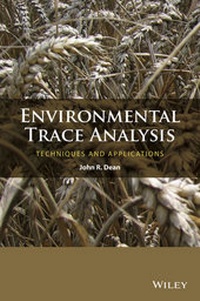
Environmental Trace Analysis
Beschreibung

Weitere Details
Weitere Ausgaben
Andere Ausgaben
Person
Inhalt
About the Author xv
Preface xvii
Acknowledgements xix
Acronyms and Abbreviations xxi
1 Basic Laboratory Procedures 1
1.1 Introduction 1
1.2 Health and Safety Issues 2
1.3 Sample Handling: Solid Samples 4
1.4 Sample Handling: Liquid Samples 4
1.5 Sample Handling: Gases/Vapour Samples 5
1.6 Summary 5
2 Investigative Approach for Environmental Analysis 7
2.1 Introduction 7
2.2 Recording of Practical Results 7
2.3 Significant Figures 9
2.4 Units 12
2.5 Summary 13
3 Principles of Quantitative Environmental Analysis 21
3.1 Introduction 21
3.2 Preparing Solutions for Quantitative Work 23
3.3 Calibration Graphs 24
3.4 Limits of Detection/Quantitation 27
3.5 Calculations: Dilution or Concentration Factors 27
3.6 Quality Assurance 29
3.7 Summary 36
4 Environmental Sampling 37
4.1 Introduction 37
4.2 Sampling Soil (and Sediments) 39
4.3 Sampling Water 40
4.4 Sampling Air 42
4.5 Summary 44
5 Storage of Samples for Analysis 45
5.1 Introduction 45
5.2 Choice of Storage Container for Liquid Samples 45
5.3 Preservation Techniques for Liquid Samples 47
5.4 Storage and Preservation of Solid Samples 48
5.5 Storage and Preservation of Gaseous Samples 48
5.6 Summary 50
6 Preparation of Environmental Solid Samples for Inorganic Analysis 51
6.1 Introduction 51
6.2 Decomposition Techniques 53
6.3 Selective Extraction Methods 64
6.4 Physiologically-Based Extraction Test or In Vitro Gastrointestinal Extraction 70
6.5 Earthworms 72
6.6 Summary 75
7 Preparation of Environmental Liquid Samples for Inorganic Analysis 81
7.1 Introduction 81
7.2 Liquid-Liquid Extraction of Metals 82
7.3 Ion Exchange 83
7.4 Co-precipitation 84
7.5 Summary 84
8 Preparation of Environmental Solid Samples for Organic Analysis 85
8.1 Introduction 85
8.2 Liquid-Solid Extraction 85
8.3 Pressurised Fluid Extraction 91
8.4 Microwave-Assisted Extraction 100
8.5 Supercritical Fluid Extraction 103
8.6 Matrix Solid Phase Dispersion 107
8.7 Physiologically-Based Extraction Test or In Vitro Gastrointestinal Extraction 108
8.8 A Comparison of Extraction Techniques 109
8.9 Summary 112
9 Preparation of Environmental Liquid Samples for Organic Analysis 115
9.1 Introduction 115
9.2 Liquid-Liquid Extraction 116
9.3 Solid Phase Extraction 120
9.4 Purge and Trap Extraction 127
9.5 Headspace Extraction 128
9.6 Solid Phase Microextraction 132
9.7 Stir-Bar Sorptive Extraction 135
9.8 Microextraction in a Packed Syringe 137
9.9 Liquid Phase Microextraction 139
9.10 Membrane Extraction 140
9.11 A Comparison of Extraction Techniques 143
9.12 Summary 143
10 Preparation of Environmental Air Samples for Organic Analysis 145
10.1 Introduction 145
10.2 Thermal Desorption 147
10.3 Summary 148
11 Pre-concentration and Clean-up Procedures for Organic Sample Extracts 149
11.1 Introduction 149
11.2 Methods for Solvent Evaporation 149
11.3 Sample Extract Clean-up Procedures 151
11.4 Summary 154
12 Instrumental Techniques for Environmental Trace Analysis 157
12.1 Introduction 157
12.2 Environmental Inorganic Analysis 157
12.3 Environmental Organic Analysis 176
12.4 Other Techniques for Environmental Organic Analysis 188
12.5 Portable Techniques for Field Measurements 189
12.6 Summary 195
13 Selected Case Studies 197
13.4 Sequential Extraction of Metals from Soils 201
13.5 Oral Bioaccessibility Testing of Metals from Soils 204
13.6 Pressurised Fluid Extraction of Organic Compounds from Soils 206
13.7 Solid Phase Extraction of Organic Compounds from Liquid Samples 210
13.8 Headspace Solid Phase Microextraction of Organic Compounds 211
13.9 Dynamic Headspace Analysis of Organic Compounds 215
13.10 An Environmental Case Study: From Site to Analysis to Data Interpretation and Contextualisation 217
13.11 Summary 232
References 237
14 Some Numerical Worked Examples 239
14.1 Introduction 239
Index 251
1
Basic Laboratory Procedures
1.1 Introduction
Environmental analysis does not start in the laboratory but outside (e.g. in a field, river, lake, urban environment or industrial atmosphere). Nevertheless it is important to develop a good understanding of the underlying principles of good laboratory practice and apply them from the start to the end of the process. In the case of an undergraduate laboratory class, for example, this would include:
- Read the laboratory script in advance [Practical point: it is important to establish that you understand the requirements of the experiment and the skills required to perform the tasks].
- Identify the appropriate level of safety required to undertake the experiment [Practical point: perform the appropriate risk assessment prior to starting the laboratory].
- Listen and understand any verbal instructions given by the demonstrator/lecturer.
- Organise your workspace [Practical point: keep your workspace clean, tidy and organised].
- Record the exact laboratory procedure that you have carried out in your laboratory notebook.
- Identify and record any issues with the experiment [Key point: what solutions to the issues have been tried?].
- Record and interpret the results.
- Understand the relevance of the results.
All the above can be applied and the process followed outside the laboratory, that is in the sampling, collection and storage of environmental samples. For the postgraduate student it is likely that the formal laboratory script does not exist and that you are actually developing the methods/procedures as your research develops. Your supervision team will, of course, be providing guidance on the actual direction and line of thought to follow (and certainly at the start of any research project).
This chapter and the following four chapters all provide invaluable information on the processes and procedures to be developed and understood, prior to undertaking any environmental analyses.
1.2 Health and Safety Issues
In the UK the Health and Safety at Work Act (1974) provides the main framework for health and safety, however, it is the Control of Substances Hazardous to Health (COSHH) regulations of 2002 that impose strict legal requirements for risk assessment wherever chemicals are used. Whereas in the European Union (EU) the system for controlling chemicals is the Registration, Evaluation, Authorisation and restriction of CHemicals (REACH). While in the USA the Environmental Protection Agency (EPA) is responsible for chemical safety relating to human health and the environment.
In all cases, however, it is important to understand the definitions applied to hazard and risk.
- A hazardous substance is one that has the ability to cause harm.
- Whereas risk is about the likelihood that the substance may cause harm.
On that basis the widespread approach to safe working practice (whether in or outside the laboratory) is to undertake a risk assessment. By undertaking a risk assessment you are aiming to establish:
- The intrinsic chemical, physical or biological hazards associated with the substances to be used [Practical point: manufacturers of the substances provide data sheets identifying the hazards associated with the handling and use of their substances].
- The impact on yourself and other workers by considering the possible exposure routes, for example inhalation, ingestion and dermal absorption; alongside the amount of the substance intended to be used.
- The steps to be taken to prevent or control any exposure. This would include the choice of personal protective equipment, where the experiment would take place (fume cupboard or open bench) as well as the safe and appropriate disposal route.
The risk assessment must be recorded and the safety procedures and precautions passed on to those at risk and the person in charge.
The basic generic rules for laboratory work (and as appropriate for associated work outside the laboratory using chemicals) are as follows:
- Always wear appropriate protective clothing; typically, this involves a clean laboratory coat fastened up, eye protection in the form of safety glasses or goggles, appropriate footwear (open toed sandals or similar are inappropriate) and ensure long hair is tied back. In some circumstances it may be necessary to put on gloves, for example when using concentrated acids.
- Never eat or drink in the laboratory.1
- Never work alone in a laboratory.2
- Make yourself familiar with fire regulations in your laboratory and building.
- Be aware of accident/emergency procedures in your laboratory and building.
- Use appropriate devices for transferring liquids [Practical point: never mouth pipette].
- Only use/take the minimum quantity of chemical required for your work [Practical point: this can prevent cross-contamination as well as reducing the amount to be disposed of].
- Use a fume cupboard for hazardous chemicals, for example volatile organic compounds and concentrated acids [Practical point: check that the fume cupboard is functioning properly (i.e. has an air flow that takes fumes away from the worker) before starting your work].
- Clear up spillages and breakages as they occur; for example, in the undergraduate laboratory notify the demonstrator/technician immediately to ensure that appropriate disposal takes place, such as broken glass in the glass bin.
- Always work in a logical and systematic manner; it saves time and can prevent a waste of resources, for example only weighing out the amount of chemical required when it is required.
- Always think ahead and plan your work accordingly; this involves reading the laboratory script before you enter the laboratory as well as checking that you are following the script while undertaking the experiment.
1.3 Sample Handling: Solid Samples
The main vessels used for weighing out solids (e.g. soils and biological materials) in environmental analyses are weighing bottles, plastic weighing dishes or weighing boats. These containers are used to accurately weigh the solid using a four decimal place balance [Practical point: accurate weighing in a container involves weighing by difference, that is the container is weighed prior to addition of sample; the sample plus container are weighed, and finally the emptied container is weighed]. The analyte to be investigated will determine the specific sample preparation technique to be applied to the solid. For example, a solid sample for metal analysis will often require acid digestion (see Chapter 6); while for organic compounds it will require some form of solvent extraction (see Chapter 8). Once the solid has been either dissolved or extracted the resultant solution will need to be quantitatively transferred to a volumetric flask and made to the graduation mark, that is meniscus, with solvent (e.g. 1% v/v nitric acid or an organic solvent) [Practical point: volumetric flasks are accurate for their specified volume when the solution itself is at a particular temperature, e.g. 20 °C].
1.4 Sample Handling: Liquid Samples
The main vessels used for measuring out liquids (e.g. river or estuarine water) in environmental analyses are volumetric flasks, burettes, pipettes and syringes.
The composition of the vessel may be important in some instances [Practical point: some plasticisers are known to leach from plastic vessels especially in the presence of organic solvent e.g. dichloromethane; this is particularly important in organic analyses]. In inorganic analyses, contamination risk is evident from glass vessels that may not have been cleaned effectively; for example, metal ions can adsorb to glass and then leach into solution under acidic conditions thereby causing contamination [Practical point: this can be remedied by cleaning the glassware prior to use by soaking for 24 hours in 10% nitric acid solution, followed by rinsing with de-ionised water (three times)]. The cleaned vessels should then either be stored upside down or covered with Clingfilm® to prevent dust contamination.
1.5 Sample Handling: Gases/Vapour Samples
In the case of gaseous samples, it is essential to ensure that the sample is effectively trapped (e.g. on a sorbent) and retained until required to be analysed. Gaseous samples can be introduced on to a trap by using, for example, a pump to transfer the sample from one location to the trap. It is important to know the rate of transfer of the gaseous sample and duration to allow an estimate of the volume of air sampled.
1.6 Summary
This chapter has introduced the reader to the importance of good laboratory practice, health and safety requirements and specifically risk assessments, as well as given some introductory comments on the sample handling basics associated with solids, liquids and gases.
Notes
1. Smoking is banned in public buildings in the UK.
2. This is strictly enforced with undergraduate students; however, postgraduate researchers often work in the proximity of others to ensure some safety cover is available. Universities will have procedures in place to allow such work to take place and it will always involve notifying others of your name and location. In the case of...
