

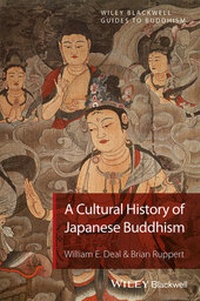
A Cultural History of Japanese Buddhism
Beschreibung

Rezensionen / Stimmen
"In short, this study is a welcome contribution to the field and will make an excellent textbook for the classroom." (Japanese Journal of Religious Studies, 1 October 2015)Weitere Details
Weitere Ausgaben
Andere Ausgaben
Personen
Inhalt
Introduction
The notion that "Buddhism" is a "world religion" is an idea derived from nineteenth-century Western scholars. Moreover, the discourse of "world religions" is alive and well in the twenty-first century, as world religions courses have, if anything, proliferated at North American and European colleges and universities. Despite revisionist views within the history of religion that call into question the unitary character of any of the great "isms," Buddhism frequently continues to be described as a singular and stable tradition. The result is the obfuscation of manifold "Buddhisms" displaying complex, multiple religious practices and ideas.
On campuses and in college towns throughout the world, Zen centers and Tibetan monks confront us with the fact there are those among us who continue to enter Buddhist lineages and follow these religious paths. The appetite for books on Buddhism in English has similarly grown in recent decades, and while Buddhist paths are better understood in the West currently than at any time in the past, they are typically represented as emanations of a mostly "outsider" religion, a faith both monolithic and the obverse of Western monotheisms. Buddhism, such representations often suggest, is impersonal, lacks any notion of sin or hell, and is realized through a direct experience that, presumably, transcends the limitations of institutions or customs.
Unfortunately, the appearance that there is an essential core to Buddhism is also inadvertently suggested by the many books on the history of Buddhism that treat Japanese Buddhism as either an afterthought or as a not-fully-orthodox version of Indian Buddhism. Many histories of Buddhism provide but scant coverage of its Japanese traditions and often end coverage at the beginning of the seventeenth century, when lineages of Japanese Buddhism faced increasing ideological competition from neo-Confucian and Shinto adherents. Rarely do these volumes cover contemporary Japanese Buddhism.
This study offers an in-depth, nuanced account of the history of Japanese "Buddhisms" that attempts to rectify the many lacunae of scope and content evident in books that only cursorily deal with Japanese Buddhist traditions. Incorporating scholarship not represented sufficiently in the coverage of introductory volumes on Buddhism, we attempt to break new ground by taking advantage of the many insights of scholarship from Japan and the West. The vast majority of authors of Buddhist histories are scholars of Indian or Indo-Tibetan Buddhism, which has contributed to confusion about Japanese Buddhism, including profound ignorance about features as basic as the identity of major Buddhist institutions and the sheer volume of cultural production in Japanese Buddhist traditions. (A recently published and prominent dictionary of Buddhism failed to include any discussion of Daigoji, an institution that has played a major role in Japanese Buddhist and secular history and which holds what may be the largest manuscript collection in all of Japanese Buddhism.)
We include coverage of Japanese Buddhism(s) beginning with the introduction in sixth-century Japan of continental monks, Buddhist images and texts, and related ritual paraphernalia, and continue to the present. In doing so, we use a periodization scheme that follows moments of significant transition within Buddhist organizations and in their relationship to the larger society rather than one based solely on political regime change. For example, we place "medieval" Japanese Buddhists in a period beginning in the tenth century because it was in this era that cultural practices such as writing and inheritance took on features very different from those of earlier eras but were clearly distinct from those practiced after the tumultuous events associated with the Onin war (1467-77), the appearance of Westerners and their religion, and the consolidation of power under the Tokugawa shogunate. We also attempt to highlight local variations in Japanese Buddhism by drawing attention to mountain-related traditions (e.g., beliefs and practices of mountain ascetics) as well as the increased physical movement of figures such as networking monks who carried Buddhist beliefs and practices between geographical and cultural centers and peripheries.
Our rationale for this approach is to engage upper-level undergraduate and graduate students as well as scholars in more detailed discussion of issues of discourse and material culture current in the eras under study. In doing so, we explore how Japanese Buddhists of varying contexts drew upon Buddhist ideas and practices to make sense of their lives, to solve problems, and to create a meaningful world - a cosmos - out of chaos. In drawing attention to figures like networking monks as well as to physical mobility and landscape, we also want to underscore that Japanese Buddhist paths included local traditions that were often very different from those, for example, of the royal court (including aristocrats) and the warrior class, particularly in the commonly studied settings of the shogunate's headquarters and the royal capital. Our attention to material culture such as visual media centers attention on the exchange and appropriation of material objects in the practices of Japanese Buddhism. As with Buddhist paths in other cultural milieux, those of Japanese Buddhists were complex traditions with broad philosophical and ritual implications, and it is ultimately impossible to disentangle practices we associate with the "material" from others since, for example, writing in and of itself was often undertaken as a religious act and, clearly, an extension of the religious practitioner's identity - an expression of religious modes of performative interaction with his or her environs.
Finally, readers can see that we maintain a focus throughout on Japanese Buddhist discourse, which provides a means of exploring with greater depth the multiple interpretations that people in the Japanese isles made of Buddhist texts and ideas. Japanese Buddhist thought and language are sometimes treated as if they were part of a unitary and, implicitly, unchanging cognitive complex. In fact, Japanese Buddhists appropriated Buddhist discourses to justify multiple and often competing perspectives. In sum, Japanese Buddhists "performed" Japanese Buddhism(s) at both the state and local levels, utilized material objects as a means of ritual exchange and enactment, and undertook multiple interpretations that utilized Buddhist language - all toward different and sometimes competing religious, social, and political ends.
Overview of the Book
Chapter 1: Early Historical Contexts (Protohistory to 645)
This chapter explores the multiple contexts that made possible the introduction of Buddhist texts, images, and ritual objects into sixth-century Japan, and the conditions for its development over the subsequent two centuries. We begin with a discussion of the narrative in the mytho-history Nihon shoki (720) of the introduction of Buddhist images and implements to the Japanese royal court. Through this discussion, the chapter considers the continental Asian influences, the struggle between the Soga and Mononobe families over the advisability of embracing Buddhist rituals, the representations of Prince Shotoku's support of Buddhist practices, Buddhism in the late seventh-century Yamato Court, the early construction of Buddhist temples, and the relationship between Buddhas, bodhisattvas, and the indigenous kami. Particular attention is given to the early Buddhist images such as those in the Shaka Triad at Horyuji, which were an important focus of devotional practice.
Chapter 2: Ancient Buddhism (645-950)
This chapter focuses on the development and flourishing of Buddhist institutions in the Nara and early Heian eras. Of note is the significance of the ruling family's support of Buddhist monastics and temples as well as the spread and propagation of Buddhism beyond the immediate circle of court families. This chapter includes coverage of the nationwide temple system inaugurated during the Nara period, the six Nara Buddhist lineages, the construction of such temples as the Todaiji, the ritual significance of sutra-copying bureaus, the monastic hierarchy, the relationship between court families and Buddhist clerics, the increasing prominence of Buddhist rituals performed for the protection of the ruling class, the establishment of the Shingon and Tendai lineages, and the use of Buddhist rituals at court. It concludes with a discussion of women in ancient Japanese Buddhism.
Chapter 3: Early Medieval Buddhism (950-1300): The Dawn of Medieval Society and Related Changes in Japanese Buddhist Culture
This chapter explores the discursive and ritual dominance of Buddhist lineages in the lives of Japanese aristocrats as well as the former's increasing influence in the lives of wider segments of the Japanese population. The chapter includes coverage of the relationship between dominant court families - such as the Fujiwara - and Buddhist practices, annual Buddhist ceremonies at court, temple-shrine patronage, the marked growth of esoteric Buddhist rituals to the Heian court, the increasing importance of Pure Land Buddhist practices and discourses, important temples and pilgrimage sites, the role of Buddhas and bodhisattvas in...
