

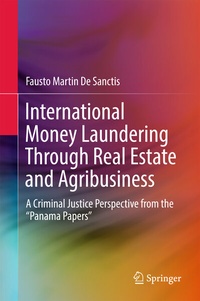
International Money Laundering Through Real Estate and Agribusiness
Beschreibung

This book examines two types of transnational money laundering: the use of offshores and wire transfers to "invest" in real estate; and agribusiness, a nebulous activity that is difficult to regulate. The author also examines current international mechanisms to combat money-laundering; whether these efforts have been successful or unsuccessful; and whether multilateral instruments are an effective tool in the war against international organized crime.
As national borders have opened and trade barriers have fallen, transnational crime has grown at unprecedented levels. The current situation, better revealed by the so-called "Panama Papers," is a result of a lack of local cooperation in the investigations, prosecution, and/or extradition of criminals. Governments profit from ill-gotten wealth hosting international criminal enterprises in their own territories, thus providing a fertile ground for illicit practices, closing their eyes to the nexus among false or inappropriate identification, fraudulent records, corruption, and money laundering. If these types of transnational money-laundering are allowed to remain as they are currently treated, the shift in the financial paradigm, from centralized and regulated to decentralized and "unregulated," would allow for the continuation of some of the most dangerous criminal activity. In this timely book, the author presents arguments that by "following the money," capital movements involved in transnational money laundering through real estate and agribusiness can be examined, revealed, and understood.
Weitere Details
Weitere Ausgaben
Andere Ausgaben
Person
Fausto Martin De Sanctis
holds a
Doctorate in Criminal Law from the University of São Paulo's School of Law (USP) and an advanced degree in Civil Procedure from the Federal University of Brasilia (UnB) in Brazil. He was a Public Defender in São Paulo from 1989-1990, and a State Court Judge, also in São Paulo, from 1990-1991, until he was appointed to the Federal Courts.
Judge De Sanctis was selected to handle a specialized federal court created in Brazil to exclusively hear complex cases involving financial crimes and money laundering offenses. He is a world known expert on this topic and has been invited to participate in programs and conferences both in Brazil as well as internationally.
From April 2 to September 28, 2012, Judge De Sanctis was a fellow at Federal Judicial Center in Washington, DC.
