

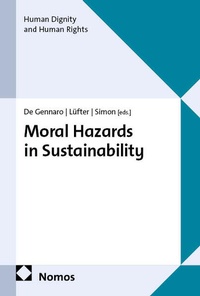
Moral Hazards in Sustainability
1. Auflage
Erschienen am 19. Mai 2026
148 Seiten
978-3-7489-6785-9 (ISBN)
Beschreibung

The formulation of sustainability goals - implicitly or explicitly placed within the wider perspective of a "sustainable future" - is often characterised by a certain vagueness and arbitrariness. This allows for practices and outcomes which, although formally compliant with set objectives and benchmarks, generate misgivings as to how sustainable they truly are.
The term "moral hazard", widely used in economic discourse, is adopted here to encapsulate the decoupling between intended or declared objectives, on the one hand, and deviant actions with (nominally) undesired results, on the other. This volume addresses moral hazards in the context of sustainability research and policy from the economic, political, and ethical perspectives.
With contributions by
Christian Arnsperger | Ivo De Gennaro | Giulia Isetti | Ralf Lüfter | Ugo Mattei | Eugene Nulman | Sören Schuster | Oliver Schlaudt | Robert Simon | Jenny Ufer
Weitere Details
Weitere Ausgaben
Andere Ausgaben
Ivo De Gennaro | Ralf Lüfter | Robert Simon
Moral Hazards in Sustainability
Buch
05/2026
1. Auflage
Nomos
39,00 €
Sofort lieferbar
Inhalt
- Preface
- Contents
- Introduction
- References:
- From Green Growth to Post-Growth: Overcoming Moral Hazards in the Capitalist Social-Existential Metabolism|Christian Arnsperger
- 1. Introduction
- 2. Moral Hazard and the "Newspeak" of Weak Sustainability
- 3. Green Growth and the Risk of Magical Thinking
- 4. Doughnut Economics and the Risk of Anthropo-Optimism
- 5. Existential Economics and the Deeper Function of Capitalism
- 6. The Capitalist Social-Existential Metabolism
- 7. Towards Existential Ecological Economics
- References
- Unveiling Moral Hazards: Interdisciplinary and Participatory Theatre in Climate Change Communication to Address the Action-Knowledge Gap|Giulia Isetti and Jenny Ufer
- Introduction
- 1. Communicating climate change and averting possible moral hazards
- 2. Navigating moral hazards: why critical thinking and response-ability matter in climate change communication
- 3. The case study of Anthropos, Tyrann (Ödipus): Deconstructing moral hazards in climate change narratives through interdisciplinary and participatory theatre
- 4. Conclusions and Future Directions
- References
- False Conscience: Sustainability and Smart Evolution - Between Law and Power|Ugo Mattei
- 1. Premise
- 2. Early Institutional Response to the Social Demand for Ecological Sustainability
- 3. Neoliberal Reaction
- 4. The Anti-Law Movement
- 5. Sustainability, Legal and Natural
- 6. Captured
- References
- From Moral Hazard to Moral De-haphazarding: Climate Movements as Moral Agents|Eugene Nulman
- 1. Introduction
- 2. Methods
- 3. Results
- 4. Quantitative Results
- 5. Discussion and Conclusion
- References
- "Responsible consumption and production" (SDG12) as a moral hazard: The case against recycling and the circular economy|Oliver Schlaudt
- 1. Recycling is a technofix is a moral hazard
- 2. Techno-fix reconsidered
- 3. Technofix is real
- 4. Recycling, a false promise
- 5. Conceptual interlude: Anbau vs. Abbau and the Law of Technological Escalation
- 6. Low Tech vs. High Tech
- 7. Technofix? Sure! Moral Hazard? Of course! But Ideology?
- References
- The "Economy" in SDG 8: On a Possible Revival of Aristotelian Economics|Sören E. Schuster
- 1. Introduction
- 2. Aristotle's Natural Economy
- 3. How Economics Became Chrematistics
- 4. SDG 8 Between Legitimizations and Critiques
- 5. Outlook
- References
- Human Dignity and Personhood in the Age of Technology|Robert Simon
- 1. Introduction: The United Nations' vision of sustainability: prosperity through technological progress and human dignity
- 2. A brief reminder of the significance of the concept of person in the European tradition
- 2.1 Two concepts of person in Modernity
- 2.2 The transcendental concept of personhood
- 2.3 The functional concept of personhood
- 3. Moral Hazard
- References
