

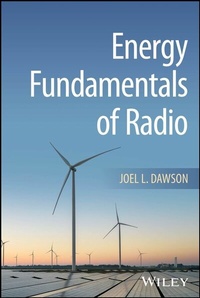
Energy Fundamentals of Radio
Beschreibung

Understand the technology that has reshaped global communication.
Wireless communication has transformed virtually every area of global technology, interaction, and commerce. The flow of information between transmitter and receiver without the aid of wires or cables has placed online and network communication on a revolutionary new footing, with ramifications that are still being felt. No communications or information professional can be without a working knowledge of this area of technology.
Energy Fundamentals of Radio provides an accessible, readable overview of this critical subject. It emphasizes the fundamental realities of wireless communication with respect to energy use and energy tradeoffs, surveys the major theories underlying wireless technology, and analyzes key 5G techniques that can minimize energy consumption. The result promises to be a standard introduction to the field.
Energy Fundamentals of Radio readers will also find:
- Detailed discussion of topics including antenna theory, electromagnetic fields, sustainability, and more.
- In-depth chapter on The Shannon Limit to demonstrate a key principle in the field.
Energy Fundamentals of Radio is ideal for any communications, networking, or information professional looking for a one-stop reference on wireless technology.
Weitere Details
Weitere Ausgaben
Andere Ausgaben
Person
Joel L. Dawson, PhD, is an entrepreneur and former MIT professor in the EECS department. He is currently President and CEO of The Dawson Group, Inc., and Founder and CEO of TalkingHeads Wireless, Inc. He serves on the Board of Advisors for the Museum of Science, Boston, USA. His publications include numerous scholarly articles on wireless communications and related subjects, numerous patents, and two other books on foundational electrical engineering topics.
Inhalt
List of Figures xiii
List of Tables xxvii
Acknowledgments xxix
1 A First Look at a Radio Link 1
1.1 Introduction 1
1.2 A Radio Link: The Basic Parts 3
1.3 On Using Nature's Laws to Build Machines 3
1.4 The Key Natural Law for Radio Communications 5
1.5 A Simple Radio Transmitter and Receiver 8
1.6 The Most Important Question in Engineering 8
1.7 Overview of This Book 9
2 Highlights from Linear System Theory 13
2.1 What Are "Signals," Come to Think of It? 13
2.2 Representing Signals in the Time Domain 16
2.2.1 Continuous-time Representations 16
2.2.2 Discrete-time Representations 18
2.2.3 Sampling and Hazards Thereof 18
2.2.4 Discretizing Amplitude and the Concept of Bits 22
2.3 Representing Signals in the Frequency Domain 26
2.3.1 On the Centrality of Exponentials and Sinusoids in Linear System Theory 28
2.3.2 The Fourier Series 42
2.3.3 The Fourier Transform 45
2.3.4 In Praise of Discretized Representations: The Discrete Fourier Transform (or Fast Fourier Transform) 47
2.4 Parseval's Theorem and Signal Energy 57
2.4.1 Signal Energy and Power for Time-domain Signals 58
2.4.2 Deriving Parseval's Theorem 59
2.4.3 The Concept of Power Spectral Density 60
2.4.4 Noise and Energy Spectral Density 61
2.5 Bandwidth Equals Speed: The Uncertainty Principle 63
2.5.1 Deriving the Uncertainty Principle 64
2.5.2 Implications of the Uncertainty Principle for Communications 71
3 The Least You Need to Know About Analog Electronics 75
3.1 The RC Circuit 77
3.1.1 Time Domain Behavior 77
3.1.2 Frequency Domain Behavior 79
3.1.3 Energy Considerations for RC Circuits 80
3.2 The Resistive Load: When You Have to Deliver Energy 87
3.2.1 Maximum Power Transfer 89
3.2.2 That Said .The Best Way to Transfer Power Is Not to Have a Source Impedance at All 91
3.2.3 The Power to Drive a Resistor Is Linear in B 91
3.3 The Parallel RLC Circuit 92
3.3.1 Time Domain Behavior 94
3.3.2 Frequency Domain Behavior 96
3.3.3 Energy Considerations and Q 98
3.4 Energy Considerations Summary 102
4 Noise in Communications Systems 105
4.1 The Importance of Thermal Noise 106
4.1.1 The Equipartition Theorem for Circuits 107
4.1.2 All Objects Radiate 109
4.1.3 .But You'll Only Notice This Using Radio Telescopes 111
4.2 Dealing with Probabilistic Signals 111
4.2.1 "Normal" or Gaussian Distributions 112
4.2.2 The Meaning of Correlation 115
4.2.3 The Meaning of Autocorrelation 120
4.2.4 Autocorrelation and Power Spectral Density as a Fourier Transform Pairs 121
4.3 Characteristics of Thermal Noise in Circuits 124
4.3.1 In the Frequency Domain 125
4.3.2 In the Time Domain 127
4.4 What Happens When Noise Gets Filtered 129
4.5 What Happens When Noise Gets Averaged 131
4.5.1 Notice How Uncorrelated Noise Sources Combine 132
4.6 Harmonizing Averaging and Filtering 132
4.7 The All-important Signal-to-noise Ratio 133
4.8 The Effective Number of Bits, or ENOB 135
4.9 The RC Circuit as a Noisy System 140
4.10 The Thermal Noise Floor in Radio Receivers 142
5 Understanding the Shannon Limit 147
5.1 Putting the Shannon Limit to Work 148
5.1.1 Exploring the Shannon Limit with Numbers 148
5.1.2 Using the Shannon Limit 151
5.1.3 Repeat: We Do Require Energy to Move Bits Through a Network! 153
5.2 Detecting Signals Buried in Noise 154
5.2.1 Using Correlation to Extract Signal from Noise 155
5.2.2 Correlation-based Detection 157
5.3 Shannon Warmup Problem: Reading a Capacitor Voltage 165
5.3.1 Noise Variance and Error Rate 166
5.3.2 Averaging to Drive the Error Rate Low 170
5.3.3 A Way Out: Doing Measurements in Batches 172
5.4 Arriving at the Shannon Limit 181
5.4.1 How Many Samples Do We Need for a Bandlimited Signal? 181
5.4.2 The Final Result 181
5.4.3 A Note on the Geometry of Low SNRs 182
5.5 Chapter Summary 183
6 Digital Modulation Basics 185
6.1 Modulating a Carrier 185
6.2 Spectral Efficiency Is Important 191
6.2.1 Pulse Shaping to Stay Within Our Spectral Boundaries 191
6.2.2 We Often Avoid Constant-envelope Modulation 198
6.2.3 .Except When Energy Is More Scarce Than Spectrum 202
6.2.4 Navigating the Modulation Alphabet Soup 202
6.2.5 OFDM: A Powerful Technique for Sharing Network Resources 202
6.3 Error Correction Codes 213
6.4 Are Our Modulation Techniques Optimal? 214
7 Selected Topics in Electromagnetic Theory 215
7.1 Action at a Distance Is Weird 216
7.1.1 Forces on Charges: How We Know There Is an Electric Field 218
7.1.2 The Electric Field of a Point Charge at Rest 218
7.1.3 Forces on Charges: How We Know There Is a Magnetic Field 220
7.1.4 The Magnetic Field of a Current Element 222
7.1.5 Frame of Reference and E Versus B Fields 222
7.2 We Use Maxwell's Equations When Fields Are Not Static 223
7.2.1 Maxwell's Equations in Integral Form 224
7.2.2 Divergence and Curl 229
7.2.3 Maxwell's Equations in Differential Form 237
7.3 General Wave Solutions of Maxwell's Equations 238
7.4 A Wave Solution of Particular Interest 247
7.5 EM Fields and Energy 249
7.5.1 Energy Associated with Static Fields 249
7.5.2 Poynting Flux: When Field Energy Is On the Move 252
7.5.3 Poynting Flux and the Humble Resistor 253
7.6 Accelerating Charges: Why We Can Have Wireless Links 254
7.7 EM Theory Summary 257
8 The Least You Need to Know About Antennas 259
8.1 The Friis Equation 259
8.2 Focus on SNR Rather Than Received Power 262
8.3 The Hertzian Dipole 266
8.3.1 The Hertzian Dipole as It Is Usually Analyzed 267
8.3.2 The Hertzian Dipole as Accelerating Charges 268
8.3.3 Field Strengths Are Solely a Function of Transmit Power 273
8.4 A Friis-like Equation for the SNR in a Wireless Link 274
8.5 A First Look at Friis and the Shannon Limit 277
8.6 A Few Loose Ends 278
9 A Note on Linear Algebra 281
9.1 What Problem Are We Solving with a Matrix? 281
9.2 The Mechanics of Matrices 284
9.3 A Few Facts About Matrices 287
9.4 Orthonormal Basis Vectors 288
9.5 Matrix Inversion 290
9.6 The Singular Value Decomposition 292
9.7 Least Squares 296
9.8 The FFT and the IFFT 300
10 Multiple Antennas in Wireless Links 303
10.1 Spatial Diversity to Combat Fading 304
10.2 Beamforming Basics 307
10.2.1 Calculating the Beam Width 313
10.2.2 Steering the Beam 316
10.2.3 Synthesizing a Radiation Pattern 318
10.2.4 On Getting Overly Excited About Beamforming 320
10.3 Spatial Multiplexing for Single User MIMO 320
11 Transmitter Structures 329
11.1 The Miller Effect in Amplifiers 330
11.2 Filters 333
11.2.1 The Impulse Response 335
11.2.2 Finite Impulse Response Filters 336
11.2.3 Other Filter Implementations 341
11.3 A Note on Frequency Synthesis 344
11.3.1 The Problem of Matching Carrier Frequencies 344
11.3.2 Phase-locked Loops and Frequency Synthesis 347
11.4 Power Amplifiers 354
11.4.1 Power Amplifier Preliminaries 355
11.4.2 Nonlinearity in Signal Chains 360
11.4.3 The Linearity/Efficiency Trade-off 367
11.4.4 Doherty: A Highly Successful Power Amplifier Technique 372
11.4.5 Backoff: Doherty's Achilles Heel 376
11.4.6 Envelope Tracking: Don't Do This 378
11.4.7 Discrete Supply Modulation 381
11.4.8 Efficiency Metrics for Power Amplifiers 384
11.5 A Primer on Heat Sinks 386
12 Energy and the Shannon Limit 391
12.1 An Energy Scaling Rule for Wireless Links 391
12.1.1 An Example Calculation 393
12.1.2 When to Use a Scaling Rule Instead of Straight Calculation? 396
12.1.3 Performance Requires Power in Electronic Machines 396
12.2 The Whole Fun of Radio Is Not Knowing Where Everybody Is 398
12.3 Spectral Efficiency Versus Energy Efficiency 400
12.4 On the Finiteness of Spectral Real Estate 401
12.5 When Energy Consumption Is Not Central, It Grows 401
A References for Discrete Supply Modulation 403
A. 1 Overall Architecture 404
A. 2 Power Management 405
A. 3 Digital Predistortion 406
A. 4 Early Papers and Patents (MIT) 407
Index 409
List of Figures
1.1 A cartoon radio link. 1.2 Setup for a mechanical calculator. 1.3 What is 2+3? It is 5, evidently. 1.4 Force on test charge qtest due to Q0. 1.5 Accelerating charges is where the action begins. 1.6 A very simple radio link. 1.7 Overview of a radio transceiver. 2.1 A car equipped with a 2D accelerometer. 2.2 Example accelerometer data. 2.3 Example speedometer data. 2.4 A voltage amplifier. 2.5 Signals in continuous time. 2.6 Signals in DT. 2.7 Sampling "often enough" to represent a signal well in DT. 2.8 An example of extreme undersampling. 2.9 A frequency number line. For a sampling rate of fs, there will be no ambiguity among frequencies in a band that is fs Hz wide. 2.10 We normally enforce the assumption that the input to a sampler is restricted to frequencies of magnitude less than fs/2. An important exception is subsampling receiving architectures, which seek to downconvert frequency bands that are fs wide but centered at high carrier frequencies. 2.11 A four-bit digital register composed of four flip-flops. 2.12 The three basic logic functions at the foundation of Boolean algebra. 2.13 Introducing additive noise to a voltage. 2.14 Detailed accounting for the number of distinguishable levels of a signal contaminated by noise. 2.15 A very common signal processing lineup: a CT signal x(t) is the input to an analog-to-digital converter (ADC), which produces discretized samples x[n]; any number of processing steps are carried out by a microprocessor (µP) producing discretized samples y[n]; a digital-to-analog converter (DAC) (plus, usually, some sort of analog filter) then turns discretized samples y[n] into CT signal y(t). 2.16 A square wave. 2.17 We pass our square wave into the input of a mystery circuit... 2.18 ...and see this on the display of our oscilloscope. 2.19 Exponentials and sinusoids as eigenfunctions of LTI systems. 2.20 A simple circuit for exploring eigenfunctions of LTI systems. 2.21 The unit circle. 2.22 cos?0t in the frequency domain. 2.23 A square wave in the frequency domain. If you want to check the math, use Eqs. 2.50, 2.52, and 2.54. 2.24 A pure sinusoid in a noiseless environment, as measured on a spectrum analyzer. 2.25 A pure sinusoid in a noisy environment, as measured on a spectrum analyzer. 2.26 A pure sinusoid in a noisy environment, as measured on a spectrum analyzer, but this time with a bandpass filter preceding the spectrum analyzer. 2.27 A pure sinusoid in a noisy environment, as measured on a spectrum analyzer, again with a bandpass filter. This time, we have tightened the bandpass filter to really raise the SNR. 2.28 We approach the Fourier transform as a limit of the Fourier series, stretching the fundamental period T so that it is large compared to the time span of our signal. 2.29 Discretizing the Fourier transform. 2.30 A short, DT data buffer. 2.31 A short DT data buffer, but now made periodic with period N. 2.32 The highest frequency sinusoid in DT, with O=p. 2.33 A simple circuit, dissipating energy at a rate of v2(t)RJ/sec. 2.34 Contrasting thermal noise spectra with identical heights but differing bandwidths. 2.35 A pulse Fourier transform pair. 2.36 At minimum, our analytical definition of width should deal successfully with all three of these examples. 2.37 A try at defining the width of a distribution x(t). 2.38 Improving our definition of w by employing the absolute value |x(t)|. 2.39 Using the square x2(t) vs. the absolute value |x(t)|. 2.40 A point mass rotating around an axis. The force vector is into the page. 2.41 A two-mass structure rotating around an axis. The force vector is again into the page. 2.42 A symmetrical version of Figure 2.41 with the same total mass and moment of inertia. 2.43 Transforming a continuous, asymmetric mass distribution into an equivalent, symmetrical one. In this figure, m1=m2=12?-l1l2m(x)dx. 2.44 An example pulse shape. 2.45 A pulse train. 2.46 In the frequency domain, separate multiplicative components of a pulse train. 2.47 If we use P1 our pulse train occupies a bandwidth of B1. 2.48 If we use P2 our pulse train occupies a bandwidth of B2. 3.1 A model of the Task for much of analog electronics. 3.2 A model of the Task when we have to deliver energy. 3.3 A model of the Task when it must be accomplished over a narrow band. 3.4 The RC circuit for analysis. 3.5 A unit step input. 3.6 Response of an RC circuit to a step input. 3.7 Frequency response of the RC circuit. 3.8 Analyzing the energy required to charge the capacitor once the switch closes. We assume in the analysis that the capacitor starts with zero charge. 3.9 Breaking the charging of Figure 3.8 into two steps. First, we connect the V/2 voltage source and wait until the capacitor has settled. Then, we open that switch and complete the charging by connecting the V voltage source. 3.10 Analyzing the average power to impose a sinusoid at the output. 3.11 The average power required of the source to impose a sinusoid at the output as a function of ?0. Note that the power is also quadratic in amplitude A. 3.12 Many times, the spectrum that we want to impose on an RC is flat from somewhere near DC to an upper limit B. 3.13 Driving a resistor: more interesting than it looks. 3.14 Four example transducers. To the source, it appears as though it is driving a resistive load. 3.15 A voltage source, with source resistance Rs. 3.16 Connecting a load resistor. How much power can we transfer to the load?. 3.17 Ideal amplifier chain. 3.18 Amplifier chain showing finite output impedances and parasitic capacitances. 3.19 An...
