

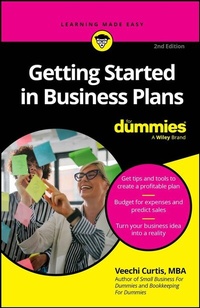
Getting Started in Business Plans For Dummies
Beschreibung

Turn a business plan into profitable reality with practical hands-on tips
A solid business plan is crucial to the ultimate success of your start-up or small business. But don't fret, your friends at For Dummies are here to help! Getting Started in Business Plans For Dummies gives you the fundamentals you need to let your business really take flight. Inside, you'll find practical, hands-on information that will help you take your business from idea to profitable reality.
From the basics of deciding what your business is all about, to building a long-term vision of where your company will go, this book has you covered. Discover step-by-step advice for budgeting and margins, prices and profits, costs and expenses, and much more.
- Use the latest AI tools to bring your plan together quickly and more effectively
- Identify what gives your business an edge - and keep ahead of threats and competitors
- Stay right on the money, with everything you need to know to put together a sound financial forecast
- Create a smart business model that really works
Perfect for anyone starting a new business, or even just thinking about it, Getting Started in Business Plans For Dummies has everything you need in one useful package. So what are you waiting for? It's time to plan your dream business!
Weitere Details
Weitere Ausgaben
Andere Ausgaben
Person
Veechi Curtis is a qualified accountant and business consultant who specializes in mentoring small businesses, helping business owners find the secrets to their own success. She is the author of the bestselling Small Business For Dummies and Bookkeeping For Dummies.
Inhalt
Introduction 1
Chapter 1: Letting Your Plan Take Flight 5
Chapter 2: Figuring Out What's So Special about You 17
Chapter 3: Sizing up the Competition 25
Chapter 4: Separating Yourself from Your Business 35
Chapter 5: Exploiting Opportunities and Avoiding Threats 51
Chapter 6: Developing a Smart Marketing Plan 61
Chapter 7: Budgeting for Start-Up Expenses 75
Chapter 8: Figuring Out Prices and Predicting Sales 87
Chapter 9: Calculating Costs and Gross Profit 103
Chapter 10: Managing Expenses 117
Chapter 11: Assembling Your First Financial Forecast 129
Chapter 12: Perfecting the Final Pitch 143
Chapter 13: Ten Suggestions for a Plan that's Not Shaping Up 159
Index 167
Chapter 2
Figuring Out What's So Special about You
IN THIS CHAPTER
Determining the edge you have over others
Articulating your strategic advantage statement
Getting technology to fine-tune your business idea
What is it that makes you, or your business, so special?
Even if you have a business that's similar to thousands of others - maybe you mow lawns, have a hair salon, or tutor high-school students - if you wish to make above-average profits, you still need to come up with an idea that makes your business different from others, or that provides you with a competitive edge.
Similarly, if your business caters for a very specific niche - maybe you sell gluten-free cookies or baby clothes made from organic cottons - to make above-average profits, you need to identify how you can service this niche in a way that others can't, or what it is about your skills or circumstances that enables you to service this niche better than others.
If your business centers on an idea that you reckon nobody has tried before, the million-dollar question is why nobody else has bothered to try this idea until now. In the event that you're successful, the next key question is what prevents others from copying your idea straightaway.
The essence of what makes your business special, or more likely to succeed than others, is called your competitive or strategic advantage. I believe that this advantage is the single most important ingredient for ongoing business success, and is elemental to how you frame your business plan.
In this chapter, I outline how to determine your edge, and how to include your strategic advantage in your business plan.
Understanding Strategic Advantage
In the introduction for this chapter, I mention the terms competitive advantage and strategic advantage. These two terms tend to overlap so much that I try to avoid getting bogged down in arguing about the distinction. I use the term strategic advantage in this chapter (because, after all, a true strategic advantage should ultimately result in a competitive advantage) but if you'd rather use the term competitive advantage in your business plan, that's just fine.
Gaining the edge
How can your business beat the competition, and what benefits can you provide that the competition can't? Here are some ways that your business may be able to secure a strategic advantage against others in the same industry:
-
Added value: Can you offer added value in comparison to your competitors? Think 24-hour delivery, ethically sourced product, a mobile service, or a quality of product or service that's beyond industry norms.
- Excellent location: If you have a retail shopfront, do you have a great location in a central shopping area? (Location is always the prime strategic advantage for retailers.) Or are you the only business providing a service in a particular suburb or region? Are the demographics of your location ideally matched to your business, or are you located in a central spot for freight and transport?
- Exclusive distribution rights: Do you have exclusive distribution rights to a sought-after product or service?
- First cab off the rank: Do you have a new idea that nobody else has tried before? Or a new way of doing something that makes the product or service better, quicker, or cheaper?
- Intellectual property: Do you have unique intellectual property (IP) that customers want and that's hard to copy? IP includes copyright, patents, and trademarks. If you're just getting started with your business, your IP could be as simple as a clever business name, an eye-catching logo, or a well-chosen domain name (that is, a web address).
- Lower costs: Do you have an innovative way of doing things that reduces costs, creates economies of scale, or significantly improves business processes?
- Obsession and drive: Do you have exceptional vision or drive? Is this drive connected with a particular obsession? (For example, think of Coco Chanel with her ambitious vision and flair for design.)
- Perfectly matched team: If you're in a business partnership of some kind, do you have a unique combination of skills and do you work well together as a team? (The synergy created by two or more people who have complementary skills and who work well together can be a force to be reckoned with, and something that's hard for competition to copy.)
- Specialist skills: Are you a specialist who has an insight into a particular industry that nobody else is likely to have? Maybe you can see a gap in the industry that nobody else is catering for, or maybe you can see a way to do something better.
Think of a business that has been really successful (maybe a local business or a friend's business, or even a big name such as IKEA, Patagonia, or Microsoft). Go through the strategic advantages listed here, and think about which of these advantages could apply to these businesses.
From here, think about how you can find a strategic advantage for your own business. What can you do better than anybody else?
Avoiding the trap of being the cheapest
When looking for a strategic advantage for your own business, don't fall into the trap of thinking that because you're cheaper than everyone else, this is a strategic advantage. Being cheaper than everyone else usually means one of two things: Either your business isn't as profitable as it should be, or your competitors can grab your strategic advantage at any moment just by dropping their prices too. Usually, being cheaper than others is only a strategic advantage if you have some special skills, technology, or volume of production that enables you to be cheaper.
Trading risk and gain
In most situations, the business with the highest potential strategic advantage is going to be the business that requires the most capital or involves the highest risk of failure. For example, imagine you had a really creative idea for a new fitness app. Your idea potentially has great strategic advantage (a new invention or first cab off the rank), but is almost certainly quite risky. (Smartphone apps generally have high development costs, an unknown and untested market, and may not even work that well when complete.)
In contrast, a safe business, such as lawn mowing, has few potential strategic advantages but involves the lowest risk of all. (The cost to set up this business could be as low as a few business cards.) Strategic advantages are hard to find for this kind of business because a lawn is only ever a lawn, and the owner will be limited in what to offer that others can't.
Identifying potential strategic advantages for a business or service that lots of other people provide, and where it's difficult to differentiate between your service and those of your competitors, can be tricky. The upside of this kind of business is that the risks are usually lower; the downside is that it's always going to be tricky to charge premium rates or make above-average profits.
Justifying why you can succeed
For a strategic advantage to be really worth something - in terms of the goodwill of your business or your likely financial success - this advantage has to be something that you can sustain over the long term.
I like to think that any really strong strategic advantage should have three attributes:
- The advantage can't be easily copied by others. The ideal strategic advantage is one that's really tricky for your competition to copy. Examples are a winning recipe or flavor (think Coca-Cola), a unique synergy of skills within your organization, or expert knowledge that few others have.
- The advantage is important to customers. Think of the farmers who switched to growing organic produce in the early 1990s, before organics became more mainstream. Many of these farmers did really well because organics were so important to particular customers. (And although the advantage was relatively easy to copy, many authorities required a seven-year lead time with no chemicals before a farm could be officially certified.)
- The advantage can be constantly improved. If you can identify the thing that gives you an edge and constantly work this advantage, you have a strategic advantage that is potentially sustainable in the long term.
When Steve Jobs and Steve Wozniak started Apple, one key strategic advantage was that they were a perfectly matched team, and were passionate about design. The synergy of their skills was hard for others to copy, the beautiful design was something that customers really wanted, and Apple were in a position to continually improve and develop this advantage.
Developing Your Strategic Advantage Statement
In this book, I'm realistic about the written part of business plans. I know how few people actually write a 20- or 30-page business plan, despite their best intentions (which is why I also cover creating pitch decks and one-page business plans in Chapter 12).
However, even if you put nothing else in writing, I do recommend you write a statement of strategic advantage. In this statement, your purpose is to articulate exactly what gives your business an edge over others.
Your strategic advantage statement is usually...
