

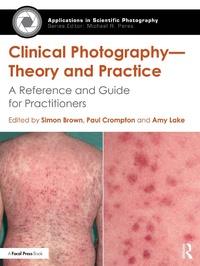
Clinical Photography - Theory and Practice
A Reference and Guide for Practitioners
1. Auflage
Erschienen am 25. September 2024
348 Seiten
978-1-317-48632-9 (ISBN)
Beschreibung

This is an authoritative and comprehensive reference for understanding clinical photography and improving the reader's ability to hone their skills and knowledge.
The book first explores the rationale for clinical photography before going on to provide a practical guide to equipment selection, standardized techniques and digital workflows in a range of settings, from the professional studio to the DIY enthusiast, whilst also including telemedicine.
Written and edited by three of the UK's most experienced and qualified clinical photographers, with additional chapters written by other specialists, it is richly illustrated with numerous example images and suggested protocols and covers basic photographic theory, suitable equipment, digital image workflow and a major chapter on standardized representational photography, the cornerstone of professional clinical photography.
Some medical specialties are covered in detail, including dermatology, dental and oral medicine, pediatrics, orthopedics, telemedicine and photography in surgery and the operating room. As well as a practical guide to clinical photography, the book also discusses the legal, moral and ethical contexts within which photography in medicine operates and, for the first time, explores the societal, cultural and religious factors for practicing in today's digitally literate, multicultural world.
This book will provide a valuable resource for biomedical photography students, practitioners and clinicians interested in developing their photography skills and applying them to medicine.
The book first explores the rationale for clinical photography before going on to provide a practical guide to equipment selection, standardized techniques and digital workflows in a range of settings, from the professional studio to the DIY enthusiast, whilst also including telemedicine.
Written and edited by three of the UK's most experienced and qualified clinical photographers, with additional chapters written by other specialists, it is richly illustrated with numerous example images and suggested protocols and covers basic photographic theory, suitable equipment, digital image workflow and a major chapter on standardized representational photography, the cornerstone of professional clinical photography.
Some medical specialties are covered in detail, including dermatology, dental and oral medicine, pediatrics, orthopedics, telemedicine and photography in surgery and the operating room. As well as a practical guide to clinical photography, the book also discusses the legal, moral and ethical contexts within which photography in medicine operates and, for the first time, explores the societal, cultural and religious factors for practicing in today's digitally literate, multicultural world.
This book will provide a valuable resource for biomedical photography students, practitioners and clinicians interested in developing their photography skills and applying them to medicine.
Rezensionen / Stimmen
"This is a masterpiece. It is thorough and answers many questions about the why and how to necessary for the creation of exceptional medical photographs by untrained photographers who use photography as a part of their job responsibilities. The authors have done an excellent job in highlighting the key elements used in many areas of medicine with discussions about equipment and methods. Essential for every reference collection."Michael Peres, Professor, Biomedical Photographic Communications, Rochester, New York
"Clinical Photography - Theory and Practice is an excellent up-to-date resource for the seasoned physician or nurse assistant as well as residents and fellows. It's for anyone involved in making high-quality standardized images for patient care to be used in medical teaching and publication. It's a must-have for all clinical photographers."
Norm Barker, MA, MS, RBP, FRPS. Professor of Pathology and Art as Applied to Medicine. Johns Hopkins University, School of Medicine "This is a masterpiece. It is thorough and answers many questions about the why and how to necessary for the creation of exceptional medical photographs by untrained photographers who use photography as a part of their job responsibilities. The authors have done an excellent job in highlighting the key elements used in many areas of medicine with discussions about equipment and methods. Essential for every reference collection."
Michael Peres, Professor, Biomedical Photographic Communications, Rochester, New York
"Clinical Photography - Theory and Practice is an excellent up-to-date resource for the seasoned physician or nurse assistant as well as residents and fellows. It's for anyone involved in making high-quality standardized images for patient care to be used in medical teaching and publication. It's a must-have for all clinical photographers."
Norm Barker, MA, MS, RBP, FRPS, Professor of Pathology and Art as Applied to Medicine, Johns Hopkins University, School of Medicine
Weitere Details
Reihe
Auflage
1. Auflage
Sprache
Englisch
Verlagsort
London
Großbritannien
Verlagsgruppe
Taylor & Francis Ltd
Zielgruppe
Für Beruf und Forschung
Illustrationen
11 Line drawings, color; 6 Line drawings, black and white; 221 Halftones, color; 5 Halftones, black and white; 243 Illustrations, color
Dateigröße
42,82 MB
ISBN-13
978-1-317-48632-9 (9781317486329)
Copyright in bibliographic data and cover images is held by Nielsen Book Services Limited or by the publishers or by their respective licensors: all rights reserved.
Schweitzer Klassifikation
Weitere Ausgaben
Andere Ausgaben
Simon Brown | Paul Crompton | Amy Lake
Clinical Photography - Theory and Practice
A Reference and Guide for Practitioners
Buch
09/2024
1. Auflage
Routledge
370,38 €
Versand in 10-20 Tagen
Simon Brown | Paul Crompton | Amy Lake
Clinical Photography - Theory and Practice
A Reference and Guide for Practitioners
Buch
09/2024
1. Auflage
Routledge
170,38 €
Versand in 10-20 Tagen
Personen
Simon Brown has been a clinical photographer for over forty years, mainly in London, UK and has been involved in teaching and training in the profession for more than two decades.
Simon holds a master's degree in Medical Illustration (Photography & Video) from the University of Wales College of Medicine. He is both a Fellow and an Honorary Fellow of the Institute of Medical Illustrators (IMI) in the UK and a Fellow of the BioCommunications Association (BCA) in the USA. In 2005, he was awarded the Combined Royal Colleges medal by the Royal Photographic Society. He has presented extensively in Europe and America and has several peer-reviewed papers to his name.
Paul Crompton trained as a medical photographer at the University Hospital of Wales, then took up the position as Course Leader at a college in Cheshire, UK. He returned to Cardiff as Head of Medical Photography in 1994. He has received several awards for his photography, in particular in ophthalmic imaging. He has presented at conferences in the UK and North America, and has written a number of papers in academic journals. His received an Honorary Fellowship of the Institute of Medical Illustrators in the UK and the BioCommunications Association's Louis Schmidt Award.
Amy Lake has been working in the clinical photography profession for over twenty years and, since 2009, she has been educating clinical photographers new to the profession. Amy is currently the Clinical Photography Education Programme Manager for Health Education and Improvement Wales (HEIW), which is the strategic workforce body for NHS Wales.
Amy has received numerous awards from the Institute of Medical Illustrators (IMI) for her photography and for her contribution to the profession. Amy holds a master's degree in Medical Illustration from the University of Wales College of Medicine and a Postgraduate Certificate of Education (PGCE) from Cardiff University.
Simon holds a master's degree in Medical Illustration (Photography & Video) from the University of Wales College of Medicine. He is both a Fellow and an Honorary Fellow of the Institute of Medical Illustrators (IMI) in the UK and a Fellow of the BioCommunications Association (BCA) in the USA. In 2005, he was awarded the Combined Royal Colleges medal by the Royal Photographic Society. He has presented extensively in Europe and America and has several peer-reviewed papers to his name.
Paul Crompton trained as a medical photographer at the University Hospital of Wales, then took up the position as Course Leader at a college in Cheshire, UK. He returned to Cardiff as Head of Medical Photography in 1994. He has received several awards for his photography, in particular in ophthalmic imaging. He has presented at conferences in the UK and North America, and has written a number of papers in academic journals. His received an Honorary Fellowship of the Institute of Medical Illustrators in the UK and the BioCommunications Association's Louis Schmidt Award.
Amy Lake has been working in the clinical photography profession for over twenty years and, since 2009, she has been educating clinical photographers new to the profession. Amy is currently the Clinical Photography Education Programme Manager for Health Education and Improvement Wales (HEIW), which is the strategic workforce body for NHS Wales.
Amy has received numerous awards from the Institute of Medical Illustrators (IMI) for her photography and for her contribution to the profession. Amy holds a master's degree in Medical Illustration from the University of Wales College of Medicine and a Postgraduate Certificate of Education (PGCE) from Cardiff University.
Inhalt
1. A History of Clinical Photography 2. Clinical Photography: Society and Subject 3. Legal, Ethical and Moral Frameworks 4. Photography Essentials 5. Equipment Selection 6. Digital Image Workflow 7. Standardized Representational Photography (SRP) 8. Advanced Imaging 9. Photography in Dermatology 10. Photography in Dental and Oral Medicine 11. Photography in Surgery and the Operating Room (OR) 12. Photography in Wound Management 13. Photography in Burns and Plastic Surgery 14. Photography in Pediatrics 15. Photography in Orthopedics 16. Photography in Telemedicine
