

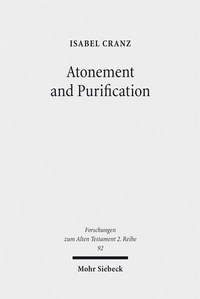
Atonement and Purification
Priestly and Assyro-Babylonian Perspectives on Sin and its Consequences
1. Auflage
Erschienen am 12. Mai 2017
178 Seiten
978-3-16-155114-7 (ISBN)
Beschreibung

Die alttestamentliche Forschung tendiert dazu, die priesterschriftlichen Rituale in den Kontext der Ritualtraditionen des Alten Orients zu stellen. Im Rahmen dieses Vergleiches wird der Priesterschrift (P) oftmals ein monotheistischer und polemisierender Charakter zugeschrieben. Isabel Cranz richtet dieses Verständnis der priesterschriftlichen Rituale neu aus, indem sie priesterschriftliche und assyro-babylonische Sühnerituale miteinander vergleicht. Dadurch wird gezeigt, dass die Rituale der Priesterschrift weitgehend auf die Aufrechterhaltung der göttlichen Präsenz im Heiligtum abzielen. Diese Einsicht lässt P in einem neuen Licht erscheinen, da deutlich wird, dass diese Quelle kein Interesse daran hatte, monotheistische Vorstellungen durchzusetzen oder fremde Rituale abzuwerten. Stattdessen wollten die Verfasser der Priesterschrift bekräftigen, dass die Aaroniden als einzige priesterliche Gruppe für den Altardienst geeignet waren. Sollte P also eine Polemik enthalten, ist diese gegen die Gegner und Kritiker des aaronitischen Priestertums gerichtet und nicht gegen die Rituale des Alten Orients.
Weitere Details
Weitere Ausgaben
Andere Ausgaben
Isabel Cranz
Atonement and Purification
Priestly and Assyro-Babylonian Perspectives on Sin and its Consequences
Buch
05/2017
1. Auflage
Mohr Siebeck
69,00 €
Artikel ist vergriffen; siehe andere Ausgabe
Person
Inhalt
- Cover
- Preface
- Table of Contents
- Abbreviations
- Chapter 1: Introduction
- 1.1. Comparisons and Controversy
- 1.2. The Study of the Priestly Source
- 1.3. The Priestly Source in Comparison
- 1.3.1. P's Ritual Corpus in Early Comparisons
- 1.3.2. Polemics and Monotheism
- 1.3.3. Problems with Polemics and Monotheism
- 1.3.4. A Contextual Comparison
- 1.4. Method of Comparison
- 1.5. Theoretical Framework
- 1.6. Outline of the Book
- Chapter 2: Ritual Theory
- 2.1. Introduction
- 2.1.1. Defining Rituals
- 2.1.2. Ritual Typologies and Defining Rituals of Atonement and Purification
- 2.2. Ritual Theory and Ancient Texts
- 2.2.1. Ritual Theory and the Priestly Source
- 2.2.2. Ritual Theory and the Ancient Near East
- 2.3. A Framework for the Comparison of Ritual Texts
- 2.3.1. Ritual Elements Used in this Study
- 2.3.2. Ritual Contexts and Required Situations
- 2.3.3. Ritual Officiant and Participants
- 2.3.4. Ritual Space
- 2.3.5. Ritual Activities and Objects
- 2.4. Conclusion
- Chapter 3: Contexts and Required Situations
- 3.1. Introduction
- 3.2. Surpu: Date, Copies, Content and Setting
- 3.3. The Intertextuality of Lev 4 - 5, Lev 11 - 15 and Lev 16
- 3.4. The Sins Committed in Lev 4 - 5 and the verb K.. K
- 3.4.1. The Sins Addressed in Lev 5:1 - 6
- 3.4.2. The Nature and Circumstances of the Sins described in Lev 5:15 - 25
- 3.5. The Transgressions of Lev 4 - 5 and Surpu Tablet II
- 3.6. Identifying and Confessing: the Unknown and Known Sins of Lev 4 - 5 and Surpu
- 3.7. The Differences between Lev 4 - 5 and Surpu
- 3.8. Conclusion
- Chapter 4: Participants in Surpu
- 4.1. Introduction
- 4.2. The Identity of the Ritual Specialist in Surpu
- 4.3. The Neo-Assyrian Exorcist
- 4.3.1. Pedigree and Training
- 4.3.2. The Affiliation of the Exorcist: Temple, Court or Self-Employed?
- 4.4. Ritual Participants in Neo-Assyrian Exorcisms
- 4.4.1. Supplicant, Exorcist and the Gods
- 4.4.2. The Exorcist and the Supplicant in Surpu
- 4.4.3. The Identity of the Supplicant in Surpu
- 4.5. Conclusion
- Chapter 5: Objects, Activity and Space in Surpu
- 5.1. Introduction
- 5.2. Physical Disorders and Mamitu as Symptoms of Guilt
- 5.3. Substance of Purification: Water
- 5.4. The Sacrificial Component: Incense and Grain
- 5.5. Ritual Space in Surpu
- 5.5.1. The Circle of Flour
- 5.5.2. The Reed Hut
- 5.5.3. Beyond the City: A Place of Healing and Disposal
- 5.6. Temples and the Exorcist
- 5.6.1. Fungus at the Temple
- 5.6.2. Temple Building and the Inauguration of the Cult Statue
- 5.6.3. The Akitu Festival
- 5.6.4. Summary
- 5.7. Conclusion
- Chapter 6: Participants and Space in P
- 6.1. Introduction
- 6.2. Aaronide Priests and the Composition of the Pentateuch
- 6.3. The Role of the Supplicant in the Sacrificial Service
- 6.4. Priestly Ranks in P
- 6.5. The Priestly Inauguration in P
- 6.5.1. The Priestly Vestments
- 6.6. The Priestly Source of Income
- 6.7. Ritual Space, Holiness and the Divine Presence in the Priestly Source
- 6.7.1. Graded Holiness, Cultic Topography and Social Order
- 6.8. Conclusion
- Chapter 7: Priestly Atonement and the Sanctuary
- 7.1. Introduction
- 7.2. Problems with Expiation in the Priestly Source
- 7.2.1. Problems with Transfer and Elimination
- 7.2.2. Problems with Miasma
- 7.3. Cultic Expiation in the Priestly Source
- 7.3.1. Space, Social Hierarchies and the Offering of the ???? and ??? according to P
- 7.3.2. Burning as Part of the Sacrificial Ritual
- 7.3.3. Blood Manipulation
- 7.4. Vocabulary of Atonement
- 7.4.1. The Meaning of ???
- 7.4.2. The Ultimate Goal: 'Forgiveness'
- 7.5. Lev 16: The Last Step in Priestly Atonement
- 7.6. Conclusion
- Chapter 8: Purification in Leviticus 14
- 8.1. Introduction
- 8.2. Participants and Space in Leviticus 14:1 - 20
- 8.2.1. Ritual Participants and Ritual Instructions in Lev 14:1 - 20
- 8.2.2. Ritual Space
- 8.3. The (Missing) Link between ???? and Transgression
- 8.4. Ritual Activities and Objects
- 8.4.1. Ritual Activities and Objects Part 1: Birds and Living Water
- 8.4.2. Ritual Activities and Objects Part 2: Shaving, Laundering and Concluding Sacrifices
- 8.5. Purification from ???? and the Strive for Priestly Control
- 8.6. Conclusion
- Chapter 9: Conclusion
- Bibliography
- Source Index
- Author Index
- Subject Index
