

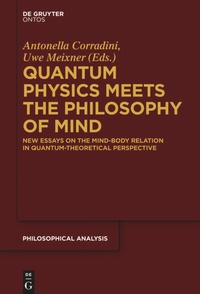
Quantum Physics Meets the Philosophy of Mind
Beschreibung
Quantum physics, in contrast to classical physics, allows non-locality and indeterminism in nature. Moreover, the role of the observer seems indispensable in quantum physics. In fact, quantum physics, unlike classical physics, suggests a metaphysics that is not physicalism (which is today's official metaphysical doctrine). As is well known, physicalism implies a reductive position in the philosophy of mind, specifically in its two core areas, the philosophy of consciousness and the philosophy of action. Quantum physics, in contrast, is compatible with psychological non-reductionism, and actually seems to support it. The essays in this book explore, from various points of view, the possibilities of basing a non-reductive philosophy of mind on quantum physics. In doing so, they not only engage with the ontological and epistemological aspects of the question but also with the neurophysiological ones.
Weitere Details
Weitere Ausgaben
Personen
Inhalt
2 - Preface [Seite 9]
3 - Part I: Quantum Physics and the Mind [Seite 11]
3.1 - Quantum Physics and Philosophy of Mind [Seite 13]
3.2 - Of Quantum Physics and DOMINDARs [Seite 25]
3.3 - Quantum Mechanics and Intentionality [Seite 43]
3.4 - Quantum Physics and the Fundamentality of the Mental [Seite 59]
3.5 - Quantum Mechanics and Dualism [Seite 73]
4 - Part II: Quantum Physics, Consciousness, Agency, and Free Will [Seite 91]
4.1 - Consciousness in the quantum world: An Indian perspective [Seite 93]
4.2 - Consciousness, free will and quantum brain biology - The 'Orch OR' theory [Seite 107]
4.3 - Physics, Free Will, and Temporality in the Open World [Seite 143]
4.4 - Quantum Physics, Action and Free Will: How Might Free Will be Possible in a Quantum Universe? [Seite 171]
4.5 - Quantum Stochasticity and (the End of) Neurodeterminism [Seite 191]
5 - Name Index [Seite 207]
6 - Subject Index [Seite 211]
7 - The Contributors [Seite 217]
