

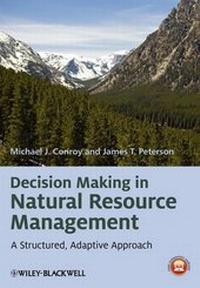
Decision Making in Natural Resource Management
A Structured, Adaptive Approach
Erschienen am 31. Dezember 2012
480 Seiten
978-1-118-50620-2 (ISBN)
Beschreibung
This book is intended for use by natural resource managers andscientists, and students in the fields of natural resourcemanagement, ecology, and conservation biology, who are confrontedwith complex and difficult decision making problems. The book takesreaders through the process of developing a structured approach todecision making, by firstly deconstructing decisions into componentparts, which are each fully analyzed and then reassembled to form aworking decision model. The book integrates common-senseideas about problem definitions, such as the need for decisions tobe driven by explicit objectives, with sophisticated approaches formodeling decision influence and incorporating feedback frommonitoring programs into decision making via adaptive management.Numerous worked examples are provided for illustration, along withdetailed case studies illustrating the authors' experience inapplying structured approaches. There is also a series of detailedtechnical appendices. An accompanying website providescomputer code and data used in the worked examples.
Additional resources for this book can be foundat: www.wiley.com/go/conroy/naturalresourcemanagement.
Additional resources for this book can be foundat: www.wiley.com/go/conroy/naturalresourcemanagement.
Weitere Details
Weitere Ausgaben
Personen
Michael J. Conroy is a Senior Research Scientist in theWarnell School of Forestry and Natural Resources at the Universityof Georgia. He has over thirty years experience inapplications of quantitative approaches to solving problems innatural resource management and is the author of threeprevious books. He teaches and runs workshops in modeling,statistical estimation, and structured decision making forundergraduate and graduate students and professionalsboth in the US and internationally.
James T. Peterson is the Assistant Unit Leader andAssociate Professor for the USGS Oregon Cooperative Fish andWildlife Research Unit at Oregon State University. He has beendeveloping and teaching courses in applied quantitative decisionmaking to undergraduate and graduate students andprofessionals in natural resource and related disciplines for morethan a decade.
James T. Peterson is the Assistant Unit Leader andAssociate Professor for the USGS Oregon Cooperative Fish andWildlife Research Unit at Oregon State University. He has beendeveloping and teaching courses in applied quantitative decisionmaking to undergraduate and graduate students andprofessionals in natural resource and related disciplines for morethan a decade.
Inhalt
List of boxes xi
Preface xiii
Acknowledgements xiv
Guide to using this book xv
Companion website xvii
PART I. INTRODUCTION TO DECISION MAKING 1
1 Introduction: Why a Structured Approach in Natural Resources? 3
2 Elements of Structured Decision Making 13
3 Identifying and Quantifying Objectives in Natural Resource Management 24
4 Working with Stakeholders in Natural Resource Management 57
PART II. TOOLS FOR DECISION MAKING AND ANALYSIS 77
5 Statistics and Decision Making 79
6 Modeling the Infl uence of Decisions 147
7 Identifying and Reducing Uncertainty in Decision Making 192
8 Methods for Obtaining Optimal Decisions 232
PART III. APPLICATIONS 261
9 Case Studies 263
10 Summary, Lessons Learned, and Recommendations 294
PART IV. APPENDICES 307
Appendix A Probability and Distributional Relationships 309
Appendix B Common Statistical Distributions 317
Appendix C Methods for Statistical Estimation 339
Appendix D Parsimony, Prediction, and Multi-Model Inference 373
Appendix E Mathematical Approaches to Optimization 384
Appendix F Guide to Software 430
Appendix G Electronic Companion to Book 432
Glossary 433
Index 449
Preface xiii
Acknowledgements xiv
Guide to using this book xv
Companion website xvii
PART I. INTRODUCTION TO DECISION MAKING 1
1 Introduction: Why a Structured Approach in Natural Resources? 3
2 Elements of Structured Decision Making 13
3 Identifying and Quantifying Objectives in Natural Resource Management 24
4 Working with Stakeholders in Natural Resource Management 57
PART II. TOOLS FOR DECISION MAKING AND ANALYSIS 77
5 Statistics and Decision Making 79
6 Modeling the Infl uence of Decisions 147
7 Identifying and Reducing Uncertainty in Decision Making 192
8 Methods for Obtaining Optimal Decisions 232
PART III. APPLICATIONS 261
9 Case Studies 263
10 Summary, Lessons Learned, and Recommendations 294
PART IV. APPENDICES 307
Appendix A Probability and Distributional Relationships 309
Appendix B Common Statistical Distributions 317
Appendix C Methods for Statistical Estimation 339
Appendix D Parsimony, Prediction, and Multi-Model Inference 373
Appendix E Mathematical Approaches to Optimization 384
Appendix F Guide to Software 430
Appendix G Electronic Companion to Book 432
Glossary 433
Index 449
