

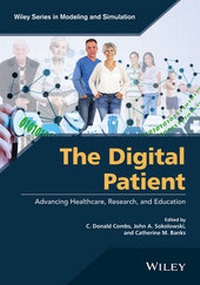
The Digital Patient
Beschreibung

Weitere Details
Weitere Ausgaben
Andere Ausgaben
Personen
C. Donald Combs, PhD, is Vice President and Dean of the School of Health Professions at Eastern Virginia Medical School and is also a senior faculty member in the Department of Modeling, Simulation, and Visualization Engineering at Old Dominion University.
John A. Sokolowski, PhD, is Associate Professor and Executive Director of the Virginia Modeling, Analysis, and Simulation Center at Old Dominion University.
Catherine M. Banks, PhD, is Research Associate Professor at the Virginia Modeling, Analysis, and Simulation Center at Old Dominion University.
Inhalt
Preface xvii
Part 1 The Vision: The Digital Patient-Improving Research, Development, Education, and Healthcare Practice 1
1 The Digital Patient 3
C. Donald Combs
Health, The Goal, 4
Personalized Medicine, 4
The Best Outcomes, 5
The Emergence of the Digital Patient, 5
The Human Physiome, 6
Enabling the Digital Patient, 8
P4 Medicine, 11
Conclusion, 11
References, 12
2 Reflecting on Discipulus and Remaining Challenges 15
Vanessa Díaz?]Zuccarini, Mona Alimohammadi, and César Pichardo?]Almarza
Introduction, 15
A Brief Contextual Background and a Call for Integration: Personalized Medicine is Holistic, 16
The Many Versions of the Digital Patient: On the Road to Medical Avatars, 18
Discipulus: The Digital Patient Technological Challenges and Main Conclusions, 19
The Remaining Challenges and Big Data, 24
Conclusion, 25
References, 26
3 Advancing the Digital Patient 27
Catherine M. Banks
Introduction, 27
The Digital Patient: Its Early Start, 28
Engaging the Digital Patient, 30
Conclusion, 31
4 The Significance of Modeling and Visualization 33
John A. Sokolowski and Hector M. Garcia
Introduction, 33
Modeling a Complex System: Human Physiology, 34
Medical Modeling, Simulation, and Visualization, 35
Modes and Types of Visualization, 40
Visualization for Patient?]Specific Usefulness, 43
Conclusion, 43
References, 45
Part 2 State of the Art: Systems Biology, the Physiome and Personalized Health 49
5 The Visible Human: A Graphical Interface for Holistic Modeling and Simulation 51
Victor M. Spitzer
Introduction, 51
Education, 53
Modeling, 55
Virtual Reality Trainers and Simulators, 56
Conclusion, 58
References, 59
6 The Quantifiable Self: Petabyte by Petabyte 63
C. Donald Combs and Scarlett R. Barham
Introduction, 63
Smarr's Quantified Self, 64
Extending Smarr's Research, 67
The Quantified Self?]Vision, Simplified, 69
Criticism, 69
Conclusion, 71
References, 72
7 Systems Biology and Health Systems Complexity: Implications for the Digital Patient 73
C. Donald Combs, Scarlett R. Barham, and Peter M. A. Sloot
Introduction, 73
Systems Biology, 75
The Institute for Systems Biology, 76
The Complexity Institute, 78
The Potential of Systems Biology, 81
Criticism, 82
Conclusion, 83
References, 83
8 Personalized Computational Modeling for the Treatment of Cardiac Arrhythmias 85
Seth H. Weinberg
Introduction, 85
Basics of Cardiac Electrophysiology, 86
Cardiac Modeling Advancements, 89
Regulation of Intracellular Calcium, 90
From Cells to Cables to Sheets to Tissue to the Heart, 91
Where Can we go from Here? What is the Cardiac Model in the Digital Patient? 95
References, 96
9 The Physiome Project, openEHR Archetypes, and the Digital Patient 101
David P. Nickerson, Koray Atalag, Bernard de Bono, and Peter J. Hunter
Introduction, 101
Multiscale Physiological Processes, 102
Physiome Project Standards, Repositories, and Tools, 103
Archetype Specialization, 112
Archetype Definition Language, 113
Linking Archetypes to External Knowledge Sources (Terminology and Biomedical Ontologies), 114
Archetype Annotations, 114
OpenEHR Model Repository and Governance, 115
Fast Healthcare Interoperability Resources, 115
A Disease Scenario, 116
Summary and Conclusions, 121
References, 122
10 Physics?]Based Modeling for the Physiome 127
William A. Pruett and Robert L. Hester
Introduction, 127
Modeling Schemes, 128
Future Challenges, 142
Conclusion, 142
Acknowledgments, 143
References, 143
11 Modeling and Understanding the Human Body with SwarmScript 149
Sebastian von Mammen, Stefan Schellmoser, Christian Jacob, and Jörg Hähner
Introduction, 149
Related Work, 150
Multiagent Organization, 152
Designing Interactive Agents, 152
Speaking SwarmScript, 153
Answering Demand: The Design of SwarmScript, 153
Graph?]Based Rule Representation, 153
The Source-Action-Target, 154
SwarmScript INTO3D, 154
A SwarmScript Dialogue, 155
Discussion, 159
Summary, 161
References, 162
12 Using Avatars and Agents to Promote Real?]World Health Behavior Changes 167
Sun Joo (Grace) Ahn
Introduction, 167
Avatars and Agents, 168
Using Agents and Avatars to Promote Health Behavior Changes, 169
Conclusion, 174
References, 174
13 Virtual Reality and Eating, Diabetes, and Obesity 179
Jessica E. Cornick and Jim Blascovich
Introduction, 179
Virtual Reality, 179
Obesity and Weight Stigma, 184
Virtual Reality as a Tool for Combatting Health Issues, 185
Conclusion, 189
References, 189
14 Immersive Virtual Reality to Model Physical: Social Interaction and Self?]Representation 197
Eric B. Bauman
Introduction, 197
Theory for Immersive Virtual Learning Spaces, 197
Conclusion, 202
References, 203
Part 3 Challenges: Assimilating the Comprehensive Digital Patient 205
15 A Roadmap for Building a Digital Patient System 207
Saikou Y. Diallo and Christopher J. Lynch
Introduction, 207
Approach, 210
Building the Digital Patient Through Interoperability, 211
Conclusion, 221
Acknowledgments, 221
References, 221
16 Multidisciplinary, Interdisciplinary, and Transdisciplinary Research: Contextualization and Reliability of the Composite 225
Andreas Tolk
Introduction, 225
Interdisciplinarity and Interdisciplinary Research, 226
Data Engineering to Support Interdisciplinarity and Interoperability, 228
Base Object Models to Support Transdisciplinarity and Composability, 233
Open Challenges on Reliability, 235
Summary and Conclusion, 237
References, 239
17 Bayes Net Modeling: The Means to Craft the Digital Patient 241
Joseph A. Tatman and Barry C. Ezell
Introduction, 241
Other Interesting Applications, 246
Conclusion, 251
References, 253
Part 4 Potential Impact: Engaging The Digital Patient 255
18 Virtual Reality Standardized Patients for Clinical Training 257
Albert Rizzo and Thomas Talbot
Introduction, 257
The Rationale for Virtual Standardized Patients, 258
Conversational Virtual Human Agents, 259
Usc Efforts to Create Virtual Standardized Patients, 260
Conclusion, 269
References, 270
19 The Digital Patient: Changing the Paradigm of Healthcare and Impacting Medical Research and Education 273
V. Andrea Parodi
Introduction, 273
Overview Digital Medicine Projects, 275
Personalized Patient Care Clinical Use, 279
Recommended Education and Training for VPH Project Participation, 281
From Flexner to the 2010 Carnegie Report, 284
Summary Statements, 286
References, 287
20 The Digital Patient: A Vision for Revolutionizing the Electronic Medical Record and Future Healthcare 289
Richard M. Satava
Introduction, 289
Applications of the Digital Patient as the EMR, 291
Discussion, 296
Conclusion, 297
References, 297
21 Realizing the Digital Patient 299
C. Donald Combs and John A. Sokolowski
Index 305
1
THE DIGITAL PATIENT
C. Donald Combs
School of Health Professions, Eastern Virginia Medical School, Norfolk, VA, USA
Whatever we do together is pure invention,
The maps they gave us were out of date by years.
-Adrienne Rich, 21 Love Poems
"Men's courses will foreshadow certain ends, to which, if persevered in, they must lead," said
Scrooge."But if the courses be departed from, the ends will change."
-Charles Dickens, A Christmas Carol
It is, perhaps, odd to begin a book about a highly technical subject, the Digital Patient, with quotations from a poem and a book that, in very different ways, confront the vagaries of relationships. Then again, perhaps it is not so odd after all. Rich identifies the reality that relationships change and head in unexpected directions and that, often, what we thought was settled turns out to be in flux. Dickens describes the inevitable intertwining of past, present, and future in a hopeful homily. Imagine if we could all, without the ghosts, have the opportunity to revisit our past, understand clearly how it affects the present, and realize that the future can be changed into a more rounded, healthier human experience. In its essence, that is what the Digital Patient entails-the development of an evolving foundation for a better future in terms of personal and population health, in the validity of biological and social research, and in the development of more effective drugs and devices.
Dickens' story is a useful metaphor because it invokes the passage of time and describes that passage within a social context. Incorporating those two factors, time and social context, into the discussion of the Digital Patient foreshadows the emergence of an infinite array of applications that will advance our understanding of health and the factors affecting its realization. This introductory chapter provides some historical context for the concept of a Digital Patient, refines the definition to reflect explicitly the impact of the emerging fields of systems biology and computational physiology, and provides a rationale for the chapters that follow. The chapter draws heavily from the writings of Vanessa Díaz-Zuccarini, Peter Hunter, Robert Hester, Leroy Hood, Richard Satava, Peter M. A. Sloot, and other chapter authors. It draws as well from the research conducted by hundreds of international researchers who address topics important to the Digital Patient as diverse as Big Data, the human physiome, systems biology, human behavior, multiscale modeling and simulation, ontologies in healthcare, and Bayesian analysis.
HEALTH, THE GOAL
The most widely accepted definition of health is the one developed by the World Health Organization: Health is a state of complete physical, mental and social well-being and not merely the absence of disease or infirmity [1]. The definition applies to individuals and to populations. From a societal perspective, achieving the goal of health, both individually and as a whole, is why we fund (through both public and private sources) research and development efforts in the domains related to the Digital Patient.
PERSONALIZED MEDICINE
Historically, understanding in detail and with certainty what is going on within the human body has been an elusive quest. Partial glimpses and general understanding are the best we have been able to do with the data we have at our disposal and within the limitations of population-normed theories of what the data mean for the diagnosis and treatment of individuals. In the not-too-distant future, however, that will change as the Digital Patient is developed. The capacity to measure one's personal physiological and social metrics, compare those metrics with the metrics of millions of other humans, personalize needed therapeutic interventions, and measure the resulting changes will realize the vision of personalized medicine. The capacity to aggregate and integrate data from millions of individuals will provide a means to improve health across populations with differing cultures and behaviors.
President Barack Obama stated in the 2015 State of the Union speech that his administration wants to increase the use of personalized genetic information to help treat diseases such as cancer and diabetes. He urged Congress to boost research funding to support new investments in precision medicine. Obama wants "the country that eliminated polio and mapped the human genome to lead a new era of medicine-one that delivers the right treatment at the right time" [2, 3].
He will seek hundreds of millions of dollars for a new initiative to develop medical treatments tailored to genetic and other characteristics of individual patients. "Most medical treatments have been designed for the average patient," said Jo Handelsman, associate director of the White House Office of Science and Technology Policy. "In too many cases, this one-size-fits-all approach is not effective." Dr. Ralph Snyderman, a former chancellor for health affairs at Duke University, often described as the father of personalized medicine, said he was excited by the president's initiative. "Personalized medicine has the potential to transform our healthcare system, which consumes almost $3 trillion a year, 80% of it for preventable diseases," said Dr. Snyderman [3].
THE BEST OUTCOMES
A patient is a person who is receiving healthcare. Healthcare involves surveillance, diagnosis, treatment, monitoring, and quality assessment. The goal of healthcare is, of course, a healthy outcome. Several analytic frameworks for assessing quality have guided initiatives in the public and private sectors to develop measures of the outcomes of healthcare. One of the most influential is the framework put forth by the Institute of Medicine (IOM), which includes the following goals for the healthcare system [4]:
- Safety, avoiding harm to patients from the care that is intended to help them.
- Effectiveness, providing services based on scientific knowledge to all who could benefit and refraining from providing services to those not likely to benefit (avoiding underuse and misuse, respectively).
- Patient-centered, providing care that is respectful of and responsive to individual patient preferences, needs, and values and ensuring that patient values guide all clinical decisions.
- Timeliness, reducing waits and sometimes harmful delays for both those who receive and those who give care.
- Efficiency, avoiding waste, including waste of equipment, supplies, ideas, and energy.
- Equity, providing care that does not vary in quality because of personal characteristics such as gender, ethnicity, geographic location, and socioeconomic status.
Having the goal of improved healthcare outcomes in mind helps to frame the importance of the Digital Patient: it is among the most powerful technological tools that we can develop and deploy to improve health outcomes. The Digital Patient is not a panacea; it will become, however, an essential component of the twenty-first-century healthcare toolkit.
THE EMERGENCE OF THE DIGITAL PATIENT
The Digital Patient's origins are recent, tied as they are to computer and imaging technologies developed during past 40 years. Although some of the modeling related to the human physiome dates back to the early 1980s and the emergence of computers as a significant factor in biomedical research, the clearest point of origin for the Digital Patient is the US Library of Medicine's Visible Human Project (VHP).
The Visible Human
The VHP has now celebrated the twentieth anniversary of the completion of the male (1993) and female (1994) image collections [5]. The data has been used broadly and remains a primary resource for research in the areas of human modeling and simulation of structures. The need for the VHP was predicted by the National Library of Medicine's (NLM) 1986 Long-Range Plan to include applications in education, training, modeling, simulation, morphometrics, information interfaces, reference standards, and entertainment [6].
The VHP (described more fully in Chapter 5) has contributed significantly to the education and training of both healthcare professionals and the general public. The data have been used extensively in atlases of both cross-sections and three-dimensional images of the human anatomy. The segmented image data has been the foundation for models used for 3D printing and virtual and augmented reality surgical simulators. Yet, further dynamic tissue modeling enhancements are needed to bring the Visible Human's cadaveric anatomical images to life.
Dead humans, such as the cadavers used in the VHP, are obviously not the same as living humans. They are, however, very useful models of human anatomy, both diseased and healthy. The data derived from analysis of human anatomic structures is an important component of the Digital Patient. That said, the pressing challenge is to build accurate human simulations, comprising many interacting models, capable of representing living humans moving through time.
THE HUMAN PHYSIOME
There are several international collaborative efforts directed toward the analysis of the human physiome. Two of those most inclusive efforts are described here. The International...
