

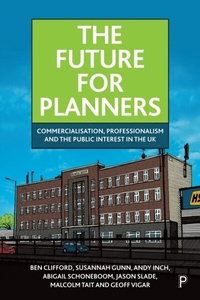
The Future for Planners
Commercialisation, Professionalism and the Public Interest in the UK
1. Auflage
Erschienen am 21. August 2024
276 Seiten
978-1-4473-6605-8 (ISBN)
Beschreibung

Winner of the Royal Town Planning Institute Patsy Healey Award for Academic Excellence 2025.
Spatial planning is at a crossroads, with government reform undermining the traditional vision of state-employed planners making decisions about urban development in a unified public interest. Nearly half of UK planners are now employed in the private sector, with complex inter-relations between the sectors including supplying outsourced services to local authorities struggling with centrally-imposed budget cuts.
Drawing on new empirical data from a major research project, 'Working in the Public Interest', this book reveals what it's like to be a UK planner in the early 21st century, and how the profession can fulfil its potential for the benefit of society and the environment.
Spatial planning is at a crossroads, with government reform undermining the traditional vision of state-employed planners making decisions about urban development in a unified public interest. Nearly half of UK planners are now employed in the private sector, with complex inter-relations between the sectors including supplying outsourced services to local authorities struggling with centrally-imposed budget cuts.
Drawing on new empirical data from a major research project, 'Working in the Public Interest', this book reveals what it's like to be a UK planner in the early 21st century, and how the profession can fulfil its potential for the benefit of society and the environment.
Weitere Details
Auflage
First Edition
Sprache
Englisch
Verlagsort
Bristol
Großbritannien
Verlagsgruppe
Bristol University Press
Zielgruppe
Für Beruf und Forschung
Illustrationen
1 s/w Abbildung, 4 s/w Tabellen
4 Tables, black and white; 1 Illustrations, black and white
ISBN-13
978-1-4473-6605-8 (9781447366058)
DOI
https://doi.org/10.51952/9781447366058
Copyright in bibliographic data and cover images is held by Nielsen Book Services Limited or by the publishers or by their respective licensors: all rights reserved.
Schweitzer Klassifikation
Weitere Ausgaben
Andere Ausgaben
Ben Clifford | Susannah Gunn | Andy Inch
The Future for Planners
Commercialisation, Professionalism and the Public Interest in the UK
Buch
ca. 02/2026
1. Auflage
Policy Press
35,00 €
Noch nicht erschienen
Ben Clifford | Susannah Gunn | Andy Inch
The Future for Planners
Commercialisation, Professionalism and the Public Interest in the UK
Buch
08/2024
1. Auflage
Policy Press
105,50 €
Versand in 15-20 Tagen
Ben Clifford | Susannah Gunn | Andy Inch
The Future for Planners
Commercialisation, Professionalism and the Public Interest in the UK
E-Book
08/2024
1. Auflage
Policy Press
46,99 €
Als Download verfügbar
Personen
Ben Clifford is Professor of Spatial Planning at the Bartlett School of Planning, University College London.
Zan Gunn is Senior Lecturer of Planning at Newcastle University.
Andy Inch is Senior Lecturer of Urban Studies and Planning at the University of Sheffield.
Abigail Schoneboom is Lecturer in Urban Planning at Newcastle University.
Jason Slade is Lecturer in Planning at the University of Sheffield.
Malcolm Tait is Professor of Planning at the University of Sheffield.
Geoff Vigar is Professor of Urban Planning at Newcastle University.
Zan Gunn is Senior Lecturer of Planning at Newcastle University.
Andy Inch is Senior Lecturer of Urban Studies and Planning at the University of Sheffield.
Abigail Schoneboom is Lecturer in Urban Planning at Newcastle University.
Jason Slade is Lecturer in Planning at the University of Sheffield.
Malcolm Tait is Professor of Planning at the University of Sheffield.
Geoff Vigar is Professor of Urban Planning at Newcastle University.
Inhalt
Part 1: Contexts
1. Introduction: The Changing Organisational Contexts for Planning and Why It Matters
2. Public and Private in Postwar British Planning
3. The Public Interest and Planning's Contested Purposes
4. Organisational Settings and Everyday Practices
Part 2: Conditions
5. Privatisation and the Contemporary Landscape of Planning Provision in the UK
6. Commodification and Casualisation: Consultancies and Agency Staff in UK Planning
7. Commercialisation and Planning
8. Twenty-First-Century Planning Work and Workplaces
Part 3: Consequences
9. Professionalism and Planning
10. Realising the Public Interest in Planning?
11. Conclusions: Reorganising the Future of Public Interest Planning?
1. Introduction: The Changing Organisational Contexts for Planning and Why It Matters
2. Public and Private in Postwar British Planning
3. The Public Interest and Planning's Contested Purposes
4. Organisational Settings and Everyday Practices
Part 2: Conditions
5. Privatisation and the Contemporary Landscape of Planning Provision in the UK
6. Commodification and Casualisation: Consultancies and Agency Staff in UK Planning
7. Commercialisation and Planning
8. Twenty-First-Century Planning Work and Workplaces
Part 3: Consequences
9. Professionalism and Planning
10. Realising the Public Interest in Planning?
11. Conclusions: Reorganising the Future of Public Interest Planning?
