

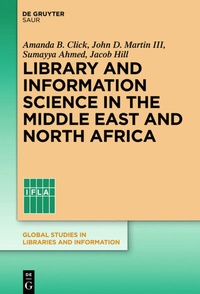
Library and Information Science in the Middle East and North Africa
1. Auflage
Erschienen am 11. Juli 2016
XIII, 355 Seiten
978-3-11-034178-2 (ISBN)
Beschreibung

This volume offers up-to-date insights into the state of library and information science (LIS) in the Middle East and North Africa. Covered topics include information literacy, intellectual property, LIS education and research, publishing and more. This timely contribution thus presents vital areas of research on a region that receives relatively little coverage and is currently experiencing rapid and significant changes.
Weitere Details
Weitere Ausgaben
Andere Ausgaben
Amanda B. Click | Sumayya Ahmed | Jacob Hill
Library and Information Science in the Middle East and North Africa
Buch
07/2016
1. Auflage
De Gruyter Saur
149,95 €
Versand in 7-9 Tagen
Amanda B. Click | Sumayya Ahmed | Jacob Hill
Library and Information Science in the Middle East and North Africa
E-Book
07/2016
1. Auflage
De Gruyter Saur
149,95 €
Als Download verfügbar
Personen
Amanda Click, Sumayya Ahmed, Jacob Hill, John Martin, University of North Carolina, USA.
Inhalt
- Intro
- About IFLA
- Acknowledgements
- Contents
- List of Tables, Figures, and Appendices
- Introduction
- 1. Arab Book Publishing
- 2. For a Morocco that Reads: The Crisis of Reading and Recent Initiatives to Revive Libraries and Reading in Morocco
- 3. A Bird's Eye View of Two Open Access Experiences in Algeria: CERIST's Webreview and Dépôt numérique de l'Université d'Alger I
- 4. Academic Librarianship and Coercion: A Case Study in the Occupied Palestinian Territories
- 5. American-style Academic Libraries in the Gulf Region
- 6. Information Literacy in the Middle East: A Case Study of the American University in Cairo and the American University of Sharjah
- 7. Aligning Library Services to the Emerging Online Capability of Emirati Students
- 8. Correlating Information Centers to Emerging Knowledge-based Economies
- 9. Education for Library and Information Science in the Arab States
- 10. Library and Information Science Research in the Arab World: A Systematic Review 2004-2013
- 11. Addressing Bias in the Cataloging and Classification of Arabic and Islamic Materials: Approaches from Domain Analysis
- 12. Library Collaboration in the Middle East and North Africa
- 13. The State of Manuscript Digitization Projects in Some Egyptian Libraries and Their Challenges
- Contributors
- Index
