

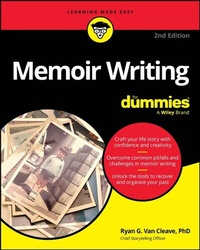
Memoir Writing For Dummies
Beschreibung
Unlock your storytelling journey with expert guidance
Memoir writing isn't just for celebrities and politicians. For anyone prone to self-reflection and ready to give shape to your memories and experiences, Memoir Writing For Dummies is your definitive guide. This book offers a concrete roadmap for writing a captivating memoir. Get advice on exploring your past, mapping out your story, and perfecting your plot, setting, character, and dialogue. You'll also find information on recruiting the help of AI and digital media for a more dynamic storytelling experience. Whether you're an amateur author with a story to tell or a bestselling author trying out a new genre, Memoir Writing For Dummies will guide you every step of the way.
- Gain a deep understanding of the memoir genre and kickstart your journey into autobiographical writing
- Learn how to structure your memoir to grab readers' attention from the first page and keep them engrossed throughout
- Organize your thoughts, address sensitive topics, and seamlessly weave your insights and reactions into your narrative
- Embrace technology to streamline your writing process and share your story with the world
Everyone has a story worth sharing, and Memoir Writing For Dummies provides would-be memoirists with the essential tools they need to share their life stories with the world and become published authors.
Weitere Details
Weitere Ausgaben
Person
Ryan G. Van Cleave, PhD, is a writing coach, keynote speaker, and award-winning author of 40+ books. He runs the creative writing program at the Ringling College of Art and Design and serves as Editor at Bushel & Peck, a children's book publisher. Ryan has taught memoir writing at universities, conferences, and workshops.
Inhalt
Introduction 1
About this Book 1
Foolish Assumptions 3
Icons Used in This Book 3
Beyond the Book 4
Where to Go from Here 4
Part 1: the First Steps to Writing a Memoir 5
Chapter 1: Diving into Memoir Writing: Just the Basics 7
Understanding the DNA of a Memoir 8
Identifying the Essential Parts of a Memoir 9
Making the Necessary Revisions and Edits to Help Your Memoir Shine 10
Focusing on the End Goal: Publication 11
Answering the Key Question: Why Write a Memoir? 14
Chapter 2: Getting Started: What You Need to Know about Writing Your Memoir 17
Exploring Why People Write Memoirs Anyway 18
Granting Yourself Permission to Write a Memoir 25
Focusing on More Than Just Fame and Fortune 27
Tapping into the Vaults of Memory 28
Contemplating the Role of Reading 30
Finding your audience 32
Understanding subgenre 33
Chapter 3: Understanding What Readers Expect: The Story Behind a Good Story 35
Following the Traditional Story 36
Seeing Your Story as a Pyramid 42
Eyeing the Importance of Plot 48
Chapter 4: Researching and Remembering: Gathering Enough Material 49
Tapping into Your Past: Unlocking Your Memories 50
Putting on Your Researcher's Cap: Uncovering Vital Info about Yourself 52
Using Others as a Mirror to See Yourself 57
Sticking to the Truth: Avoid Embellishment 60
Chapter 5: Developing Ideas like the Pros 63
Summoning Your Muse: How to Get Inspired 64
Giving Yourself Some Structure 72
Breaking Past Writer's Block 75
Part 2: Telling Your Story with Pizzazz 79
Chapter 6: Giving Your Story Some Structure 81
Going Chronological 82
Taking a Nonlinear Approach 83
Embracing Episodic Storytelling 84
Sticking with a Thematic Structure: Focus on Connective Threads 87
Recognizing Unconventional Structures 88
Developing an Outline that Works for You 89
Chapter 7: Considering Scenes and Setting 99
Maximizing Scene Power 100
Defining Setting: Where It's All At 106
Creating a Sense of Place 109
Building Atmosphere 111
Chapter 8: The Character of Characters 119
Understanding What Makes a Good Character 120
Identifying Character Archetypes 127
Making Characters Three-Dimensional 130
Ensuring That Characters Evolve 132
Dealing with Minor Characters 136
Chapter 9: Making the Most of Dialogue 139
Managing Memoir Dialogue Differently than Novel Dialogue 140
Recognizing What Good Dialogue Should Do for Your Manuscript 141
Identifying the Four Types of Dialogue 147
Managing the Mechanics 151
Drafting Speech that Sounds Real versus Real Speech 153
Writing Less Is More 155
Considering Accents and Dialect 158
Recognizing Where Dialogue Goes Awry 161
Chapter 10: Maximizing the Power of Voice 165
Grasping Voice: Your Manuscript's Soul 166
Being a Minimalist versus Maximalist 168
Shaping Tone 169
Creating Irony 172
Generating Humor 173
Using (Yes, I Said "Using") Clichés 175
Chapter 11: Handling Point of View 177
Understanding Your Basic Options 177
Recognizing When "I" Isn't "Me" 186
Using More Than One Point of View 187
Creating Narrative Distance 188
Chapter 12: Bold Beginnings, Magnificent Middles, and Fantastic Finishes 191
Going with the Three-Act Structure 192
Beginning with the First Scene: Setting Up Act 1 194
Moving to the Middle Scenes: Making Act 2 Work 197
Ending with the Final Scene: Closing Act 3 201
Part 3: Revising, Editing, and Pushing Your Story to the Next Level. 207
Chapter 13: Making Revisions 209
Differentiating Between Revision and Editing 210
Embracing Rigor and Honesty in Your Revision Process 212
Developing Your Revision Process (and Sticking to It) 213
Navigating with a Road Map: A Nine-Item Checklist 214
Incorporating Three More Advanced Revision Tactics 216
Chapter 14: Adjusting the Big Picture: Fine-Tuning Structure and Story 219
Sizing Up Your Story: Maintaining Proportion 220
Revving Up the Story's Engine: Bring on Conflicts Big and Small 221
Adjusting the Pace 222
Using Transitions Effectively 226
Chapter 15: Saying the Unsayable: Knowing What to Include or Exclude 231
Addressing Painful Memories with Care and Purpose 232
Touching on the Taboo: Family Secrets with the Living 234
Dealing with the Dead: Unclear or Missing Information 235
Looking at the Ethics of a Memoir 236
Navigating Legal Considerations 239
Chapter 16: Streamlining Your Story with Sentence-Level Edits 243
Having a Firm Grasp on Grammar 244
Appeasing Your High School English Teacher: Avoid Wordiness 245
Showing versus Telling 249
Avoiding Amateur Constructions 251
Steering Clear of Common Grammar Issues 253
Maximizing the Active Voice 257
Chapter 17: Getting Outside Help: Critique Groups, Editors, Experts, and Sensitivity Readers 259
Trusting the Feedback Process 260
Joining a Critique Group 260
Finding a Golden Reader 264
Bringing in a Professional Editor 265
Seeking Expert Guidance 270
Part 4: Sharing Your Story: a Publishing Primer 275
Chapter 18: Locating and Landing a Literary Agent 277
Seeing What a Good Literary Agent Can Do for You 278
Finding an Agent Who Meets Your Needs 280
Hooking the Right Agent 283
Making Sense of an Agent Agreement 287
Chapter 19: Making Sense of Traditional Publishing and the Submission Process 293
Researching Publishers 294
Working with a Publisher: The Pros 297
Going with a Publisher: The Cons 300
Crafting a Winning Query Letter 305
Grasping the Power of a Proposal: Think like a Publisher 307
Staying Away from Serious Submission Don'ts 308
Using Subsidy/Vanity Publishers 311
Chapter 20: Going It Alone: Self-Publishing, E-Publishing, and Audiobook Publishing 315
Examining Self-Publishing and E-Publishing 316
Deciding Whether to Self-Publish: The Pros and Cons 319
Expanding Your Reach with Audiobooks and Multimedia Formats 322
Facing the Reality of E-Publishers 324
Researching and Working with Printers 329
Pricing Your Book: Two Philosophies 333
Letting Amazon Distribute Your Book: You Need to Do More 334
Chapter 21: Promoting Your Finished Product (and Yourself) 337
Understanding Marketing versus Publicity 338
Finding Cost-Effective Ways to Promote Your Book 339
Marketing Your Memoir: A Little Monetary Investment Can Pay Off 347
Bringing in Professional Help: Hiring a Freelance Publicist 351
Part 5: the Part of Tens 355
Chapter 22: Ten Myths about Memoirs 357
No One Reads Memoirs 358
You Have to Be a Celebrity to Write One 358
My Family and Friends Remember Things Differently 360
People Will Hate Me If I Include Them 360
I Can't Write an Entire Book 361
I'm Going to Be Rich and Famous 361
My Life Is So (Insert Adjective Here) that It Will Be a Bestseller 362
I Don't Have Any Writing Credentials 362
I've Been Journaling for Years So Writing My Memoir Will Be a Breeze 363
I'll Get to It Later 363
Chapter 23: Ten Reasons Memoirs Are Rejected 365
Insufficient Editing 366
Data Dumping versus Storytelling 366
Lack of Focus 367
Improper/Incomplete Submission Procedure 368
Skips/Avoids the Juiciest, Most Interesting Parts 368
Incredibly Slooooow Pace 369
Lack of a True Emotional Experience 369
Theme Bludgeons the Readers 370
The Story Is Overly (and Unnecessarily) Complicated 370
The Writing Is Merely Competent versus Exciting 371
Index 373
Chapter 1
Diving into Memoir Writing: Just the Basics
IN THIS CHAPTER
Recognizing the characteristics of a memoir
Identifying the elements of a memoir
Crafting and refining your memoir
Getting your memoir published
Understanding your memoir's purpose
Writing a memoir used to be something done only by super-famous celebrities or retirement-home folks - like your great Uncle Fred from Boca Raton. Thanks to an explosion of exciting memoirs written by people of all ages and levels of fame, the memoir as a form has become a viable way for anyone to meaningfully share their story. It makes sense, because there's something incredibly rewarding to finding the leisure time to think, remember, reflect, and then write about your past. In doing so, you can discover the emotional truths that create the undercurrent of your life and share your wisdom with others.
Memoirs and autobiographies remain quite popular with readers, with almost 50 percent of nonfiction books on the New York Times bestsellers list being biographies or memoirs. Plus, memoirs and biographies are the number-one bestselling nonfiction category in hard-copy books on Amazon and come in second in the e-books category behind religion and spirituality. With numbers like that, it's clear that memoirs have a hungry audience, which is good news for you.
This chapter serves as your stepping stone to everything you need to know about writing your memoir. I cover the basics - from defining what a memoir is and how it differs from other types of life writing, to identifying the core components of a successful memoir. You find out how to utilize revision and editing techniques to polish your work and how to incorporate impactful storytelling methods, even in the age of social media. And perhaps most important, you explore your motivations for sharing your story. No matter where you are in the writing process, this book will guide you every step of the way.
Understanding the DNA of a Memoir
The short answer for what makes a memoir a memoir is that like a novel, it tells a story, but unlike a novel, a memoir is 100 percent truthful. But that's an insufficient definition. A memoir also has other obligations that make it unique and distinct from other literary utterances. Understanding those differences is to understand the memoir's strengths. To know those is to know what areas you should play up when writing your own.
To be considered a memoir, your book needs to:
- Be book length. Generally, a memoir is between 60,000 and 100,000 words.
- Limit what's included. A memoir is focused on parts or elements of a life, whereas an autobiography strives to include everything about a life, from birth to death.
- Be truthful. You can't play loose and free with the truth and still be called a memoir. Look up the hubbub around James Frey's A Million Little Pieces (Anchor) or Alice Sebold's Lucky (Scribner) if you want to see the fallout around a memoir that isn't truthful.
- Use the elements of narrative. Fiction writers know how to tell a story and make it interesting. See the next section for more on this.
- Show desire. A story gets interesting when the main character wants something - desperately so. Be specific and clear about what your main character wants, and readers will care.
- Have conflict. If a character can just get what they want, who cares? That's not drama, that's grocery shopping. It's when a character can't get what they desire that things get interesting. Tell that story and you have the makings of a strong memoir.
- Reveal change and growth. Show how your experiences, struggles, and triumphs shape you as a person. Demonstrate the transformation that takes place over the course of your story.
Check out Chapter 2 for more information about the concepts of a memoir in far greater detail.
Identifying the Essential Parts of a Memoir
Like any good work of art, numerous parts comprise a memoir. Getting the best end product comes from knowing and having control over all of those smaller elements. Most of what a memoirist needs are skills borrowed from the world of fiction writing, though those skills are used somewhat differently in the world of nonfiction in general, and memoir specifically. For instance, you can't generate more conflict to heighten reader interest in a chapter if the scene you're writing simply didn't have that level of conflict. You can't reinvent the past to make a better story. With fiction, you can (and should).
Some of the main elements that make up a memoir include
- Structure: This is the shape of your story on the page. You may assume that the structure of your story has to be chronological to move forward in a very specific order like the days in a week, but you have far more options than that and you need to consider those options before defaulting to a chronological approach. See Chapter 6 to discover all of your structure options.
- Setting:Setting is the where and when that a story takes place. A memoir may have 2, 3, or perhaps even 23 different settings if you traveled or moved around a lot. Setting matters because it has a direct influence on character. See Chapter 7 for details on how to create and utilize setting to best effect.
- Characters:Characters are the people who populate the scenes and settings of your story. Yes, they're real-life people, but memoirists still call them characters, as novelists do. For more on why as well as how to make them come alive on the page, visit Chapter 8 .
- Dialogue: The conversations that your characters have are called dialogue. This is a particularly tricky thing to use in memoir because memory is imperfect. Who walks around recording all conversations in order to accurately quote people later? (If you actually do that, be careful - it's illegal in a lot of states.) You can discover more about the challenges and strengths of dialogue use in memoirs in Chapter 9.
- Voice:Voice is the unique manner in which a writer writes. It comes from distinctive decisions, such as word choice, rhythm, and the way a writer says things. Taken together, voice creates a powerful effect on the reader. Interested in knowing more? Chapter 10 covers voice in depth.
- Point of view: The perspective through which the story is seen is called point of view. This in an important choice because it can drastically change how your story is conveyed. Read more about point of view in Chapter 11.
- Theme:Theme is what your memoir is about. It speaks to universal truths, core ideas, and emotional truths through the development of key scenes, moments, and tensions in your story. See more about theme in Chapters 13 and 14.
- Narrator: The narrator is the reflective voice that guides the reader through your story, interpreting the past and revealing the deeper significance of your experiences. Your unique perspective, shaped by time and reflection, transforms your story from a mere recounting of events into a powerful exploration of what it all means.
Making the Necessary Revisions and Edits to Help Your Memoir Shine
A great memoir doesn't appear by magic, but rather it's the result of good revision (to get the big stuff under control) and careful editing (to get the little stuff under control). How often in life do you wish you had a Do Over button? With writing, you do. You get a second, a third, or a tenth chance if you require it, which is good news because you can improve the mistakes and poor decisions that you made earlier in the writing process.
After you have a rough draft of either your entire manuscript or even just a chapter, you can begin the revision process. Revision is important because it is the part of the process where you focus on large story elements without worrying much about specific word choices or sentence-level issues.
While revising, you certainly look over all of the essential parts of a memoir (which I discuss in the previous section) to make sure each is functioning well on its own as well as connecting meaningfully to the entire book. You have another obligation, though. You need to think like a reader, not the writer. You handle revision first because you may revise and remove an entire chapter or scene from a book. You don't need to spend the extra time polishing those sentences that won't appear in the first edition. Stay efficient by revising first and then editing after. Refer to Chapter 13 for more on making revisions.
Editing asks you to reexamine every word choice, reevaluate sentence structure, and think about how you're using paragraphs. Editing is a sentence-by-sentence level of attention that can feel tedious, but it's often the difference between a promising book that gets published or not. Some of the things that occur at this level of editing are adding or improving imagery, cutting clichés, removing most adverbs and adjectives, and tightening language across the board. Refer to Chapter 15 for more on line-by-line editing.
Focusing on the End Goal: Publication
When I was in high...
