

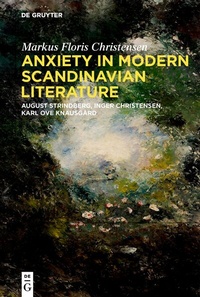
Anxiety in Modern Scandinavian Literature
Beschreibung

This book explores how states and traits of anxiety are reflected in the style and structure of certain works by three key figures of modern Scandinavian literature: August Strindberg, Inger Christensen, Karl Ove Knausgård. On the basis of particular literary analyses, it develops a literary phenomenology of anxiety as well as a hermeneutical theory of anxiety that considers the ways in which anxiety has been represented in various genres of modern Scandinavian literature from the last three centuries. Whereas the former uncovers the ways in which anxiety is reflected in literary form and style, the latter interprets the relationship between author, text, and reader as well as the effects of genre.
As Strindberg's works capture the tensions between existential indeterminism and naturalistic determinism and make way for negative aesthetic pleasure, poetry such as Christensen's challenges scientistic and psychiatric conceptions of anxiety and instigates a change in how humans conduct themselves in relation to the experience of anxiety. Finally, Knausgård's autofictive work gives voice to the socially anxious self of late modernity and incites moments of self-intensification and reorganizes the fragile self of contemporary society.
In this way, it becomes clear that literature is an outstanding archive of representations and transformations in the cultural history of anxiety. Literature is an aesthetic medium of expression and reflection that represents anxiety in a number of ways that may enrich our understanding of anxiety today. This work thus contributes to cultural and literary scholarship that contests the subjugation of anxiety to a scientific world view and aims to expose the imaginative and creative dimensions of anxiety that are often ignored in contemporary public discourse and policy.
Weitere Details
Weitere Ausgaben
Andere Ausgaben
Person
Markus Floris Christensen, Europa-Universität Flensburg/Copenhagen, Denmark.
Inhalt
- Intro
- Acknowledgments, translations, citations, and abbreviations
- Contents
- Introduction. The Literary Significance of Anxiety
- Chapter 1 August Strindberg's Representation of Anxiety: Between Naturalistic Determinism and Existential Indeterminism
- Chapter 2 Inger Christensen's Representation of Anxiety: Existential Anxiety and Poetic Creation
- Chapter 3 Karl Ove Knausgård's Representation of Anxiety: Writing the Fragile Self of Others
- Chapter 4 The Aesthetics of Anxiety
- Conclusion The Gift of Anxiety
- Bibliography
- Index
