

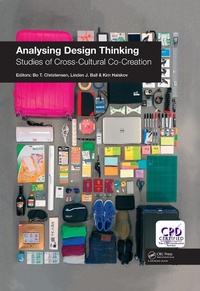
Analysing Design Thinking: Studies of Cross-Cultural Co-Creation
Erschienen am 3. August 2017
600 Seiten
978-1-351-80283-3 (ISBN)
Beschreibung
The scientific analysis of design thinking continues to burgeon and is of considerable interest to academic scholars and design practitioners across many disciplines. This research tradition has generated a growing corpus of studies concerning how designers think during the creation of innovative products, although less focus has been given to analysing how designers think when creating less tangible deliverables such as concepts and user-insights.
Analysing Design Thinking: Studies of Cross-Cultural Co-Creation brings together 28 contributions from internationally-leading academics with a shared interest in design thinking who take a close look at professional designers working on a project that not only involves soft deliverables, but where a central role is played by co-creation across multiple, culturally diverse stakeholders.
This collection of detailed, multi-method analyses gives a unique insight into how a Scandinavian design team tackled a specific design task within the automotive industry over a four-month design process. All papers draw upon a common, video-based dataset and report analyses that link together a diversity of academic disciplines including psychology, anthropology, linguistics, philosophy, architecture, management, engineering and design studies. The dataset affords multiple entry points into the analysis of design thinking, with the selected papers demonstrating the application of a wide range of analytic techniques that generate distinct yet complementary insights. Collectively these papers provide a coherent framework for analysing and interpreting design thinking 'in vivo' through video-based field studies.
Analysing Design Thinking: Studies of Cross-Cultural Co-Creation brings together 28 contributions from internationally-leading academics with a shared interest in design thinking who take a close look at professional designers working on a project that not only involves soft deliverables, but where a central role is played by co-creation across multiple, culturally diverse stakeholders.
This collection of detailed, multi-method analyses gives a unique insight into how a Scandinavian design team tackled a specific design task within the automotive industry over a four-month design process. All papers draw upon a common, video-based dataset and report analyses that link together a diversity of academic disciplines including psychology, anthropology, linguistics, philosophy, architecture, management, engineering and design studies. The dataset affords multiple entry points into the analysis of design thinking, with the selected papers demonstrating the application of a wide range of analytic techniques that generate distinct yet complementary insights. Collectively these papers provide a coherent framework for analysing and interpreting design thinking 'in vivo' through video-based field studies.
Weitere Details
Sprache
Englisch
Verlagsort
London
Großbritannien
Verlagsgruppe
Taylor & Francis Ltd
Zielgruppe
Für höhere Schule und Studium
Für Beruf und Forschung
Dateigröße
9,30 MB
ISBN-13
978-1-351-80283-3 (9781351802833)
Copyright in bibliographic data and cover images is held by Nielsen Book Services Limited or by the publishers or by their respective licensors: all rights reserved.
Schweitzer Klassifikation
Weitere Ausgaben
Personen
Bo Christensen is Professor with special responsibilities in Creative Cognition at Copenhagen Business School, Denmark. His research concerns the study of creativity in various domains including design, innovation, and cuisine, and involves studies of creative cognition, the evaluation of creativity, analogical reasoning, and idea selection in product development. Using video recordings of creative teams at work in their natural environment (both professional designers and non-skilled students) he studies the underlying cognitive processes and mechanisms of creative work. He was twice awarded the Design Studies Award by the Design Research Society for best paper published in Design Studies (co-authored) in 2013 and 2009. He is also an editorial board member of CoDesign, She Ji, and International Journal of Design Creativity and Innovation.
Linden Ball is Professor of Cognitive Psychology at the University of Central Lancashire, UK, where he is also Dean of the School of Psychology. He conducts experimental research on fundamental deductive and inductive reasoning processes as well as naturalistic research examining thinking, problem solving and creativity in design. His research is characterized by the use of a mixed-methods approach that involves a combination of qualitative and quantitative techniques. His most recent published work focuses on the role of metacognition in thinking and reasoning, including the ways in which feelings of uncertainty engender strategic shifts in people's information processing. He is the editor of the Routledge book series entitled Current Issues in Thinking & Reasoning and co-editor of the Routledge International Handbook of Thinking & Reasoning. He is also an Associate Editor for Journal of Cognitive Psychology and Thinking & Reasoning and a member of the editorial boards of CoDesign, Design Studies and She Ji.
Kim Halskov is Professor of Interaction Design at Aarhus University, Denmark, director of Centre for Advanced Visualization and Interaction (CAVI) and co-director of the Centre for Participatory IT at Aarhus University. Kim has a background in participatory design and his research areas include design processes, participatory design, creative processes, and interaction design. Kim is the project manager for the research project CIBIS (Creativity in Blended Interaction Spaces); a project that develops and explores Blended Interaction Spaces seeking to supporting the creative potential of young people at the high school level. The objectives are to demonstrate the potentials of integrating multiple digital devices and physical materials in a shared environment to support individual and collaborative creativity and to develop the theoretical foundation for the study of creativity constraints, design ideas, generative design materials, and creative methods in design processes.
Linden Ball is Professor of Cognitive Psychology at the University of Central Lancashire, UK, where he is also Dean of the School of Psychology. He conducts experimental research on fundamental deductive and inductive reasoning processes as well as naturalistic research examining thinking, problem solving and creativity in design. His research is characterized by the use of a mixed-methods approach that involves a combination of qualitative and quantitative techniques. His most recent published work focuses on the role of metacognition in thinking and reasoning, including the ways in which feelings of uncertainty engender strategic shifts in people's information processing. He is the editor of the Routledge book series entitled Current Issues in Thinking & Reasoning and co-editor of the Routledge International Handbook of Thinking & Reasoning. He is also an Associate Editor for Journal of Cognitive Psychology and Thinking & Reasoning and a member of the editorial boards of CoDesign, Design Studies and She Ji.
Kim Halskov is Professor of Interaction Design at Aarhus University, Denmark, director of Centre for Advanced Visualization and Interaction (CAVI) and co-director of the Centre for Participatory IT at Aarhus University. Kim has a background in participatory design and his research areas include design processes, participatory design, creative processes, and interaction design. Kim is the project manager for the research project CIBIS (Creativity in Blended Interaction Spaces); a project that develops and explores Blended Interaction Spaces seeking to supporting the creative potential of young people at the high school level. The objectives are to demonstrate the potentials of integrating multiple digital devices and physical materials in a shared environment to support individual and collaborative creativity and to develop the theoretical foundation for the study of creativity constraints, design ideas, generative design materials, and creative methods in design processes.
Inhalt
Introduction
1. Designing across Cultures
2. The Role of Tension and Conflict in Design Thinking
3. The Cognitive Aspects of Design Thinking
4. Aspects, Iterations and Co-Evolution in Design Thinking
5. Designing with Users and Co-Creation
6. Bridging Disciplines in Design Thinking Research
Concluding Remarks
1. Designing across Cultures
2. The Role of Tension and Conflict in Design Thinking
3. The Cognitive Aspects of Design Thinking
4. Aspects, Iterations and Co-Evolution in Design Thinking
5. Designing with Users and Co-Creation
6. Bridging Disciplines in Design Thinking Research
Concluding Remarks
