

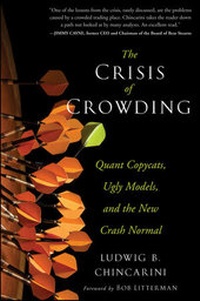
The Crisis of Crowding
Beschreibung

Weitere Details
Weitere Ausgaben
Andere Ausgaben
Person
Inhalt
Foreword
I sat on the risk committee of Goldman Sachs during 2006 and 2007 as the financial markets began to crack and the forces that led the economy into recession and the financial sector into bankruptcy emerged. It was an interesting perspective. I watched as the heads of our trading businesses struggled to deal with one crisis after another. Like generals in battle, our vision of future events was clouded by fog. Liquidity in many markets was significantly reduced. Prices stopped reflecting fundamentals. Opportunities that looked attractive one day suddenly turned into crowded trades and became quicksand for those trapped in them. And most scary of all, the problems in subprime mortgages suddenly popped up in seemingly unrelated venues such as credit and money markets, and then in July 2007 in a large number of unlikely linear combinations of U.S. equities-the so-called quant factors. In the latter case one needed sophisticated computer algorithms to see what was happening.
The firm's instruction to its traders was clear: Stay close to home. In other words, continue to make markets, but don't build up sizable positions. Increase your spreads to reflect market realities, but avoid crowded trades like the plague. With respect to mortgages, in late 2006 and early 2007 there was, as has been documented elsewhere, a growing recognition that the risk of a significant meltdown in prices was rising and the firm needed to liquidate inventory and hedge its remaining positions.
I was lucky. I had a large personal investment in a four-times-leveraged market-neutral quantitative equity hedge fund called "Global Equity Opportunities," run by the business I headed, Quantitative Investment Strategies, a part of Goldman Sachs Asset Management. Although I had a ringside seat, like most investors watching the events unfold, I did not see what was coming. However, when the financial tsunami spilled into and nearly destroyed those invested in quantitative equity portfolios in the first week of August 2007, Goldman Sachs senior management had the financial strength, vision, and crisis management expertise to quickly inject sufficient liquidity into our hedge fund to turn the situation around. Not only our hedge fund, but the entire quantitative equity space rebounded rapidly when news of the Goldman liquidity injection reached the market.
The quantitative equity strategies, a narrow part of the much broader quantitative investment space, had become crowded when the financial crisis began. Although many details are unknowable, my best guess is that the unwinding of quantitative equity portfolios began in one or more multistrategy hedge funds that also had exposure to mortgages, credit, and other already directly impacted strategies. Of course with the benefit of hindsight I wish I had been able to make the connection earlier on between those risk committee warnings about crowded trades and the quantitative business that I was heading. Unfortunately, at the time the admonitions to avoid crowded trades did not seem to apply to our investment strategy, which relied on complex computer algorithms that slowly and continuously adjusted thousands of relatively small individual equity positions in liquid markets around the world. As it turned out, the admonitions did apply; quantitative equity was a crowded space that was, in retrospect, just as dangerous as any crowded trade.
This generalization of the concept of crowded trades is just one of the many lessons from the recent financial crisis that are highlighted in this book by Ludwig Chincarini, an economist I have known for many years. Both an academic and a financial market professional himself, Chincarini uses his economist's perspective and quantitative expertise, as well as many in-depth interviews with academics turned practitioners, to bring insights to events that have stunned investors in recent years.
Many of the lessons highlighted in this book, like the lesson about avoiding a crowded space, are hard to disagree with. In this case the only question is: how does one identify and deftly depart from a crowded space before others do? Other lessons learned, however, are less clear and will require careful consideration in the years ahead. The events covered start with a brief look at the market crash in 1987, and include an in-depth look at the Long-Term Capital Management (LTCM) crisis in 1998, multiple dimensions of the financial crisis of 2007 through 2009 (including the quant meltdown), and recent events such as the flash crash of May 2010 and the Greek debt crisis.
Many of the events described started with a good idea. A crowded trade or space generally grows up around what seems to be a good idea. Portfolio insurance was a dynamic trading strategy developed in the mid-1980s that seemed to be just such a good idea. The strategy used futures to replicate a put option that would protect a portfolio against a significant equity market decline. It was such a good idea that it was successfully marketed to large pension funds by a number of investment advisors. Putting together a portfolio of convergence trades in fixed income, as was carefully crafted on the proprietary trading desks of Salomon Brothers in the early 1980s and later by the hedge fund LTCM, was another good idea. Carefully identifying characteristics of equities that are likely to predict future returns and then using computer algorithms to incorporate those positions into equity portfolios, as was done inside my group at Goldman Sachs, was another seemingly good idea. And by far the biggest example of all, providing incentives to encourage home ownership, especially to those who might not otherwise be able to qualify for a mortgage, was the seemingly good idea embraced by the U.S. government. As we know from history, each of these good ideas ended in disaster.
The path that leads from good idea to disaster is eerily similar in each case. A good idea leads to a successful business model. Others, whom Chincarini calls "copycats," learn how to enter the space, and the business expands successfully. Capital flows into the strategy, leading to even more success for those already there, until at some point the pendulum swings and the music stops. And thus we have the crisis of crowding, copycats, and crashes.
If you want to understand the rise and fall of LTCM, perhaps you might start with interviews of the Nobel laureates who were there. The business of LTCM, according to Robert Merton, quoted at length in this book, was as follows: "We were not faster, smarter, or had necessarily better models than others. We had good stuff, but that wasn't the secret. It was institutional rigidities. We provided a service. With all the rules, regulations, and complexities, it is inevitable that those rules will have unintended consequences which put intermediaries in a bind. If you can loosen the constraints of that rigidity you can get a premium for that. Just like you get paid for cutting someone's lawn." Similar insights are found throughout.
There are, however, some unanswered questions raised by the concerns of Chincarini's book. How, for example, can we identify ahead of time when copycats are turning an investment strategy into a crowded trade or a crowded space? This, of course, is a difficult question that does not have an obvious answer. Chincarini suggests that better risk models would help solve this problem. Risk models, he says, should take crowdedness into account as well as valuation. On this point I'm not sure how it could be done. You might criticize an investor for not recognizing the risk as others pile into his space, or for not pulling back having recognized the risk, but I don't know how you can expect the investor's risk model to identify a crowded trade before the investor does. Similarly, you might expect investors to try to identify cheap assets because they have more room to appreciate, but I don't trust an investor whose risk metrics rely on measures of valuation. As Chincarini recognizes, fundamental valuation goes out the window when investors rush for liquidity. Chincarini raises some interesting arguments on crowding and risk models, and practitioners and academics can debate these ideas since risk management is still evolving and the market events of 2008 showed that these models were not fully reliable.
There are places where Chincarini applies the crowd idea differently. For example, the author puts "crowd behavior" at the center of the flash crash of May 6, 2010, which is the subject of Chapter 17. The flash crash was, no doubt, a very interesting event. Most accounts blame a large trade in the equity futures market, apparently implemented by a poorly designed algorithm that did not respond appropriately as market impact increased over time. According to this version of events, the trade created a shock that led to a whiplike impact in exchange-traded funds (ETFs) and then even more profound price moves in individual equities as liquidity, today largely provided by high-frequency trading algorithms, dried up. Chincarini suspects that the futures market trade may not have been so central to the event and summarizes the cause as follows: "Crowd behavior erased liquidity just when traders needed it the most, and just as the markets saw in the LTCM crisis, the quant crisis, and the subprime crisis." We both agree that an initial order may have triggered confusion in the market space, but Chincarini believes it was the crowded behavior of liquidity providers that ultimately caused liquidity to vanish. It could have been simply that rational actors stepped aside in the midst of uncertainty. Either way, current risk models did not anticipate such...
