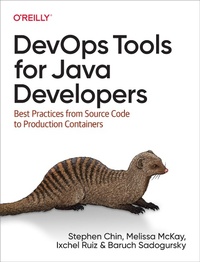
DevOps Tools for Java Developers
Beschreibung

With the rise of DevOps, low-cost cloud computing, and container technologies, the way Java developers approach development today has changed dramatically. This practical guide helps you take advantage of microservices, serverless, and cloud native technologies using the latest DevOps techniques to simplify your build process and create hyperproductive teams.
Stephen Chin, Melissa McKay, Ixchel Ruiz, and Baruch Sadogursky from JFrog help you evaluate an array of options. The list includes source control with Git, build declaration with Maven and Gradle, CI/CD with CircleCI, package management with Artifactory, containerization with Docker and Kubernetes, and much more. Whether you''re building applications with Jakarta EE, Spring Boot, Dropwizard, MicroProfile, Micronaut, or Quarkus, this comprehensive guide has you covered.
- Explore software lifecycle best practices
- Use DevSecOps methodologies to facilitate software development and delivery
- Understand the business value of DevSecOps best practices
- Manage and secure software dependencies
- Develop and deploy applications using containers and cloud native technologies
- Manage and administrate source control repositories and development processes
- Use automation to set up and administer build pipelines
- Identify common deployment patterns and antipatterns
- Maintain and monitor software after deployment
Weitere Details
Weitere Ausgaben
Andere Ausgaben