

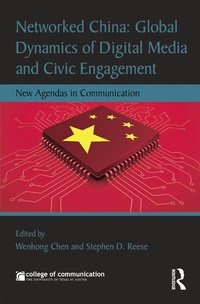
Networked China: Global Dynamics of Digital Media and Civic Engagement
New Agendas in Communication
Erschienen am 8. Mai 2015
256 Seiten
978-1-317-55688-6 (ISBN)
Beschreibung

The Internet and digital media have become conduits and locales where millions of Chinese share information and engage in creative expression and social participation. This book takes a cutting-edge look at the impacts and implications of an increasingly networked China. Eleven chapters cover the terrain of a complex social and political environment, revealing how modern China deals with digital media and issues of censorship, online activism, civic life, and global networks. The authors in this collection come from diverse geographical backgrounds and employ methods including ethnography, interview, survey, and digital trace data to reveal the networks that provide the critical components for civic engagement in Chinese society.
The Chinese state is a changing, multi-faceted entity, as is the Chinese public that interacts with the new landscape of digital media in adaptive and novel ways. Networked China: Global Dynamics of Digital Media and Civic Engagement situates Chinese internet in its complex, generational context to provide a full and dynamic understanding of contemporary digital media use in China. This volume gives readers new agendas for this study and creates vital new signposts on the way for future research.
.
The Chinese state is a changing, multi-faceted entity, as is the Chinese public that interacts with the new landscape of digital media in adaptive and novel ways. Networked China: Global Dynamics of Digital Media and Civic Engagement situates Chinese internet in its complex, generational context to provide a full and dynamic understanding of contemporary digital media use in China. This volume gives readers new agendas for this study and creates vital new signposts on the way for future research.
.
Rezensionen / Stimmen
China is a networked society, where people and organizations maneuver through their relationships. Information flows through complex networks that encompass both mass media and social media. This fascinating book scans wide and digs deep to show how. Barry Wellman, director of NetLab, University of TorontoIt has been twenty years since China joined the unfolding Internet era, and this volume helps to document the remarkable developments of this generation. Twenty years ago, scholars and policy makers were asking if China, with its cautious approach to information and information technologies, would be able to fully embrace the Internet. Ten years ago, those analysts were asking if the network would change China. This volume demonstrates that China has more than embraced the network; it has indeed changed it, and that many of the most important on- and off-ramps of that superhighway are written in Chinese. Randy Kluver, Associate Professor, Texas A&M University
This is, of no doubt, a definite book for Chinese Internet research. The authors have examined cyber-China and its political dynamics from multiple vantage points, using solid quantitative and qualitative data, applying both traditional and the latest digital methods. The result is systematic and comparative, informative and nuanced. Jack Qiu, Associate Professor, Chinese University of Hong Kong China is a networked society, where people and organizations maneuver through their relationships. Information flows through complex networks that encompass both mass media and social media. This fascinating book scans wide and digs deep to show how. Barry Wellman, director of NetLab, University of Toronto
It has been twenty years since China joined the unfolding Internet era, and this volume helps to document the remarkable developments of this generation. Twenty years ago, scholars and policy makers were asking if China, with its cautious approach to information and information technologies, would be able to fully embrace the Internet. Ten years ago, those analysts were asking if the network would change China. This volume demonstrates that China has more than embraced the network; it has indeed changed it, and that many of the most important on- and off-ramps of that superhighway are written in Chinese. Randy Kluver, Associate Professor, Texas A&M University
This is, of no doubt, a definite book for Chinese Internet research. The authors have examined cyber-China and its political dynamics from multiple vantage points, using solid quantitative and qualitative data, applying both traditional and the latest digital methods. The result is systematic and comparative, informative and nuanced. Jack Qiu, Associate Professor, Chinese University of Hong Kong
Weitere Details
Reihe
Sprache
Englisch
Verlagsort
London
Großbritannien
Verlagsgruppe
Taylor & Francis Ltd
Zielgruppe
Für höhere Schule und Studium
Für Beruf und Forschung
Illustrationen
18 s/w Tabellen
18 Tables, black and white
Dateigröße
1,94 MB
ISBN-13
978-1-317-55688-6 (9781317556886)
Copyright in bibliographic data and cover images is held by Nielsen Book Services Limited or by the publishers or by their respective licensors: all rights reserved.
Schweitzer Klassifikation
Weitere Ausgaben
Andere Ausgaben
Wenhong Chen | Stephen D. Reese
Networked China: Global Dynamics of Digital Media and Civic Engagement
New Agendas in Communication
Buch
05/2015
1. Auflage
Routledge
72,90 €
Versand in 10-20 Tagen
Wenhong Chen | Stephen D. Reese
Networked China: Global Dynamics of Digital Media and Civic Engagement
New Agendas in Communication
Buch
05/2015
1. Auflage
Routledge
243,50 €
Versand in 10-20 Tagen
Personen
Wenhong Chen is an assistant professor of media studies at the University of Texas Austin where she studies implications of digital media and communication technologies.
Stephen D. Reese is professor of Journalism and Associate Dean for Academic Affairs for the College of Communication at the University of Texas Austin.
Stephen D. Reese is professor of Journalism and Associate Dean for Academic Affairs for the College of Communication at the University of Texas Austin.
Inhalt
Foreword
Guobin Yang
Preface
Introduction
A New Agenda: Digital Media and Civic Engagement in Networked China
Wenhong Chen and Stephen D. Reese
PART I. Digital Media Technologies and Civic Engagement: Implications, Conditions, and Contradictions
1
Internet Use, Socio-Geographic Context and Citizenship Engagement: A Multilevel Model on the Democratizing Effects of the Internet in China
Baohua Zhou
2
Networked Anti-Corruption: Actors, Styles and Mechanisms
Jia Dai, Fanxu Zeng, and Xin Yu
3
Memetic Engagement as Middle Path Resistance: Contesting Mainland Chinese Immigration and Social Cohesion
Pauline Hope Cheong and Yashu Chen
4
Engaging Government for Environmental Collective Action: Political Implications of ICTs in Rural China
Rong Wang
5
Mobile Activism and Contentious Politics in Contemporary China
Jun Liu
6
Campaigning on Weibo: Independent Candidates' Use of Social Media in Local People's Congress Elections in China
Fei Shen
PART II. Glocalized Media Space: Emergence, Composition, and Function
7
The Unintended Consequences of Deliberative Discourse: A Democratic Attempt for HIV NGOs in China
Samuel Galler
8
The Importance of "Bridges" in the Global News Arena: A Network Study of Bridge Blogs about China
Nan Zheng
9
Online Political Discussion in English and Chinese: The Case of Bo Xilai
Ericka Menchen-Trevino and Yuping Mao
10
Fandom of Foreign Reality TV Shows in the Chinese Cyber Sphere
Weiyu Zhang and Lize Zhang
11
The New Political of Mediated Activism in China: A Critical Review
Elaine Yuan
Guobin Yang
Preface
Introduction
A New Agenda: Digital Media and Civic Engagement in Networked China
Wenhong Chen and Stephen D. Reese
PART I. Digital Media Technologies and Civic Engagement: Implications, Conditions, and Contradictions
1
Internet Use, Socio-Geographic Context and Citizenship Engagement: A Multilevel Model on the Democratizing Effects of the Internet in China
Baohua Zhou
2
Networked Anti-Corruption: Actors, Styles and Mechanisms
Jia Dai, Fanxu Zeng, and Xin Yu
3
Memetic Engagement as Middle Path Resistance: Contesting Mainland Chinese Immigration and Social Cohesion
Pauline Hope Cheong and Yashu Chen
4
Engaging Government for Environmental Collective Action: Political Implications of ICTs in Rural China
Rong Wang
5
Mobile Activism and Contentious Politics in Contemporary China
Jun Liu
6
Campaigning on Weibo: Independent Candidates' Use of Social Media in Local People's Congress Elections in China
Fei Shen
PART II. Glocalized Media Space: Emergence, Composition, and Function
7
The Unintended Consequences of Deliberative Discourse: A Democratic Attempt for HIV NGOs in China
Samuel Galler
8
The Importance of "Bridges" in the Global News Arena: A Network Study of Bridge Blogs about China
Nan Zheng
9
Online Political Discussion in English and Chinese: The Case of Bo Xilai
Ericka Menchen-Trevino and Yuping Mao
10
Fandom of Foreign Reality TV Shows in the Chinese Cyber Sphere
Weiyu Zhang and Lize Zhang
11
The New Political of Mediated Activism in China: A Critical Review
Elaine Yuan
