

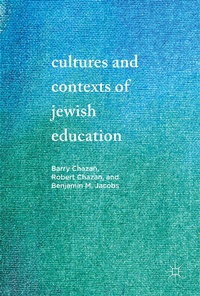
Cultures and Contexts of Jewish Education
Erschienen am 27. März 2017
XXIV, 159 Seiten
978-3-319-51586-1 (ISBN)
Beschreibung
This book examines the history of Jewish education from the Biblical period to the present. It traces how Jews have formally and informally transmitted their culture and worldview over the years, with particular attention to the shift from premodernity to modernity and to the unique opportunities and challenges of contemporary American Jewish education. Its authors combine historical background and insight with educational expertise to provide a robust portrait of the cultures and contexts of Jewish education and address possibilities for the future.
Rezensionen / Stimmen
"I recommend this work as an important and landmark study on the social and political history of Jewish education, particularly in an American context. . it is successful not only in conveying the cultures and contexts of a particularly Jewish education but also, by implication, many of the shared cultures and contexts of religious education in the American context, influenced as it is by the twin realities of religious freedom and the separation of Church and State." (Amy Lindeman Allen, Religious Education, Vol. 114 (5), 2019)"The slim Cultures and Contexts of Jewish Education offers the reader an excellent concise review of Jewish history from the Bible to the present. . All interested in developing richer language and more robust analytic tools for considering the challenges of contemporary Jewish education will benefit from reading this slim book." (Menachem Hecht, Bookjed Digest 164, listserv.biu.ac.il, Vol. 164, 2017)
Weitere Details
Weitere Ausgaben
Personen
Barry Chazan is Professor Emeritus of the Hebrew University of Jerusalem, Israel, and Professor of Education at the Spertus Institute of Jewish Learning and Leadership, USA.
Robert Chazan is S.H. and Helen R. Scheuer Professor of Hebrew and Judaic Studies and in the Skirball Department of Hebrew and Judaic Studies at New York University, USA.Benjamin M. Jacobs is Visiting Associate Professor in the Experiential Education and Jewish Cultural Arts program at The George Washington University, USA.
Inhalt
Chapter 1. Pre-Modern Jewish Education.- Chapter 2. The Crisis of Modernity.- Chapter 3. America: Contexts and Cultures.- Chapter 4. The Culture of American Jewish Schooling.- Chapter 5. The Counterculture of American Jewish Education.- Epilogue.
